
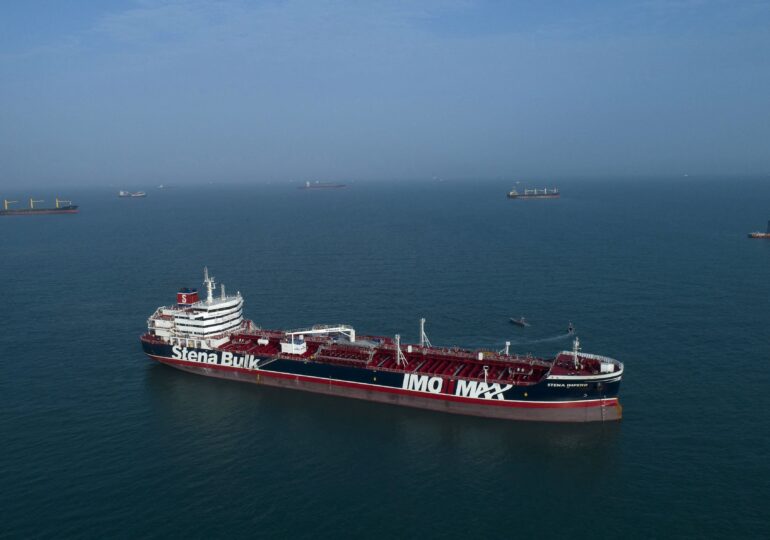
President Trump’s decision to block all Iranian shipments to or from the Strait of Hormuz sets the stage for the next major test in the Iran war: Which side can endure more economic pain, the new leadership in Tehran or Trump?
Almost everything about how this new phase of the war will unfold is likely to look very different from what has transpired so far, according to an analysis in the New York Times.
Instead of directing missiles and bombs at Iran's military sites, missile sites, and defense industry, Trump will attempt to suffocate the country's main source of revenue — oil, which accounts for over 50% of its exports and nearly all government revenues.
The president's first hope, administration officials said on Sunday, is to force the Iranian government to accept the conditions presented by Vice President JD Vance at the peace talks in Islamabad, Pakistan, conditions that Iran has rejected.
List of conditions
The list of conditions begins with Iran's agreement to hand over its entire uranium reserve, permanently dismantle its vast infrastructure for nuclear fuel production, and abandon its claims to regulate traffic in the strait.
If Iran does not capitulate, Trump seems to still hold on to the hope expressed on the first night of the war: that a disgruntled Iranian population will rise up and overthrow the military-clerical regime that has ruled the country since 1979. But achieving such a result is no easier than it was a month and a half ago.
Meanwhile, Iran's strategy seems to be to take the conflict to global markets, where Tehran has discovered new sources of power. Aware that they lost the military confrontation in the first five weeks, but performed beyond expectations in terms of information and intimidation of neighbors through well-targeted missile and drone strikes, the Iranians are betting that Trump's tolerance for political costs is limited.
If Iranian oil does not pass through the strait, prices could continue to rise over time - some companies say they are preparing for $175 per barrel. Iranians understand the potential political effects of persistent inflation in the United States, with less than seven months before the midterm elections, which could drastically change the configuration of Congress to Trump's disadvantage.
"You will soon be nostalgic for $4-5 gasoline," warned Iran's chief negotiator and Parliament President, Mohammad Bagher Ghalibaf, to American consumers after the failed talks he held with Vance over the weekend.
Khamenei's Choice
On Monday morning, with the imminent start of the naval blockade, the markets did not seem particularly panicked: the price of Brent crude oil rose by about 6%, to just over $101 per barrel, but was still below the level before last week's ceasefire declaration.
For his part, Trump is tempering his previous statements that once the fighting stops, fuel prices will drop. He told Fox News on Sunday that prices "should remain about the same" during the midterm elections and could be "slightly higher." This is exactly the fear of many Republican candidates.
This is an unprecedented situation. Like the "quarantine" imposed on Cuba in 1962 by President John F. Kennedy, aimed at preventing the Soviet Union from bringing nuclear weapons to Cuban territory, it is impossible to know in advance how the situation will unfold. Kennedy and his advisers eagerly watched to see if the Soviets would "cross the line" and risk a military confrontation with the US Navy or if they would back down, negotiate, and find a way out to save face.
The then-Soviet leader, Nikita Khrushchev, chose to withdraw.
Now, after the blockade on any ships leaving or heading to Iranian ports has come into effect, we will soon see if the new Ayatollah, Mojtaba Khamenei, and the Islamic Revolutionary Guard Corps will make the same choice. However, without a significant naval fleet, Iran knows it has virtually no chance in a direct confrontation.
Strategy Shift for Trump
For Trump, this represents yet another strategy shift. A few weeks ago, he decided to allow Iran to sell oil already at sea in the hope of alleviating supply shortages. However, the effects on prices were minimal. And Trump seemed to be waging a war without conviction, bombing Iran while allowing it to profit. Moreover, imposing fees for traffic through the strait meant that a new source of income was opening up for Tehran just when it needed it most.
"The current situation, where Iran can deny access through the strait to everyone except its allies or those who pay, is unacceptable," said Richard Haass, a former senior Republican official in national security and former president of the Council on Foreign Relations, who was among the first supporters of the blockade strategy.
"It enriches while others grow poorer," he continued. "A blockade increases economic pressure on Iran, which already existed before the war and has been exacerbated by it. If they want to sell their oil, they must reopen the strait to everyone."
Strategy Test
The test of this strategy could largely depend on the reaction of Iran's largest customers. Haass advocates combining the blockade with a diplomatic strategy to urge China, India, Pakistan, and Turkey - all significant clients of Iran - to exert pressure on the country to accept US demands and resume the flow of oil. However, it is not clear if they will do so, especially if China sees a long-term opportunity to benefit from the confrontation.
Haass also said that "we should combine the threat or reality of a blockade with a proposal to establish a new governance authority for the strait, which includes Iran," thus giving it a voice - but not control - over the administration of this waterway.
It could work. But there is also the possibility that Iran's reaction will be to resume attacks on the energy infrastructure in the United Arab Emirates, Kuwait, and possibly even Saudi Arabia. In such a scenario, Iran would essentially convey that if it cannot export its oil, neither can its Arab neighbors.
Confusion
As in many other aspects of this war, on Sunday there was confusion about what, exactly, is subject to the blockade. Trump's initial post on social media declared a "complete" blockade on all traffic entering and leaving the strait.
However, according to a statement issued by the US Central Command and later by Trump himself, the blockade only applies to ships going to or coming from Iranian ports. Goods from other Gulf states will be able to pass, assuming they are willing to take the risk of hitting mines or being attacked by Iranian fast boats or drones. It was also not clear how the United States would determine which ships have paid fees to Iran.
The strait has been closed in the past, of course, but history does not offer many benchmarks that fit the current situation.
As Haass and historians Niall Ferguson and Philip Zelikow noted in The Free Press last week, the Portuguese were the first to take control of the strait 519 years ago and imposed tolls. They were later ousted by Persian and British forces. Half a millennium later, the Portuguese and the British made it clear that attacking Iran, even in the name of preventing its nuclear weaponization, was an ill-advised decision.
In the early 1950s, Britain blocked the strait after then-Iranian Prime Minister Mohammad Mossadegh nationalized the country's oil industry. He was overthrown in a coup partly supported by the CIA - a covert intervention that Iranians still feel today and that history has not looked kindly upon.
There were also episodic disruptions during the Iran-Iraq War in the 1980s.
However, none of these experiences represent a close analogy to the complex confrontation unfolding now. If the blockade is short-lived and ends Iran's ability to economically blackmail the global economy, Trump's gamble may appear as a shrewd move to turn the tide. And if the Iranian leadership gives in to its demands, it could confirm Trump's conclusion that the new leadership is more "rational" than the previous one.
But if the blockade persists, Trump risks once again appearing unprepared for the consequences, failing to anticipate what could go wrong after an attack on a seemingly weakened Iran. The war he thought would last only a few days has already entered its seventh week. And for the global economy, the hard part is far from over.