
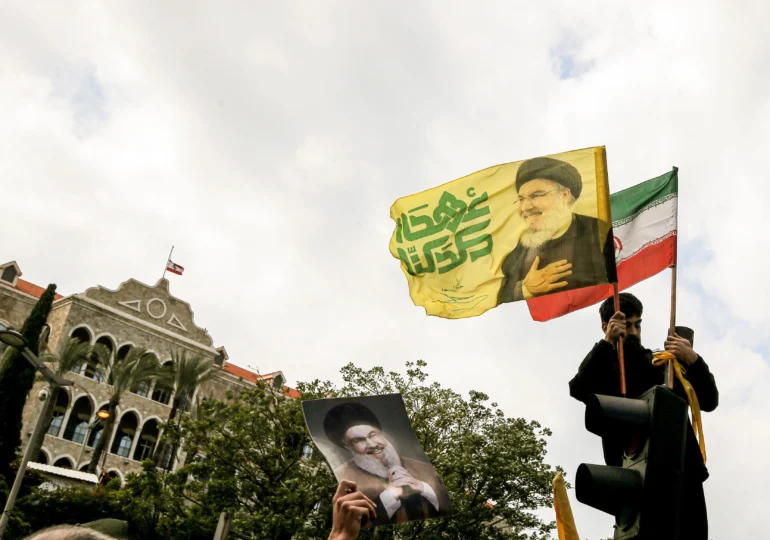
Hezbollah continues to finance its operations despite sanctions and Israeli military strikes.
The money mainly comes from Iran, but also from a complex network involving China, Turkey, the United Arab Emirates, and even Western Europe, as shown in a report by Western intelligence services consulted by Euractiv.
Amid the war in Lebanon, Western agencies are trying to block these financial flows. The military wing of Hezbollah is considered a terrorist organization by the European Union, and some member states have completely banned the group.
Israel Underestimated Hezbollah
Israel recently acknowledged underestimating Hezbollah's combat capabilities. Despite the organization being heavily hit since 2024, it continues to launch rockets at northern Israel.
An essential factor is the constant funding. Analysts estimate that Hezbollah needs about $50 million monthly. The amounts cover not only military equipment and combatants' salaries but also a vast social support network for the families of those killed or injured.
Iran, the Main Financier: Nearly One Billion Dollars in a Year
The majority of the money comes from Iran. According to the report, Hezbollah has received nearly $1 billion from this source since 2025.
"Most of Iran's budget comes from Iranian state revenues and security forces generated from oil sales, mainly to China, and is transferred back through shadow banking mechanisms designed to bypass sanctions," analysts explain the mechanism.
In addition to these funds, the group receives money from donations from sympathizers in Lebanon and the diaspora, as well as from local businesses, including the oil sector and gold trading.
Money through China, Front Companies, and Exchange Houses
The financial network described by Western services is extensive and sophisticated. Tens of millions of dollars reach Lebanon from China through front companies in Hong Kong, the United Arab Emirates, and Turkey.
The funds are then transferred to Hezbollah by Lebanese businessmen, using exchange houses and informal hawala networks.
A central figure is a businessman identified as Hassan K., who is said to have transferred hundreds of millions of dollars to Hezbollah through an exchange house in Turkey. He reportedly uses couriers who transport cash by air and land routes through Syria to move the money.
Syria Remains an Important Link, Despite Repression
Although the new Syrian authorities have launched a campaign against Hezbollah after the fall of the Assad regime, some financial channels continue to operate through Syria.
According to the report, a Syrian company supports the transfers with the help of the central bank. At the same time, Damascus authorities claim to have recently thwarted a Hezbollah plot targeting a rabbi in the capital.
Sanctioned Financiers Continue to Operate
Among the key actors is Mohamad Noureddine, designated by the US Treasury since 2016 for supporting Hezbollah. Although arrested in France for money laundering, he was later released and returned to Lebanon.
According to analysts, he continues to provide financial services to the group, collaborating with an exchange house in Syria.
Other intermediaries include exchange house operators and smuggling networks dealing with gold and cash, some of which have recently been targeted by authorities in Turkey and the United Arab Emirates.
Links to Drug Trafficking and Contacts with European Diplomats
A key figure in Iran is Abdallah Saifeddine, considered responsible for fundraising for Hezbollah, including from drug trafficking in South America, the US, and Europe.
Surprisingly, he also had contacts with European diplomats. In 2016, he met with the German Ambassador to Iran and maintained ties with representatives of some EU states.
The report further indicates that Saifeddine manages Hezbollah's financial relationships with China, including direct contacts with the central bank of that country.
Hezbollah Bank in Lebanon, Major Obstacle to Economy
In Lebanon, Hezbollah operates its own financial institution, Al-Qard al-Hassan, since 2007. It combines funds from Iran with customer deposits, mainly from Shiites in Lebanon and the diaspora.
The system is used for paying salaries and financing military operations.
"The mere fact that AQAH (Al-Qard al-Hassan Association, a kind of Hezbollah's 'parallel bank' offering interest-free loans according to Islamic principles) continues to operate severely affects the Lebanese state and its reputation. It hinders the country's financial system from recovering and building a viable and efficient framework," warns the report.
The institution is considered a major obstacle to removing Lebanon from the international financial monitoring body's "grey list" and obtaining the necessary funds for reconstruction.
However, Lebanese authorities are currently avoiding closing it down or officially declaring it illegal.
G.P.