
More and more women in Russia are marrying soldiers who are deployed to the front lines in an attempt to secure the compensation provided by the state in case of death.
When Russian soldier Sergei Khandojko got married the day after enlisting in October 2023, his family and friends were puzzled. The 40-year-old man had never mentioned anything about a bride.
The wedding ceremony added to the confusion: within just 20 minutes, everything was done, without photos or rings, and with only one guest. But the oddities continued: after the wedding, the new wife continued to live with her former husband and their children, according to testimonies and a court decision consulted by Wall Street Journal.
Alarm bells started ringing after Khandojko died from injuries sustained on the front lines in Ukraine, and his bride received the sum granted to each close relative of a fallen soldier, as stated by the soldier's sister-in-law in an interview. The payment, totaling $200,000, is nearly 20 times the average annual salary in Russia.
A civil court judge ruled earlier this year that Khandojko's bride, Elena Sokolova, deceived him into marrying her in order to take over his inheritance. The marriage was annulled, and she had to pay a fine of 3,000 rubles, equivalent to $37. The decision is not final, and Sokolova has appealed the court's ruling.
Kremlin's Money Attracts Soldiers, But Also "Black Widows"
The "hunt" for Russian soldiers for financial gain has become so widespread in Russia that people have started labeling women who engage in this practice as "black widows."
Courts dealing with such cases try to determine whether they are dealing with genuine marriages or if women have the sole purpose of financial gain upon their husband's death.
Russian lawmakers have proposed laws that would impose harsher penalties on those behind such acts or limit the benefits they can receive after marrying a soldier, as reported by the American newspaper.
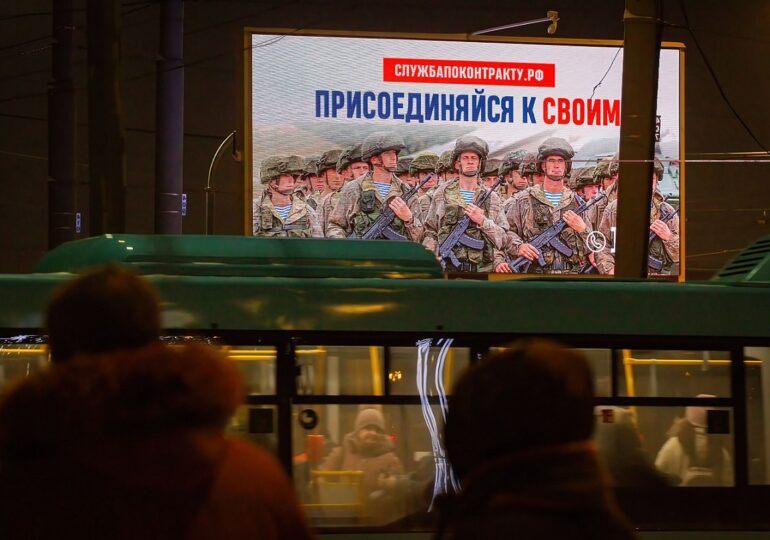
The phenomenon has been partly fueled by the substantial payments that the Russian state has offered to attract men to risk their lives in its brutal war with Ukraine. Benefits include high salaries and enrollment bonuses, as well as substantial payments to the families of those who die on the front lines.
Payments to the families of deceased soldiers often exceed 14.5 million rubles, or $180,000, depending on rank and circumstances.
These funds have flooded the impoverished regions of Russia, from which many soldiers on the front lines come, sparking disputes among relatives over incomes and attracting those seeking easy gains.
It has not been uncommon for estranged fathers to reappear, claiming a share of the death benefit, according to court documents reviewed by WSJ. Grandparents have also requested money as compensation for years spent caring for a grandchild taken to battle.
However, Russian officials say schemes in which women, either alone or as part of an organized group, persuade soldiers to marry before going to war - hoping to benefit from their death in battle - are particularly harmful.
"These monsters have chosen to dishonor the most sacred thing - taking care of the families of fallen heroes!" said parliamentarian Leonid Slutsky this summer. He compared the women involved to looters during the siege of Leningrad in World War II.
Online Networks and Criminal Groups
Russian legal experts say that the true extent of the problem is hard to determine. The American newspaper identified six cases from Russian courts where it was alleged or concluded that soldiers' money was obtained through false marriages at the expense of family members.
Social networks facilitate the finding of soldiers by potential scammers. On the Russian platform VK, there are dozens of groups specifically designed for women seeking potential husbands fighting in Ukraine - with names like "Meetings with Soldiers" and "Meetings with Shoulder Braids," a euphemism for someone in uniform.
Russian authorities say that some of these scams involve criminal groups - sometimes attempting to trap multiple soldiers simultaneously.
A group operating in the central Russian region of Khanty-Mansiysk sought unmarried men and persuaded them to sign military service contracts, according to the Investigative Committee of the region. The group then arranged false marriages for them and convinced them to hand over control of their money, the Investigative Committee stated.
The number of soldiers caught in this scheme, which generated around 30 million rubles, or $370,000, and was prosecuted under organized crime laws, has not been disclosed.
An Efficient "Business Plan"
Some Russian lawmakers have called for criminal penalties for individuals entering into a fake marriage with a soldier to receive state benefits.
A bill aims to reject divorced wives' right to a portion of the payments awarded for the former spouse if the couple married after the start of the war.
In April, a Siberian court ruled that a real estate agent was guilty of inciting hatred after urging women to marry soldiers for "selfish reasons." Marina Orlova spoke on a podcast about women trying to buy houses with large sums of money obtained from inheritances of soldiers killed in battle.
"It's very easy. Find a guy who's on the front lines, and when he dies, you get eight million. It's a business plan," Orlova said on the podcast.
A Lesson for Russian Society
Some of the cases analyzed by WSJ involved complicated family disputes over payments awarded for soldiers killed in war.
Last August, Angelina Variukina married soldier Georgy Kostirko, 27, in a city southeast of Moscow. The couple, who met on social networks, lived together for 11 days before the soldier returned to war, according to court documents.
Kostirko filed for divorce a few months later, and in February, a Russian judge annulled the marriage, allowing a month for appealing the decision. However, two weeks later, Kostirko was killed in battles in the Russian region of Kursk, and the day after, Variukina filed an appeal to annul the marriage, said the soldier's mother, Olga Kostirko, to the Russian TV station NTV.
Variukhina thus became the beneficiary of the soldier's death compensation, as indicated by Andranik Grigorian, the lawyer representing the Kostirko family. The soldier's mother then sued her former daughter-in-law, claiming that she had been unfaithful to Kostirko during their brief marriage and was now seeking to profit from her son's death.
During the trial, Variukhina posted on Instagram videos of her and her ex-husband joking in an apartment, dressed in funny costumes. "Does anyone doubt that we are a good match?" she wrote in a post in April, a month after Kostirko's death. She stated that she needed money to cover the debts Kostirko had burdened his family with.
The lawyer representing the soldier's family said that this case was a lesson for Russian society and for the increasing number of war veterans being put on a pedestal. "Her attempt to profit from her deceased husband's blood is not only immoral but pure betrayal," he said.
T.D.