

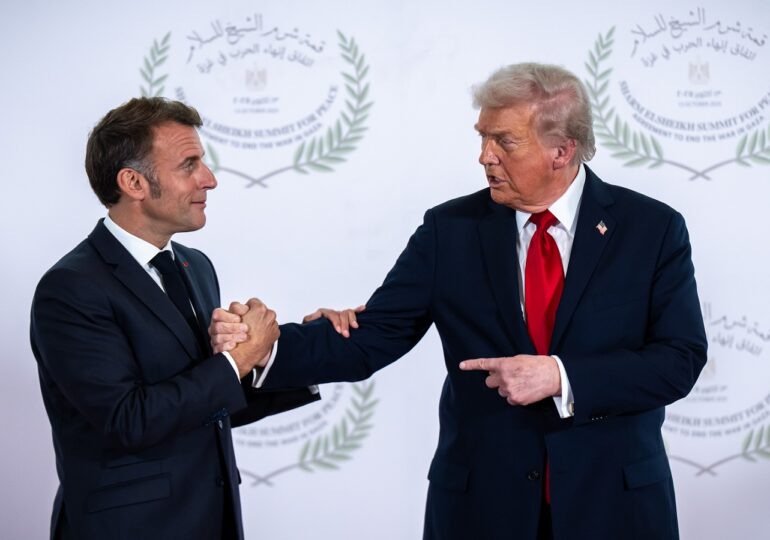
The leaders of France and Canada are responding to the American president in kind. But is it a good idea to engage in a direct confrontation with the US president?
Earlier this year, US Treasury Secretary Scott Bessent offered Western allies a paternalistic advice at Davos, as they were tired of being ridiculed and provoked by President Donald Trump and his advisors: „Stay put, take a deep breath, don’t retaliate,” he told them. „Let things evolve.”
His statements mainly concerned tariffs, but at the meeting in the Swiss Alps, Bessent and other members of the Trump administration repeated the same advice on almost all issues related to the American president. In general, leaders of allied states with Washington took heed of the warning, even though they struggled to hide their indignation over Trump's threats regarding the invasion of Greenland, writes Politico.
For Gavin Newsom, the governor of California who frequently criticizes Trump and was also at Davos, it was all too much. The world leaders present at the meeting are "pathetic," he said. "I can no longer stand this complicity of people being trampled. I should have brought a bunch of kneepads for all the world leaders."
Since then, however, things have changed — especially for Canadian Prime Minister Mark Carney and French President Emmanuel Macron, who in recent weeks have responded to Trump in kind. Amid escalating trade tensions and divergences with the White House on Russia, the two have not hesitated to escalate the confrontation when attacked, sometimes even provoking Trump without him having attacked them immediately before.
Carney and Macron have become "leaders of resistance," says Rohinton Medhora, a Canadian economist and professor at McGill University, who described Carney's evolving political vision as "values-based realism."
"They tried to flatter him. They tried to ignore him. Nothing worked, and now they have nothing to lose by these mutual provocations," Medhora added.
Carney told Trump that he should "stop with the memes, the sarcasm, and the attempts to pose as tough," but this did not stop him from publicly mocking the American president.
The Canadian Prime Minister teased Trump after he claimed it was "sabotage" when his teleprompter malfunctioned during a speech last year at the United Nations. When faced with a similar technical issue in Toronto, Carney dryly stated: "I would like to inform you now that the teleprompter has stopped working. Unlike a certain world leader, I do not believe it is a conspiracy."
In Ottawa, Carney garnered both applause and laughter by mimicking Trump's characteristic hand gestures, resembling an "accordion."
So, what is happening? Are there risks in provoking the "bear"?
According to Steve Bannon, former White House strategist and current MAGA influencer and podcaster, there are indeed such risks. "They are playing with fire," he told Politico. "They are completely dependent on us for trade." Bannon also issued a grim warning regarding the "movement for the secession of the province of Alberta, which is gaining momentum" - Bannon and other MAGA figures have encouraged the oil-rich Canadian province to break away from Canada.
Bannon also cited the recent agreement between Trump and Denmark and Greenland as an example of US power and Washington's ability to get what it wants. "Our agreement on Greenland shows the reality of Canada's inability to defend itself from becoming the next Ukraine - this time in the Arctic," he said.
However, Ivo Daalder, former US ambassador to NATO, draws a different conclusion from the Greenland agreement, which extends a previous 1951 agreement and does not give Trump control over the island, as the American president would have liked. According to Daalder, the agreement shows that when allies stand their ground, the US president backs down. "Through this agreement, Trump literally gained nothing," he told Politico.
"I think what is happening is that allies are starting to understand how to approach him," Daalder said.
It is not surprising that Macron has been quicker than other Western leaders to provoke Trump, Daalder states. "He is French, after all." Even during Trump's first term, Macron was willing to engage in a direct confrontation with the American president, gripping his hand so tightly during a meeting that their wrists turned white and refusing to let go even when Trump tried to pull away.
However, Macron's tone seems harsher now, and his actions are even more decisive. Daalder points to how Macron managed, in June, to persuade Trump to sign an agreement with Iran at Versailles — a palace famous for the treaty that ended one world war but later contributed to the outbreak of another. Trump's critics hailed Macron's action as a spectacular form of diplomatic "trolling."
What categories of the public are these two leaders trying to reach and whom do they seek to influence? "That's a good question," says Medhora. "Clearly not Americans." Undoubtedly, there is also an internal component, as both leaders gain political capital by presenting themselves as those who stand up to a man they describe as an aggressor.
However, Medhora believes that their attitude probably has a broader and more strategic component. "By doing these things publicly, they encourage other leaders to overcome their hesitations and join them," he says. "And if others join them, then everyone is stronger in the anti-Trump camp."
But this strategy will only work if their actions have real consequences — and there is always the risk that things could backfire.
Perhaps, in the conditions where Trump could face a setback in the US midterm elections, Carney and Macron would do well to follow Bessent's advice and let things evolve. The American leader could face new constraints after the elections, amid a stronger Democratic opposition. However, for now, both seem to be having too much fun provoking the "bear" to do so.