
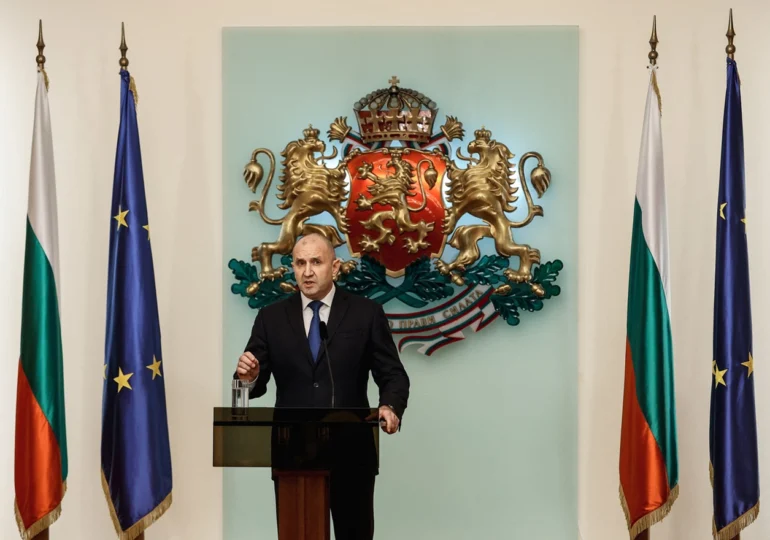
The former president and commander of the Bulgarian Air Force, Rumen Radev, is on the verge of winning Sunday’s general elections. He promises to combat the omnipresent „mafia state” that he accuses of undermining the poorest country in the EU. He faces a very tough mission.
Shaken by incessant political crises and weakened by fragile coalitions, the Balkan nation with 6.7 million inhabitants is on the brink of becoming ungovernable. It has had seven prime ministers since 2021 – none of them completing a full term – and this weekend’s vote will be the eighth election in five years.
However, it is unclear whether Radev, a former MiG-29 fighter jet pilot, a skeptic regarding support for Ukraine and Bulgaria's accession to the eurozone this year, will be able to overcome this political deadlock, writes Politico.
According to a poll conducted by this publication, his new movement, Progressive Bulgaria, will win only 31% of the votes, which means he will face the same difficulties as his predecessors in building a stable governing coalition.
A leap from president to prime minister?
Radev used his flying skills to build his political brand.
Before running for president in the 2016 elections, the public relations department of the air force heavily promoted the daring loops he performed in a large-scale air show.

Similarly, in this year's general elections, a campaign video showed him in the cockpit of his MiG-29, in a vertical takeoff. "Incredible power," he exclaims in the battle with the G-forces.
After taking office in 2017, Radev quickly compensated for his lack of political experience by leveraging his military background to cultivate the persona of a fearless patriot untainted by party politics. As a former general, he also cites his military education in his assessments of why he believes Ukraine should make peace with Russia.
His major success came in 2020, amidst a major political storm regarding the influence of oligarchs over prosecutors. It was a battle that sparked major street protests during the summer and helped Radev establish himself as the country's most popular politician.
Prosecutors searched the presidential offices and briefly detained two of Radev's employees, boosting his credibility as a fighter against state capture. As public anger grew, he went out to greet the crowd on a summer evening, raising his clenched fist, denouncing corruption, and demanding the "mafia" to leave the government.
The fight against corruption is at the center of this year's campaign, and Radev's defining electoral promise has been the "overthrow of the oligarchy," notes the cited publication.
"The oligarchy is deeply rooted in the country's social and economic life. It is a pyramid scheme that systematically drains society, while ensuring impunity through control of institutions, parties, elections, media, and business," he said last month.
"If this model is not dismantled, any form of governance is doomed to fail," he told supporters in Sofia.
This battle will pit him against powerful adversaries. His main political opponents are Bulgaria's two heavyweights - former Prime Minister Boiko Borisov and Delian Peevski, the leader of the DPS-New Beginning party. Opposition politicians accuse both of being key players in the country's oligarchic deep state - an accusation they reject.
Who are Radev's supporters
Despite years of speculation that he might run for prime minister, Radev only unveiled his Progressive Bulgaria project in March.
While Radev does not officially lead Progressive Bulgaria, he is undoubtedly its face. The movement presents a diverse group of politicians close to him or who have switched their loyalty, including military personalities, newcomers, and former sports figures. Only six women lead party lists in the country's 31 electoral districts.
"His face is everywhere, which is probably what matters because no one else is recognized," said Dimităr Bechev, a senior researcher at Carnegie Europe.
Progressive Bulgaria has attracted an eclectic range of supporters, notes Politico. Polls show that it has also attracted some supporters of the far-right pro-Russian party Renaissance. Ahmed Dogan, the founder of the ethnic Turkish party DPS and now a major rival to Peevski, has also expressed support. And VMRO, a smaller nationalist group, has officially supported Radev's party.
Radev's strategy: Speak rarely and vaguely
However, the party's program offers few specific details, and Radev has not clearly positioned Progressive Bulgaria on the political spectrum. His economic policies, for example, bear the imprint of both left-wing and right-wing platforms.
In recent weeks, Radev has campaigned across the country. His social media team has posted images and videos of packed halls and applauding spectators. But so far, he has only granted two interviews during the campaign - one for the country's public radio and television station and the other for a popular YouTube channel with a history of spreading disinformation and pro-Russian arguments. His press team declined an interview for Politico.
Bechev sees strategic silence. "He keeps his cards close to his chest," he said.
Boriana Dimitrova, managing partner at the Sofia-based polling agency Alpha Research, added: "His strategy is to keep his statements as vague and unclear as possible to allow voters to hear whatever they want to hear from him... He casts a wide political net, trying to attract voters from both the left and right of the political spectrum. He tries to collaborate with everyone."
Anti-Ukraine discourse
This approach could bring votes to Radev on Sunday, but Dimitrova warned that it could backfire once Radev takes power. She called him "a paradoxical figure" - more polarizing than unifying as president and, as a potential prime minister, "an omnivore, with little clarity regarding his principles or the solutions he offers."
Although Radev toned down his pro-Russian rhetoric during the campaign, his opinions have surfaced on several occasions, including on Bulgaria's need for cheap Russian oil.
When the current interim government decided at the end of March to sign a 10-year cooperation agreement with Ukraine, Radev strongly criticized it, accusing the cabinet of "dragging us into war."
An "electoral tsunami" ahead?
Dimitrova mentioned that Radev had anticipated an "electoral tsunami," and his allies had talked about winning at least 120 out of 240 parliamentary seats. However, polls now suggest a more modest outcome. "He fails to garner the support he expected from himself and those around him," she said.
The more complicated question is what happens if he fails to secure a majority.
The reformist coalition formed by We Continue the Change and Democratic Bulgaria seems a natural partner on the anti-corruption front. However, they have clashed in the past with Radev's camp over the war in Ukraine, and Radev's pro-Russian rhetoric could prove unpleasant for their supporters.
A sudden turn towards Moscow would also fracture any coalition and antagonize Bulgaria's partners in the EU and NATO. "It's not a winning move," Bechev said.
If a coalition with pro-Western parties materializes, Bechev expects Radev to find it easier to stay silent on Ukraine and let his coalition allies speak about Russia policy.
Dimitrova raised another possibility: "He might try to build a minority government, attempting to create different alliances on different issues. However, this requires considerable political acumen," she said. "We'll see if he has it."
A "movie" Bulgaria has seen before
This raises the deeper question of whether he has the skills required for the job. "Being president is a very different job description from being the leader of the largest party and engaging in making deals with other parties," Bechev said. "We haven't seen him in action. We don't know how he operates, what he is capable of, what his limits are."
If Radev fails to form a government, the cost will be steep. Political analysts warn that his savior aura could quickly fade. "The prospect of another snap election will likely weaken Radev's position," Dimitrova said.
Bechev agreed, warning that Radev "will no longer have the outsider aura."
Bulgaria has seen this "movie" before: The savior arrives, fails to govern, and soon loses the newcomer's advantage that made him seem unstoppable. Radev knows better than most what happens when the engines of a plane stop during flight, concludes the publication.
T.D.