

An injection of muscle cells could bring some of the benefits of physical exercise to people who cannot move, such as bedridden patients. Chinese researchers have created muscle grafts that contract on their own and have obtained promising results in tests on mice.
The so-called „myografts” improved muscle mass, bone density, and physical endurance in animals. Positive effects were also observed on the liver, metabolism, and cognitive function.
The method has not yet been tested on humans, and researchers warn that its safety and long-term effects need to be established through clinical studies, writes South China Morning Post.
The results were published in the scientific journal Nature Ageing.
How Were the Muscles That Contract Themselves Created
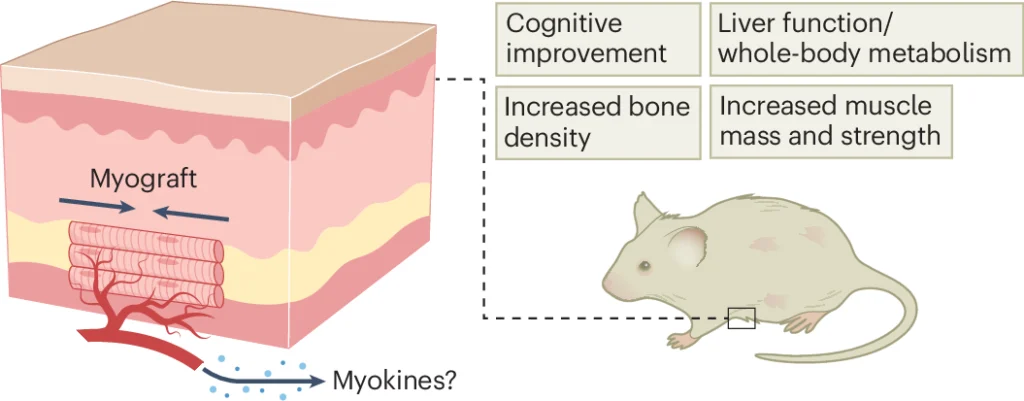
Researchers injected myocytes, specialized cells that form muscle tissue, obtained from muscle stem cells, under the skin of mice. These were introduced along with a gel that provided the necessary supporting structure.
Once under the skin, the cells organized themselves and formed mature muscle tissue. The resulting grafts began to contract spontaneously and continued to do so in the long term, without receiving signals from nerves and without the animals making any effort.
Researchers had initially attempted to transplant miniaturized muscles grown in the laboratory. However, those structures were too large, and nutrients could not reach all cells, leading to cell death.
The solution was to simplify the procedure: cells were injected separately and left to gradually form muscle tissue directly in the body.
They Contract Non-stop and Release Beneficial Substances
Myografts not only increase the amount of muscle tissue. Through their permanent contractions, they release proteins and other substances into the blood that can influence the entire body.
During physical exercises, skeletal muscles secrete hundreds of types of proteins. These contribute to the beneficial effects of movement on bones, liver, metabolism, and brain, and can slow down the loss of muscle and bone mass associated with aging.
"They contract non-stop, 24 hours a day, seven days a week, so they continuously release beneficial factors into the blood," explained Ng Shyh-Chang, professor and lead researcher at the Institute of Zoology of the Chinese Academy of Sciences.
"The huge amount of beneficial factors they secrete exceeds what can be achieved through a single hour of intense physical exercise," added the researcher.
Another advantage could be the age of the muscle fibers. Being young and still immature, they could produce higher concentrations of beneficial substances than mature muscles.
Over time, the grafts matured and connected to the surrounding blood vessels. They remained stable and did not develop tumor-like formations.
What Results Did the Researchers Obtain
Myografts were tested on aged and obese mice. Researchers observed an increase in muscle mass throughout the body, not just in the area where the cells were injected.
The animals showed better results in strength and mobility tests. At the same time, the grafts improved several age-related issues:
- muscle atrophy;
- loss of bone density;
- chronic inflammation;
- liver impairment;
- metabolic disorders.
Improvements were also observed in terms of physical endurance and cognitive health.
Researchers are now trying to precisely identify the substances secreted by myografts and determine to what extent the continuous contractions are responsible for the effects obtained.
Who Could Benefit from Them
The technology is primarily designed for people who need movement but cannot do it: bedridden patients, people in intensive care, or those with age-related conditions such as osteoporosis and Alzheimer's.
"The people who need exercise the most are also the ones who find it hardest to do," Ng said.
Myografts could help these patients regain some strength and reach a state that would later allow them to move on their own.
Researchers have also discovered that the grafts could function as a living "biofactory." They could be modified to produce certain proteins used in treatments inside the body, including compounds like GLP-1, used against diabetes and for weight loss.
In the future, theoretically, the technology could also be used by healthy individuals who want to develop their muscles without going to the gym. However, this possibility remains distant.
Human Trials, the Next Step
So far, researchers have not observed signs of toxicity or negative effects caused by continuous contractions. However, this does not prove that the method is safe for humans.
"Although the complete safety and pharmacological profile of myografts need to be established in clinical studies on humans, our preclinical research on mice represents an important first step in this direction," the study's authors state.
The team is considering starting tests on patients in intensive care. If safety and efficacy are confirmed, the research could be extended to other categories of patients.
In the case of mice, the grafts were placed near the skin surface for easy monitoring. In humans, where the skin is thicker, the injection site would be chosen so that the graft's contractions are not visible.
G.P.