
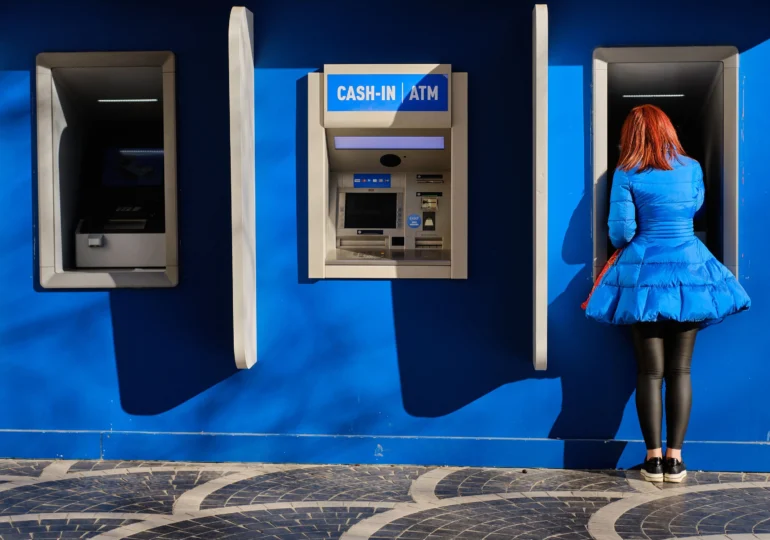
Russians are withdrawing more and more money from banks amid fears that the state could end up seizing the population’s savings and companies’ assets to finance the war in Ukraine.
In just the first two weeks of August, nearly $3.4 billion (286.4 billion rubles) were withdrawn. In July, withdrawals reached $7.3 billion, following another over $4.5 billion in June, according to data from the Central Bank of Russia cited by The Washington Post.
If the pace continues, the amount withdrawn from the banking system this year could almost double that recorded in the first year of the large-scale invasion of Ukraine, says Taras Skvortsov, the financial director of Sberbank, Russia's largest bank.
The problem for the Kremlin is that the money leaving the banks does not just disappear from the accounts of Russians. Withdrawals leave financial institutions with increasingly less liquidity and reduce their ability to buy the bonds through which the state tries to finance its deficit and, implicitly, the growing expenses caused by the war.
"People are starting to believe that money should be kept under the mattress"
A former Russian finance official, speaking on condition of anonymity, links the wave of withdrawals and the intensification of Ukrainian drone attacks on Russian soil.
"Drones are flying. Things are burning. Nervousness is increasing. And people are starting to realize that they need to keep their money under the mattress, not in banks, where they might not get it back," he told The Washington Post.
Aleksandra Prokopenko, a former adviser to the Central Bank of Russia, says the phenomenon indicates a loss of trust in the financial system.
One of the fears is that the state could end up nationalizing deposits to obtain money. Prokopenko considers such a scenario unlikely, but says the introduction of limits on money withdrawals cannot be ruled out.
The situation is reminiscent of the beginning of the war. In the first two weeks after the invasion in February 2022, Russians withdrew around $23 billion, and authorities stopped the exodus through strict capital controls and a significant increase in interest rates.
However, this time the pressure also comes from companies. In the second quarter of 2026, over $9.4 billion was transferred out of Russia, according to Central Bank data.
Banks run out of money for state bonds
The effects are starting to show in the financing of the Russian state. The Finance Ministry had to cancel planned bond issuances last month at a time when Moscow increasingly needs loans to cover the budget deficit.
Skvortsov says that the lack of liquidity causes many banks to no longer have sufficient funds to buy government securities.
And the pressure on the budget is growing. From January to July, Russia's deficit reached 6.460 trillion rubles (approximately $76 billion), well above the initial target of 3.800 trillion rubles for the entire year.
In these conditions, the fear among business people increases that authorities will seek money directly from companies and individuals who still have it.
"If the government needs money, Putin will simply resort to seizing assets. He doesn't care," said a close associate of a Russian billionaire to WP. "I think that's the direction things are heading."
However, the fears also have a context. In recent years, the Russian state has taken over significant assets from business people. Just last year, properties and companies valued at around $51.5 billion ended up in the hands of the state, according to Russian prosecutors cited by the American publication.
Civil economy begins to feel the cost of war
The pressure on banks comes at a time when the Russian economy is almost stagnant. GDP grew by only 0.3% in the first half of this year, compared to 1.2% in the same period of 2025.
Economists quoted by WP say that the Kremlin's policy of directing credit towards military production is gradually suffocating the civilian economy. High interest rates and inflation leave fewer funds for investments unrelated to the war.
However, Russia received an unexpected boost from the rise in oil prices, triggered by the war between the US and Iran. Moscow's revenues from oil and gas increased by 60% in July compared to the same month in 2025. However, they remain 11% lower for the first seven months of the year.
Meanwhile, those who can are trying to move their money out of the country. A method used by Russian business people is to open brokerage accounts in Kazakhstan, Kyrgyzstan, or Armenia, from where the funds can then be invested in other countries.
"Everyone who can is trying to take money out of the country, but it's becoming increasingly difficult," says a company director from Moscow.
Discontent with the costs of the war is starting to surface even in the statements of some Russian officials. Herman Gref, the head of Sberbank, said at the end of June that everyone wants the war to end as soon as possible.
And Moscow Mayor Sergei Sobyanin recently warned that sacrificing the civilian economy for war risks turning against Russia: without a functioning economy in peacetime, he said, there will be neither taxes nor sufficient income for the population.