

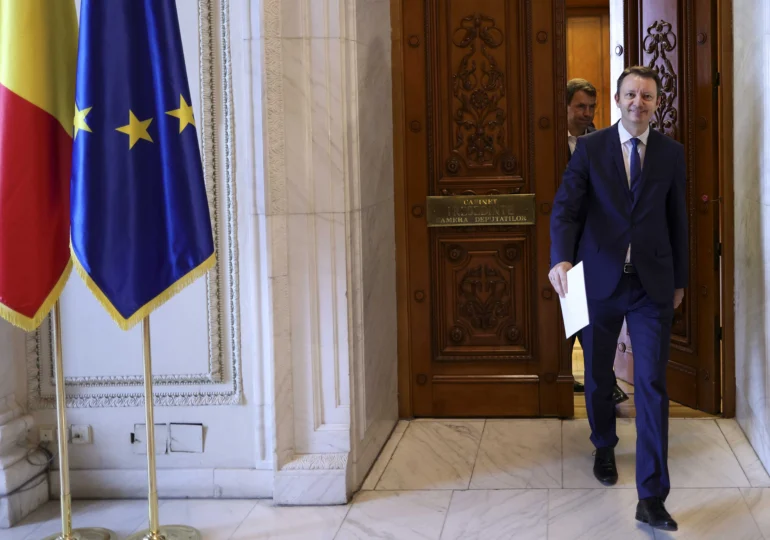
The governance program submitted on Saturday by Siegfried Mureșan to Parliament proposes changes for state-owned companies, administration, pensions, and public sector salaries. TAROM is set to be privatized, the number of parliamentarians to decrease, and a new salary law to be adopted by the end of October.
The document contains 372 measures in 28 chapters.
The program promises a reduction of VAT to 19% when Romania can afford it, indexing pensions and allowances in 2027, and a savings and investment account for children.
At the same time, the future government aims to reduce the deficit through better-controlled expenses, improved tax collection, and the use of European funds for investments. Some measures have specific deadlines, such as the adoption of the salary law by October 31, 2026. For others, like reducing VAT to 19%, the program does not set a date; their implementation depends on available funds.
### VAT at 19%, when finances permit
The program foresees maintaining the flat tax rate and eliminating the minimum turnover tax as of January 1, 2027. However, the reduction of VAT to 19% remains conditional: the document states that it will take place „as soon as Romania can afford it,” without specifying a timeframe.
For apartments contracted through authenticated deeds until December 31, 2025, an extension of 12 months is proposed until July 31, 2027, for applying a 9% VAT. The document specifies that there would be no further extensions.
### Pensions and salaries in the public sector
Pensions and allowances are expected to be indexed in 2027, with respect to the deficit target and the approval of the Fiscal Council. The program does not specify in the summary of measures how much they would increase.
The new law on public sector salaries should be adopted by October 31, 2026. The document promises to correct inequalities without reducing incomes, but it does not present salary grids or the cost of the reform.
The program also proposes banning the cumulation of pensions with state salaries, by unblocking a bill adopted by the Senate, as well as eliminating early retirement in systems where employees can retire too soon.
For defense, public order, and national security systems, service pensions are expected to be recalculated based on contributions and seniority. A transition period is provided for those nearing retirement.
### A savings account for children
Through the „Future Account,” parents could open a savings and investment account in their child’s name in the first year of their life. The program states that they would benefit from the tax advantages provided by the savings and investment accounts law. The submitted document does not specify an amount that the state would deposit into these accounts.
Another proposal concerns individuals returning to work after the first six months following the birth of a child: they could continue to receive the child-raising allowance while also receiving a salary.
### TAROM to be privatized
For TAROM, the program proposes privatization through a competitive procedure, with a set deadline. The document argues that the state has used the last restructuring aid allowed by European rules for the next ten years and foresees that the company will no longer receive new public funds, including in the form of unpaid debts to other state-owned companies.
Essential air connections are set to be ensured through public service contracts, open to any operator. The program also proposes listing packages from the companies managing Otopeni Airport and Constanta Port on the stock exchange.
### Fewer parliamentarians and changes for Bucharest
The number of parliamentarians is expected to decrease by 13%, according to the 2021 census data, without changing the electoral system. The program also includes a maximum of three secretaries of state per ministry, the consolidation of institutions, and the reduction of staff where activity analysis justifies it.
For Bucharest, the document proposes transferring certain responsibilities from the sectors to the General City Hall in urban planning, public transport, education, and health, along with the corresponding financial resources.
### Health and energy
In healthcare, the family doctor is expected to play a larger role in prevention and caring for patients with chronic diseases. The share of family medicine and prevention in the financing of the National Health Insurance House is set to increase based on annual targets. The program also proposes a clearer path from diagnosis to treatment for patients with cancer and rare diseases, as well as stricter control of medical leave.
In energy, the completion of gas-fired power plants in Mintia and Iernut, investments in energy storage, and the modernization of Unit 1 at Cernavodă are planned. The government is also expected to make a decision regarding Units 3 and 4, with financing secured. The document proposes launching the first concession procedure for wind energy production in the Black Sea.
The program links many of these proposals to deficit reduction and available funds. For 2026, it anticipates a budget adjustment within 30 days of the Government’s inauguration, without increasing the deficit. However, the implementation of measures depends first on the Parliament’s vote of confidence.