

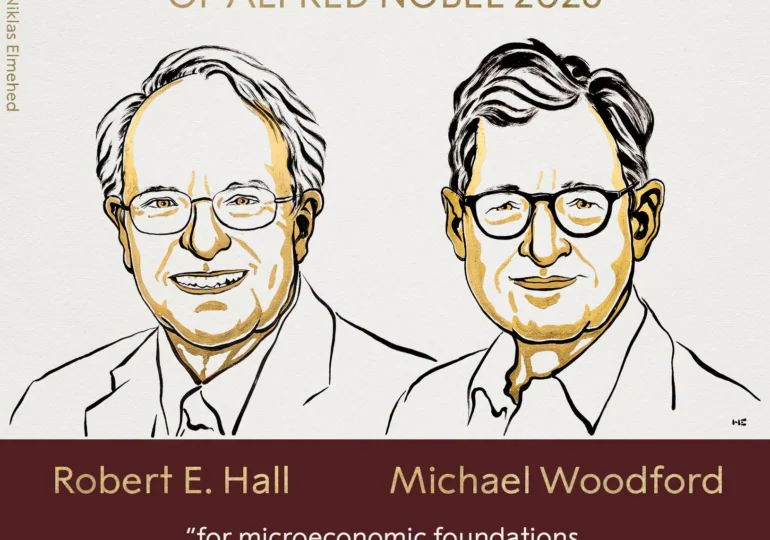
American economists Robert E. Hall and Michael Woodford have been awarded the Nobel Prize in Economic Sciences 2026 for their research that has changed the way economic stabilization policies are designed.
The models developed by the two help governments and central banks better understand how to limit recessions, inflation, and the effects of economic shocks, such as energy crises.
Robert E. Hall, emeritus professor at Stanford University, and Michael Woodford, professor at Columbia University, have contributed to the development of economic models that better explain how the decisions of individuals and companies influence the overall economy. The prize was awarded to them for the "microeconomic foundations of macroeconomic stabilization."
Their research attempts to answer an essential question: how can governments and central banks mitigate economic crises without exacerbating other issues, such as inflation or unemployment?
For a long time, economists have used models that primarily focused on general indicators such as inflation, production, and consumption.
Hall and Woodford have contributed to changing this approach by placing the individual decisions of households and companies at the center of the models: how much people consume, how much they save, whether firms invest, and how they react to changes in interest rates and prices.
Why this research matters
For example, when the economy enters a recession, a central bank can lower interest rates to encourage lending and investments. The government, in turn, can stimulate the economy through budgetary measures. Conversely, when demand rises too much and inflation accelerates, authorities may need to take tempering measures.
The issue is that the effects of these decisions depend on how people and companies react. If the population expects inflation to remain high, for instance, this can influence consumption, wage negotiations, and pricing by firms.
The models of the two American economists allow for a more rigorous evaluation of these reactions and the effects of monetary and fiscal policies. They underpin a significant part of the tools currently used by central banks and governments to manage economic fluctuations, as reported by Reuters.
Their research has contributed to the development of modern Keynesian paradigm, which seeks to explain the economy starting from individual decisions, not just from statistical relationships between macroeconomic indicators. This approach became important after the economic crises and high inflation of the 1970s revealed the limitations of previously used models.
The Nobel Prize in Economic Sciences was established by the central bank of Sweden in 1968 and first awarded in 1969. It is not one of the five prizes specified in Alfred Nobel's will, although it is commonly known as the Nobel Prize in Economics.