
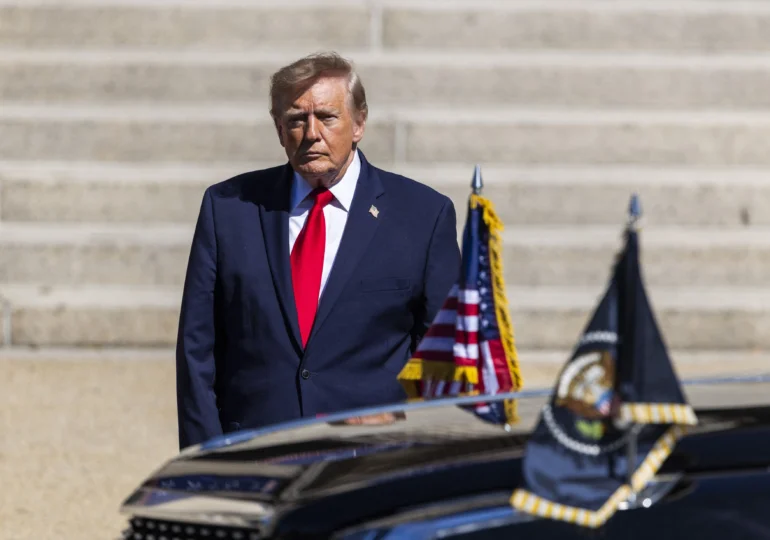
Donald Trump had two occasions this week to showcase his influence on the international stage: a speech at the UN General Assembly and a meeting at the White House with Chinese President Xi Jinping. He spoke strongly about the strength of the United States and gave the Chinese leader a lavish welcome. However, the results were more modest than the diplomatic spectacle.
A Reuters analysis shows that the American president is facing increasing resistance abroad, at a time when the conflict with Iran is weighing on the US economy and his popularity. In November, there will also be elections for Congress, which could further narrow his room for maneuver.
Summit with Xi, but without major progress
Xi Jinping's visit to Washington was filled with ceremonies, but it did not bring solutions to the major disputes between the two countries: trade, Taiwan, and competition for artificial intelligence technologies. The most concrete result seems to be the extension of the trade truce between the US and China by two months.
In public, Trump avoided confrontation with Xi. According to Chinese state media, in closed-door discussions, the Beijing leader asked him to oppose Taiwan's independence. The island, democratically governed and claimed by China, remains one of the most sensitive points in the bilateral relationship.
Trump's more cautious tone contrasts with the tariff threats he has used in the past against Beijing. Reuters indicates that this change also has a practical explanation: China controls the supply of rare earths, essential raw materials for the tech and auto industries, and has shown it can restrict exports in response to American pressures.
"Trump sees himself bringing us back to a world where might makes right. But it's remarkable how insecure he becomes in front of Xi Jinping and China's growing power," said Brett Bruen, former foreign policy advisor in the Obama administration, to Reuters.
The conflict with Iran dominates the agenda
The entire diplomatic week was overshadowed by the conflict with Iran, initiated by the US and Israel on February 28. The conflict has lasted for nearly seven months, disrupted energy supplies, and expanded to other regions, including Yemen and the Red Sea maritime route.
In his speech at the UN, Trump defended the attack on Iran and once again threatened to "annihilate" them if Tehran does not accept an agreement. He stated that "America is back" and is stronger than ever.
However, Iran continues to resist despite military strikes and economic pressure. For Trump, the war has become one of the most challenging issues of his second term: gasoline prices have risen in the US, the conflict is unpopular, and it is causing divisions even within his own political camp.
A White House official, in response to Reuters, rejected the idea that the president's foreign policy has reached an impasse. The official claimed that the UN speech highlighted the administration's successes in defending American interests, including preventing Iran from obtaining nuclear weapons. Tehran maintains that its nuclear program is for peaceful purposes.
World leaders say "no" more often
Resistance to Trump's demands is also evident in relations with allies. Most European and Asian partners have refused to get involved in the conflict with Iran, which Washington started without consulting them, Reuters notes. Pressures on Russia and Ukraine for a limited ceasefire regarding attacks on energy infrastructure have also not produced significant progress.
At the UN meeting, some leaders criticized the force-based approach, even though they did not directly name the American president. Emmanuel Macron warned against a return to the "law of the jungle." Brazilian President Luiz Inácio Lula da Silva denounced external interference in his country's elections and said, "We don't need aircraft carriers patrolling our waters. We need cooperation to stop the flow of arms and money fueling crime."
The White House maintains that some public statements by foreign leaders do not reflect what they tell Trump in private. "The president is not concerned with image demonstrations, but with results," said the official quoted by Reuters.
Trump also secured an agreement to extend the American military presence in Greenland. However, this is far from his initial goal of the US possessing the territory.
The change in atmosphere was summed up by Ian Bremmer, president of the Eurasia Group: "A year ago, few countries dared to oppose Trump. Now Canada, Europe, China, Iran, Russia, and others are increasingly willing to say no."
Trump even made an observation about his own influence in his UN speech. After proposing that world leaders use the term "superintelligence" for artificial intelligence, he added: "Let's see if I have any power. Maybe yes, maybe no. We'll find out soon enough."
G.P.