
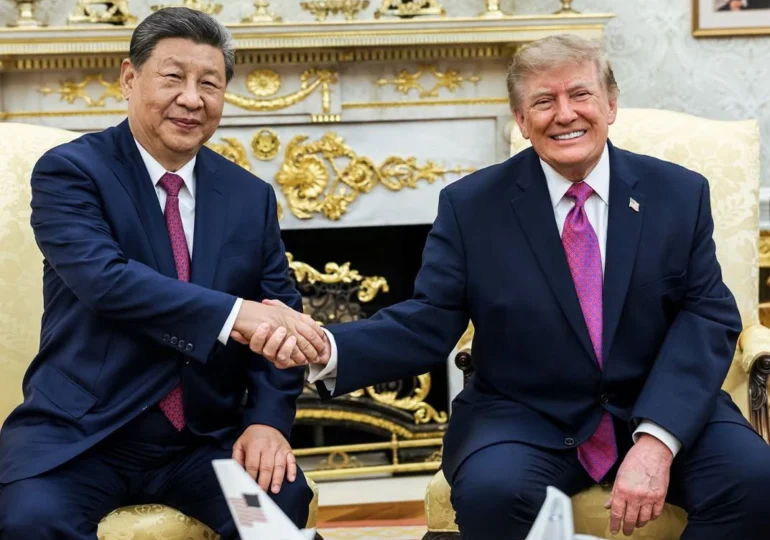
Donald Trump and Xi Jinping met at the White House in a summit dominated by diplomatic pomp and messages of cooperation, but with few signs of concrete progress on the issues straining the relationship between the US and China.
Trade, artificial intelligence, and Taiwan remained the main sensitive points, while critics say the emphasis was more on show than on tangible results.
Donald Trump welcomed Xi Jinping to the White House on Thursday, and discussions on artificial intelligence, trade, and the increasingly intense strategic rivalry between the US and China were expected to be at the center of this visit.
Here are the main conclusions drawn by The Guardian after Xi's first visit to Washington in over ten years (previously, he visited in September 2015 during the Barack Obama administration).
- Diplomacy or "diplotainment"?
US Senate Democrats criticized Trump's summit with Xi, arguing that it focused on ceremony and spectacle at the expense of concrete results on major issues on the bilateral agenda.
There were no indications that the brief closed-door meeting had produced progress on difficult issues regarding artificial intelligence, trade, Taiwan, and the conflict with Iran.
The two countries agreed to extend until January 10 the agreement that suspends the trade war, but experts suggest that there were few other concrete and visible results.
Xi once again invoked the "Thucydides Trap," an academic theory suggesting that rivalry between a rising power and an established one often leads to war. Xi said that this risk "can be overcome" and called for cooperation.
After the meeting, Trump gave Xi a tour of the new helipad he recently built on the White House's South Lawn.
"He likes good granite," Trump told reporters, adding that the two had a "great meeting," without providing further details.
Danny Russel, a former American diplomat during the Obama administration, expressed concern that the two leaders spent more time at social and ceremonial events than in the actual meeting, which lasted about 90 minutes.
"Spectacle and protocol do not mean progress. Pandas are cute (Xi announced that two panda bears will soon arrive at Zoo Atlanta), but America needs rare earths," Russel said. "What we see is not so much diplomacy as 'diplotainment,' which will not contribute much to solving the serious issues in the US-China relationship."
- Artificial Intelligence, without restrictions
Artificial intelligence analysts had to read between the lines to assess the outcome of the discussions between the two leaders on the AI topic.
Trump had written Thursday morning in a post on Truth Social that he and Xi would discuss "superintelligence" (SI), a term recently introduced by Trump to describe artificial intelligence. However, he suggested that he is not interested in new regulations, despite concerns expressed by industry leaders that AI could ultimately pose a threat to humans.
"Super Intelligence (SI) will be an important topic of discussion, but I want it to remain exactly where it is," Trump wrote. "This is also China's position."
In his statements on Thursday, Xi said that the two countries must "ensure that the development of artificial intelligence is always under human control."
Analysts argue that the intense rivalry between the two powers in AI is likely to limit the possibility of agreements that go beyond the symbolic level.
- Taiwan and the $14 billion arms deal blocked
During afternoon discussions, Xi asked Trump to oppose "Taiwan independence," according to a statement from the official Chinese news agency Xinhua. The White House did not offer its own version of the discussions.
Xi was expected to ask Trump to halt arms sales to Taiwan. After his visit to China in May, Trump stated that he was holding off on a $14 billion arms package for Taiwan and called it "a very good bargaining chip," causing concern among some US allies in Asia.
In a statement signed by at least 19 of the 47 members of the Senate Democrats group, consulted by Reuters, the Democrats urged Trump on Thursday to immediately deliver the security assistance package approved by Congress - funds worth $1.3 billion and arms sales worth $14 billion.
China regards Taiwan as its own territory and has not ruled out the use of force to take control of the island.
- An Unusual Airport Welcome
Trump greeted Xi upon his arrival with the red carpet on the runway at Andrews Air Force Base, marking the first time an American president has welcomed a foreign leader there since the meeting between Barack Obama and Pope Francis in 2015.
Normally, American presidents wait for state visit guests to arrive at the White House before offering an official welcome.
Despite repeatedly calling Democrats "communists," Xi's reception included Chinese flags displayed on the roof above the Oval Office, alongside the flags of the United States.
Despite the pomp, Trump and Xi's statements during the visit were not broadcast live by any American television network.
TV stations refused to air the footage in protest against the ban imposed by the White House on CNN, MS Now, and Politico, which was later lifted.
- Tech Billionaires Invited to State Dinner
The state dinner organized for Xi brought together influential figures from Washington and a veritable parade of billionaires, including Tim Cook from Apple, Jeff Bezos from Amazon, Sundar Pichai from Alphabet, Sam Altman from OpenAI, Elon Musk from Tesla, and Jensen Huang from Nvidia.
The menu chosen by First Lady Melania Trump included a yellow pumpkin velouté soup, sesame-crusted sea bass, and a dessert with vanilla and candied sour cherries cream.
Continuing Trump's conflict with certain media institutions, CNN and MS Now reporters were prevented from attending the event. Outside the gate, a group of noisy protesters chanted slogans such as "China out of Hong Kong," which could be clearly heard by the two leaders as they posed for photos on the White House steps, covered in red carpet.
B.B.