

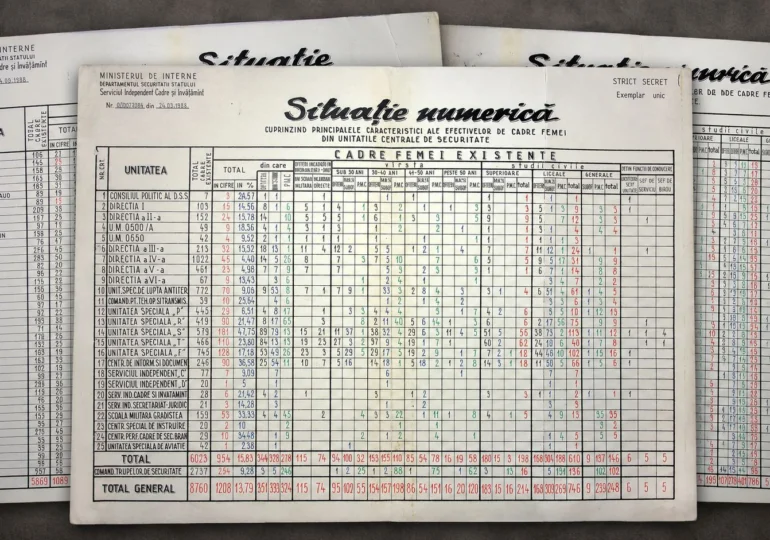
The Security had 14,629 employees in September 1988, just over a year before the collapse of the communist regime. Almost 6,000 worked in territorial structures, and hundreds of people were dedicated solely to surveillance, wiretapping, and monitoring correspondence.
The exact data, presented for the first time by the National Council for the Study of the Securitate Archives (CNSAS), comes from documents dated September 24, 1988, preserved in the file of Cabinetul Iulian Vlad, the last chief of the State Security Department.
According to CNSAS, the staff was divided as follows:
- the central apparatus of the Securitate, located in Bucharest – 6,023 employees, representing 41.17% of the total;
- Security Troops – 2,737 employees, accounting for 18.71%;
- the territorial apparatus, consisting of the structures of the 40 counties and the Securitate of Bucharest Municipality – 5,869 employees, representing 40.12%.
The total also included civilian worker personnel, consisting of approximately 1,200 individuals without military rank. They were skilled workers, technicians, drivers, telecommunications specialists, builders, typists, secretaries, as well as employees of the printing house, warehouses, and annex households of the Ministry of Internal Affairs.
Hundreds of people were monitoring, listening, and controlling letters
The central apparatus concentrated the main information, counterintelligence, surveillance, and interception structures of the regime. Division IV, responsible for military counterintelligence, had 1,022 employees, while the Special Unit for Anti-Terrorist Combat had 772.
Special Unit "F", which dealt with surveillance, street observation, and investigations, had 745 employees. According to CNSAS, they formed "mobile street teams designed for the direct monitoring of individuals considered dangerous by the regime."
Another 466 individuals worked in Special Unit "T", which was responsible for interceptions and wiretaps. The employees of this structure operated the devices used for phone tapping and environmental surveillance.
The control of letters, parcels, and other internal and international postal shipments fell under Special Unit "S", which had 356 employees in Bucharest.
In counties, this activity was carried out through special offices or compartments, "usually located secretly within large county post offices," as stated by CNSAS.
Division I, responsible for political, social, and cultural surveillance of the population, had 103 employees at the central level. Its purpose, according to CNSAS, was the "direct surveillance of the population in terms of ideological compliance."
Division II had 152 employees at the center and monitored strategic economic objectives, ministries, factories, plants, state agricultural enterprises. Division III, dedicated to counterespionage and monitoring foreign representations, had 213 employees.
The Capital and strategic counties under massive surveillance
Bucharest Municipality Security had 557 employees and was the largest territorial structure in the country. The other 40 county inspectorates totaled 5,312 employees, with an average of approximately 132 for each county.
The staff was larger in areas considered important from an economic, industrial, or strategic standpoint.
After Bucharest, the most numerous structures were those in Constanța, with 285 employees, Timiș, with 271, Prahova, with 261, Cluj, with 251, and Brașov, with 212.
CNSAS explains the size of these staff by the importance of the Constanța port, the border position of Timiș county, the refineries and oil industry in Prahova, as well as the academic, cultural, or industrial role of Cluj and Brașov cities.
At the opposite end, the smallest county apparatus was in Covasna, where 73 individuals worked. Sălaj and Ialomița had 76 each, Călărași - 78, and Giurgiu - 81.
Only 22 women held leadership positions
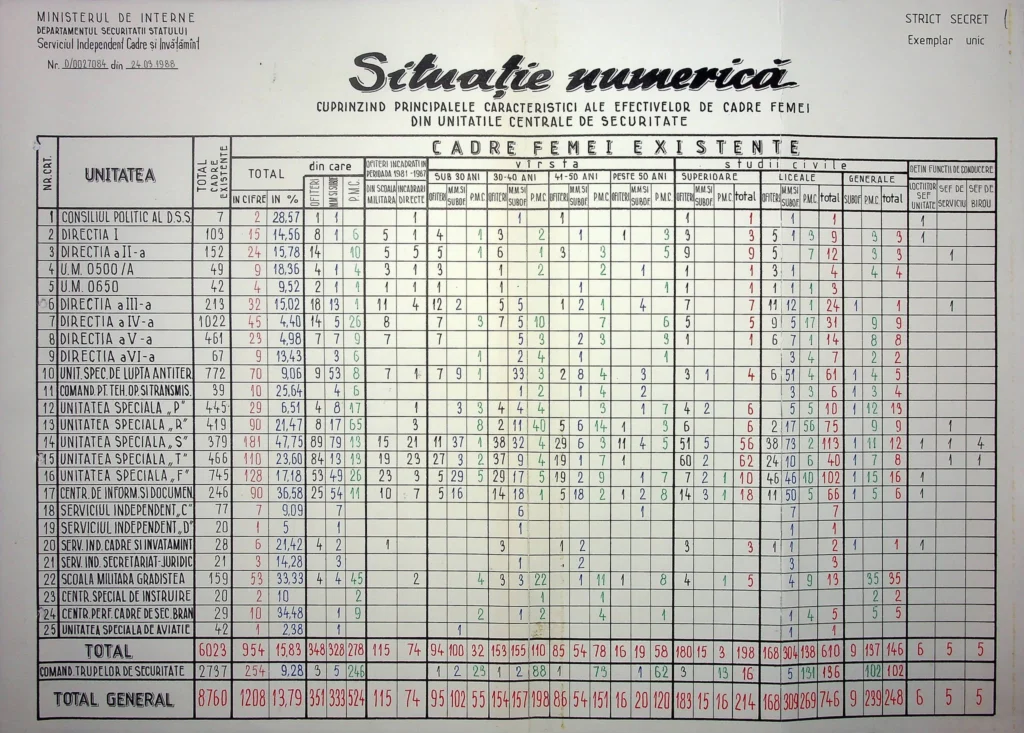
There were 2,297 women working in the Security, representing 15.70% of the total employees. Of these, 954 were in the central apparatus, 1,089 in territorial structures, and 254 in Security Troops.
Women mainly worked in technical and administrative fields, but their access to leadership positions was extremely limited.
Only 22 women held leadership positions throughout the Security apparatus: 11 at the central level and 11 in the territories. No women in the Security Troops had such a position.
"Nationally, only 0.95% of women in the Security held a leadership position. The remaining 99.05% held executive positions," CNSAS specifies.
Overall, the State Security Department was composed of 84.30% men.