
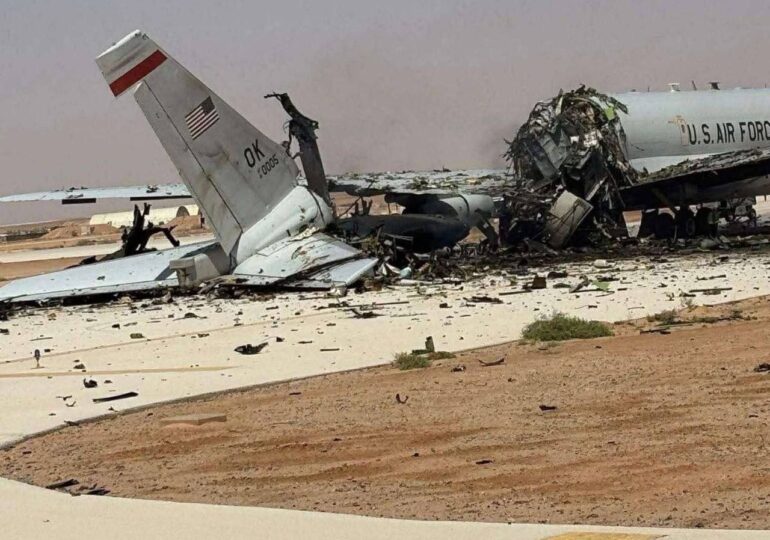
The destruction of a US Air Force AWACS radar aircraft following an Iranian attack on a base in Saudi Arabia risks severely affecting Washington’s ability to detect and manage threats from the region.
Images verified by CNN journalists show the E-3 Sentry aircraft completely damaged, with its tail broken and the radar dome – the key element of the early warning system – crashed on the ground at Prince Sultan Air Base.
"A serious blow" to surveillance capability
The loss of such an aircraft is "a serious blow to US surveillance capabilities," said military analyst Cedric Leighton, a former US Air Force colonel.
He warns that the impact is not limited to monitoring but also affects the coordination of aerial operations.
"It can affect the US ability to control fighter jets and guide them to targets or protect them from hostile aircraft and missile systems," he explained.
The US Central Command has not yet commented on the aircraft's destruction.
"The brain" in the air
The E-3 Sentry aircraft is not just a flying radar but a veritable airborne command center.
The AWACS system can monitor a battle space of up to 120,000 square miles (approximately 311,000 sq km) and can simultaneously track about 600 targets - from planes and missiles to drones or ground vehicles.
The data is transmitted in real-time to commanders, ships, or to the Pentagon, and the operators on board can coordinate interceptions or aerial attacks.
A report from the Center for a New American Security describes these aircraft as the "command center," the "brain" of the battlefield, emphasizing their essential role in real-time coordination of operations.
Lost advantage: early detection of attacks
Airborne radars provide a major advantage over ground-based ones, say experts. Peter Layton, a former Australian aviation officer, explains that an AWACS can detect threats much earlier.
In the current conflict, an Iranian Shahed drone launched from about 320 kilometers away could be observed about 85 minutes earlier than by ground radars.
Additionally, these aircraft are mobile and, typically, harder to hit than fixed infrastructure.
Key question: how was the attack possible
The destruction of the aircraft on the ground raises serious questions. "Extraordinary measures are usually taken to protect it, including fighter escort and avoiding hostile areas," said Leighton.
He considers the incident "a serious breach in force protection."
The analyst also suggests the possibility of external support for Iran. "Most likely, Russia provided coordinates and satellite images indicating the exact location," he stated.
Clear strategy: Iran targets critical assets
The attack is not random, say analysts. Kelly Grieco points out that Iran systematically targets essential assets: radars, communication infrastructure, tanker aircraft, and AWACS.
"Iran targets the radars that detect threats, the tanker aircraft that keep planes in the air, and the AWACS that coordinate the fight. It's an anti-aircraft campaign (...) and the damage is real," she explained.
An older vulnerability: small and aging fleet
The incident also highlights a structural problem in the US military: the small number and age of these aircraft. At the beginning of the year, the US had only 17 E-3 aircraft, fewer than B-2 bombers, according to industry data cited by CNN.
The first ones entered service in 1978, and the fleet has been steadily reduced over the past decade.
Built on the Boeing 707 platform, these aircraft have large crews and high costs - equivalent to about $540 million today.
In addition to the US, such aircraft are also operated by Saudi Arabia, France, and Chile, and NATO has its own joint fleet.
Delayed replacement
Although the US Air Force has been seeking a replacement for the E-3 for years, the Pentagon has not yet decided which platform to adopt.
There are alternatives, such as the E-2 Hawkeye used by the US Navy, but it is smaller and has limited capabilities compared to the E-3.
G.P.