
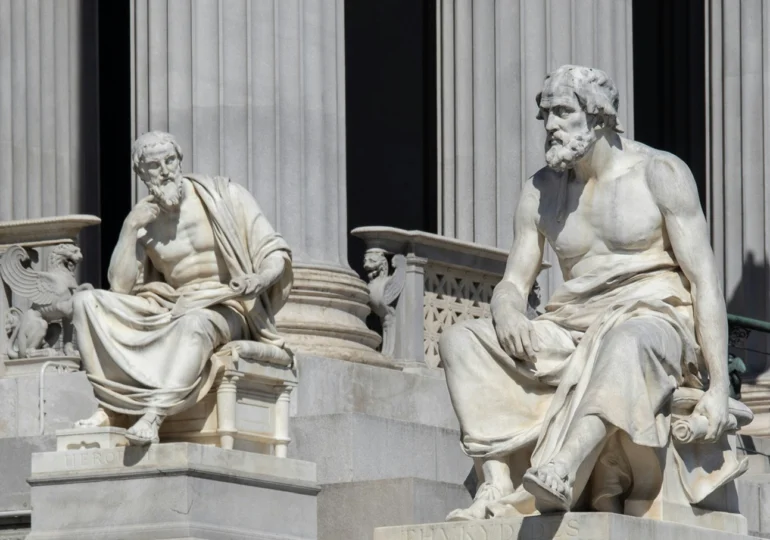
China’s leader appealed to Greece’s history to warn the United States about what can happen when a rising power meets a dominating one.
At Thursday’s meeting in Beijing with Donald Trump, Xi Jinping had in mind a much older rivalry. The Chinese president invoked a warning from the classical world, when the Greek city-states of Athens and Sparta went to war, saying that the United States and China should beware of the „Thucydides Trap” in their relations.
Xi cited the concept, popularized in recent decades, warning that Beijing and Washington could reach an "extremely dangerous" point if President Trump tried to prevent China from asserting itself over Taiwan.
The New York Times explains what the Chinese leader meant to convey.
What Happened in the Second War between Athens and Sparta
The trap referred to by Xi was named after Thucydides, the ancient Athenian general whose account of the Peloponnesian War (431 BC - 404 BC) is considered one of the first written military histories.
Thucydides wrote that the war between Athens and Sparta was driven by the threat posed to an established power by another gaining power. "The rise of Athens made Sparta afraid and forced it into war," wrote Thucydides.
For some researchers, that war - and the explanation presented in that ancient passage for its outbreak - foreshadowed nearly every major conflict that followed. International relations theorist Graham Allison named it the "Thucydides Trap" in the early 2010s.
“The idea is that when an established, great power meets a rising power, conflict between the two is likely, if not inevitable,” said Daniel Sutton, a classicist at the University of Cambridge who studies Thucydides.
In Xi Jinping's analogy, a bold China is Athens to an American Sparta, as reported by the American daily.
To support his theory, Professor Allison identified 16 historical moments where a rising power threatened to replace a ruling one. According to this, which is subjective, 12 out of the 16 rivalries ended in conflict.
Xi Has Mentioned the Thucydides Trap Before
For over a decade, Xi and senior Chinese diplomats have invoked the concept, presenting it as a moral tale rather than a real and inevitable situation.
“There is no so-called Thucydides Trap in the world,” Xi said in 2015, addressing an audience that included former Secretary of State Henry Kissinger.
This concept came back to Xi's mind on Thursday. Speaking in front of Trump in the Great Hall of the People, Xi said the world has reached a new crossroads. "Can China and the United States surpass the 'Thucydides Trap' and establish a new paradigm for relations between major powers?" he asked.
What China Wants to Tell America
Ryan Swan, an expert on China-US relations at the International Center for Conflict Studies in Bonn, Germany, viewed Xi's repeated use of the concept as part of a broader diplomatic effort by Beijing to present itself as a "responsible great power" that can peacefully coexist with the United States.
Since taking office in 2012, Xi has pressured the United States to treat China as an equal and not oppose Beijing in its own region, a stance Chinese officials see as a way to promote a more stable coexistence.
“China sees the Thucydides Trap not as a predictive model, as it has occasionally been used in Western circles, but as a threat that can and should be avoided,” Swan noted.
Delicate Exchanges between Xi and Trump
Observers noted that Xi has been using the term for years, but the classical reference during Trump's visit could have been a foreshadowing of his position on Taiwan, as reported by The Guardian.
The Chinese leader later warned Trump that any misstep regarding Taiwan could push the two countries into "conflict."
“The Taiwan issue is the most important problem in US-China relations,” said the Chinese leader, referring to the self-governing island that China claims as its own. “If mishandled, the two nations could clash or even go to war, pushing the entire US-China relationship into an extremely dangerous situation,” he added.
However, in the evening, at a state banquet, the Chinese leader took a more conciliatory tone, insisting that the US and China can manage seemingly inevitable frictions. "Achieving the great rejuvenation of the Chinese nation and restoring the greatness of America can go hand in hand... and can promote the well-being of the whole world," Xi said.
In response on social media, Trump said Xi "very elegantly referred to the United States as probably a nation in decline."
Of course, however, this was not a reference to the US under his leadership, Trump clarified. "Two years ago, we were actually a nation in decline," he wrote on social media Friday morning.
“Now, the United States is the strongest nation in the world and, hopefully, our relationship with China will be stronger and better than ever!” Donald Trump added.
T.D.