
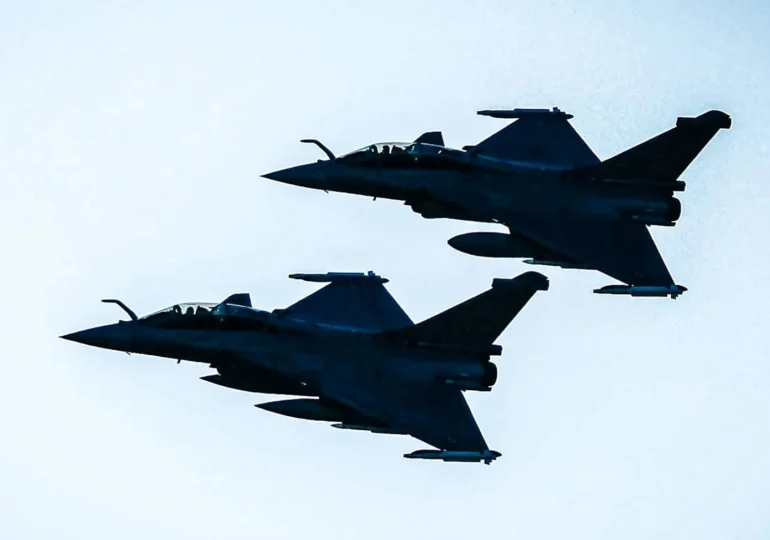
NATO has scrambled fighter jets nearly 700 times in the span of two years to intercept Russian aircraft near the Alliance’s airspace, the alliance’s top military official stated. He warns that Moscow’s threats go beyond conventional warfare.
Speaking from the Taranto naval base in southern Italy, Admiral Giuseppe Cavo Dragone, the head of NATO’s Military Committee, said that this figure demonstrates that threats to NATO’s security are not hypothetical, as reported by Kyiv Post.
"The threats are real and numerous," Dragone said, mentioning Russia and terrorist groups, as well as less visible threats such as disinformation, hybrid attacks, and authoritarian states challenging the international order.
"Seven hundred take-offs in two years. Do the math: almost one per day," said Dragone.
NATO 3.0, the anti-stress alliance
The admiral also presented his vision of "NATO 3.0" - a rebalanced Alliance where European member states take on a more significant role alongside the United States.
He stated that NATO is returning to its fundamental mission of collective defense while facing threats from all directions, including conventional and hybrid attacks, as well as physical and digital risks from the east, south, and the Arctic region.
In a previous intervention on platform X, Dragone emphasized that NATO must demonstrate greater adaptability to pressures, rather than just absorbing them.
"Antifragility is the strategic advantage of the 21st century," he wrote, comparing a fragile glass that shatters under stress to a muscle that becomes stronger because of it.
He argued that future strategic superiority will not necessarily belong to those with the most advanced weapons, but to those capable of "learning faster, deciding faster, producing faster, innovating faster, and recovering faster" - whether in times of peace, crisis, or war.
What is NATO 3.0
This concept was developed in the USA, specifically by Elbridge Colby, a Department of Defense official who has long advocated for a complete overhaul of American policy towards Europe.
Critics argue that NATO 3.0 actually amounts to a reduction in Washington's commitment to European security and represents a fundamental shift from the founding principle that Europe's security is inseparable from that of the United States.
Colby acknowledges that the US should maintain its presence in Europe, and US membership in NATO continues to enjoy bipartisan support in the American Congress. However, the United States has already withdrawn essential capabilities and forces for deterring future attacks on NATO territory. This comes as Russian aggression continues unabated in Ukraine, and allies face frequent drone incursions and hybrid attacks.
NATO Secretary-General Mark Rutte welcomed the NATO 3.0 concept as a strengthening of the alliance, acknowledging Trump's merit in finally pressuring European states to take on greater responsibility for their own defense: the increase in European and Canadian spending over the past decade contributed to what Rutte termed "Trump's trillion."
T.D.