

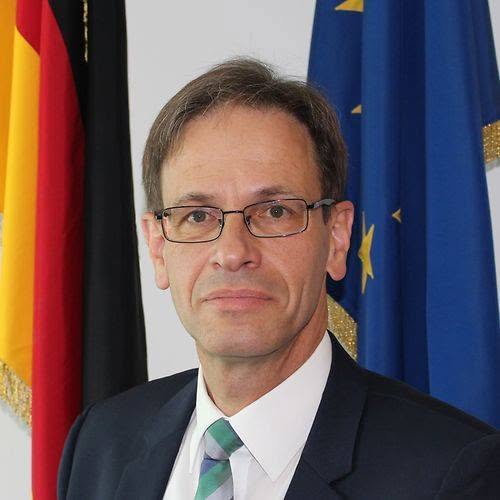
The German Ambassador to Chișinău, Hubert Knirsch, sparked a wave of reactions after stating that he would question the assertion that Romania and the Republic of Moldova share the same language and religion. Politicians and unionist commentators accuse him of legitimizing identity theses promoted during the Soviet period and call for a reaction from Bucharest. However, regarding the language, the diplomat’s statement contradicts the Constitution of the Republic of Moldova, which explicitly states that the state language is Romanian.
The statements were made on July 7, during the „Cabinetul din umbră” show on Jurnal TV, in a discussion about the possibility of the unification of the Republic of Moldova with Romania.
When asked about such a perspective, the ambassador first responded that the decision belongs exclusively to the two states and their citizens.
"Indeed, it is a question that only the people of Moldova and Romania can decide. They are two sovereign states. If they wish to unite, they will do so, and no one can comment on this," stated Hubert Knirsch, as reported by News.ro.
However, the diplomat continued by challenging some of the premises formulated by the moderator.
"I would question what you said about the Republic of Moldova, that we have the same language, the same religion as Romania," the ambassador said.
He argued that there are people who consider it the same language, but also individuals who believe they are different languages or religions, and European values require respect for individual identities and beliefs.
Factual Issue: the official language is Romanian
The ambassador's formulation has sparked controversy because the issue of the official language denomination is no longer, legally, open to interpretations.
The Constitution of the Republic of Moldova explicitly states that "the state language of the Republic of Moldova is Romanian." This wording was introduced into legislation after, in March 2023, President Maia Sandu promulgated the law that replaced the terms "Moldovan language" and "mother tongue" with "Romanian language" in normative acts.
Therefore, people can identify themselves as Moldovans or Romanians and can use different names in everyday conversation, but the official language recognized by the state of the Republic of Moldova is Romanian.
The 2024 census shows that 49.2% of respondents declared "Moldovan" as their mother tongue, while 31.3% declared Romanian. These responses reflect the self-identification of the population, not the legal or linguistic existence of two distinct official languages.
Religion: a too general formulation
Referring to "the same religion" also requires clarification.
Neither Romania nor the Republic of Moldova are states with a single religion, and religious freedom is protected. However, in both societies, the majority of the population who declared their religion is Orthodox Christian.
In the 2014 census in the Republic of Moldova, 96.8% of those who answered the religion question declared themselves Orthodox. In Romania, too, Orthodoxy is the dominant denomination, although there are regional differences and significant communities belonging to other faiths.
Therefore, it is correct that the two states are religiously diverse, but the assertion that they do not have the same dominant religion ignores the demographic reality.
Dragoș Galbur: The Ambassador Repeats Soviet-Made Theses
Among the harshest reactions was that of Dragoș Galbur, the president of the National Moldovan Party, a formation supporting the unification of the Republic of Moldova with Romania.
Galbur accused the ambassador of adopting identity theses built during the Soviet period to separate the population between the Prut and the Dniester from Romania.
"When a German ambassador repeats the identity theses fabricated by the USSR, the cynical echo of the old complicity between Nazi Germany and the Soviet Union is felt, resulting in Bessarabia being handed over to Stalin," he said, as quoted by News.ro.
He added that the identity of the citizens of the Republic of Moldova is not "a diplomatic dossier," and any potential union with Romania should not require Germany's approval.
However, the ambassador's statement that the union can only be decided by the two states does not suggest that Berlin would claim a veto right. On the contrary, in the same intervention, Knirsch explicitly acknowledged the sovereign nature of such a decision.
Request for a Reaction from Bucharest
Journalist Răzvan Gheorghe also argued that the diplomat's statement reproduces "Stalinist Moldovanism" and the narratives used by Russia to deny the identity and linguistic connection between Romanians on both sides of the Prut River.
He urged the Ministry of Foreign Affairs in Bucharest to react "firmly" and described the statements as "lies and anti-Romanian insults."
Knirsch, however, did not explicitly state that Moldovans are not Romanians or that the official language of the Republic of Moldova is not Romanian. He said he questions the idea of a common language and religion and invoked the existence of different identities and opinions in society.
Hubert Knirsch's Diplomatic Past Brought into Discussion
His critics have also brought attention to the diplomatic career of the ambassador.
Hubert Knirsch worked twice at the German Embassy in Moscow: between 2014 and 2018 as the Head of the Political Department, and again between 2022 and 2025 in a political coordination role.
In September 2025, he was accredited as the German Ambassador to the Republic of Moldova.
Between 2018 and 2022, he was the ambassador to Georgia, where politicians from the pro-European opposition accused him of being too lenient towards the government in Tbilisi and Russia's interests.
These accusations were contested at the time by representatives of the European Union, who condemned the attacks on the diplomat and urged political actors to avoid disrespectful accusations.
The fact that a diplomat worked in Moscow is not, in itself, proof that he supports Kremlin's positions. Working in capitals considered challenging is a common part of a diplomatic career, and such accusations must be supported by concrete facts and statements.
Until the article's publication, the German Embassy in Chișinău had not publicly provided a clarification of the statement or nuanced the ambassador's position.