

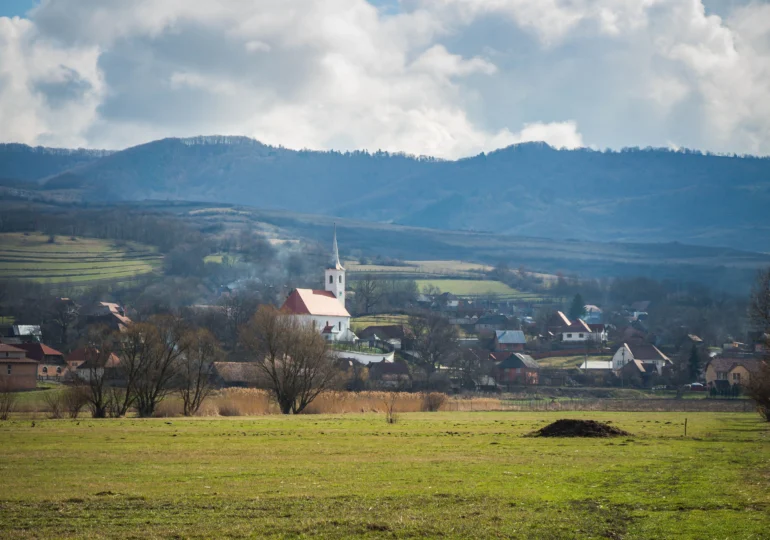
Mountains covered in forests, lakes, peaceful villages, bears that can be observed in their habitat, and places where you hardly encounter anyone. A British journalist discovered a lesser-known part of Transylvania to foreign tourists and left impressed especially by two things: the beauty of the places and how little a vacation costs here compared to the famous mountain destinations in Europe.
Graeme Green, a travel journalist at The Guardian, spent 12 days with his family in Harghita County and the Eastern Carpathians. Instead of the classic tourist route to Bran Castle and the Dracula stories, the Brit chose the mountains, lakes, and villages inside Transylvania.
His conclusion might surprise Western tourists: "A vacation here costs only a fraction of what it would in the Dolomites or the French or Swiss Alps."
Moreover, the journalist says the region is "surprisingly uncrowded," making the experience feel much more authentic.
A region that foreign tourists have yet to discover
The journey begins in Brașov, where the family rents a car and heads north, "away from Bran Castle and all the vampire-related hustle and bustle."
The destination is Harghita, an area that The Guardian notes has largely remained outside international tourist circuits. According to the article, 85% of visitors to the region are Romanians.
For the author, this seems hard to explain once he sees what the place has to offer.
The road passes through quiet villages and rural areas, past horse-drawn carts, churches with silver domes, and storks nesting on electricity poles.
The first longer stop is at Sâncrăieni, in a cabin overlooking the Harghita Mountains. The family then reaches Lake Sfânta Ana and Tinovul Mohoș, which the journalist describes as giving the sensation of a return to the glacial era through its unusual vegetation.
Meeting the bears
Bears are a constant presence during the journey. The family first observes them from a specially arranged point, where four individuals come to eat corn.
However, the encounter that impresses the journalist the most happens on the road. "We see a mother bear and her cub strolling leisurely through the forest, sniffing the air near the road," he recounts.
The Guardian notes that Harghita has one of the highest densities of bears in Europe. Towards the end of the journey, the family also spots a few individuals from a hidden observatory in the forest, near Băile Homorod.
Bicaz Gorges, Red Lake, and a dinner at 1,550 meters
The route continues to Red Lake and the Bicaz Gorges, where the journalist describes the huge rock walls and Piatra Altarului, with its metal cross on top.
They then reach Toplița and from there to the Gurghiu Mountains, for one of the experiences that stands out in his narrative. At an altitude of 1,550 meters, far from any town or village, the family eats trout prepared on a hot stone slab, along with sheep cheese, lamb sausages, and palinca.
Their guide is Samir Teslovan, a local who organizes nature tours and wildlife photography excursions with his son.
"When I come here, to the mountains, I recharge my batteries, I recharge my soul. I feel free, like the wind," he tells the British journalist.
And it's precisely the lack of people that attracts him the most. "I prefer the wild areas, where no one goes. There are places here that no one knows," says Samir.
On the highest peak in the Harghita Mountains
The journey also takes them to Harghita Mădăraș, at 1,801 meters, the highest peak in the Harghita Mountains.
This time, the weather is not favorable to the tourists. Thunder echoes, rain wets them, and clouds cover the view from the peak. The journalist describes the gloomy atmosphere created by the fog around the stone mounds, crosses, flags, and monuments on the mountain.
The family also visits Mini Transylvania Park, with models of castles, palaces, and churches from Transylvania, then concludes their adventure on Lake Zetea, in a kayak.
There, in the middle of the water, the journalist rediscovers the feeling that accompanied him during the journey through Harghita. He sets the oars down and remains carried by the water for a few moments, surrounded by the forest. It is, he writes, once again that sense of "peace, nature, and freedom, like the wind."
After 12 days in Transylvania, the image that remains with the British journalist is thus very far from what Romania has been selling to foreign tourists for decades through Dracula and Bran Castle: a wild, quiet region still shielded from mass tourism, where a vacation can cost much less than in the major mountain destinations of Europe.