
The climate crisis is no longer just a problem of the future. For hundreds of millions of children, its effects are already visible in their daily lives: inaccessible schools, extreme heatwaves, floods, droughts, or increasingly powerful storms.
A new UNICEF report shows that half of the world’s children are simultaneously exposed to at least three major climate risks, affecting their health, education, and chances for a better future, as highlighted by The Guardian.
Over a billion children are currently facing threats such as heatwaves, extreme temperatures, floods, storms, or drought, amid worsening climate change.
To go to school, children cross a river with crocodiles
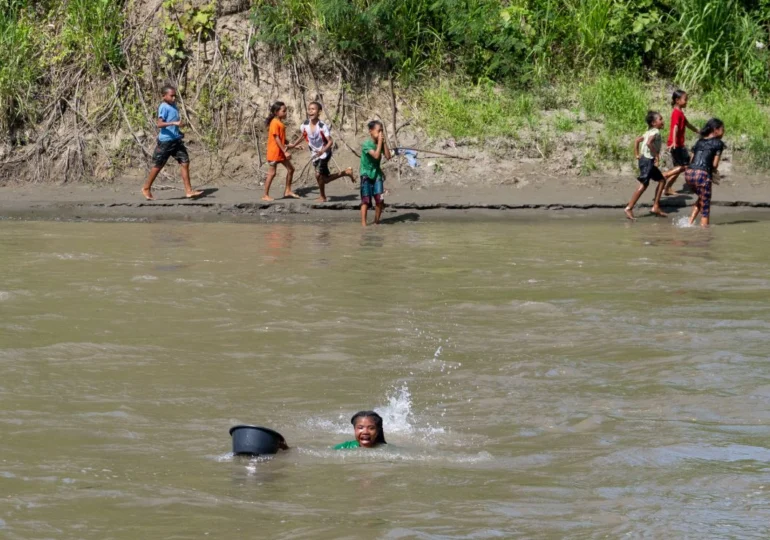
To illustrate the concrete impact of these phenomena, UNICEF has released images from Papua New Guinea showing students who have to swim through a crocodile-infested river to get to school.
Among them is Lorna, a 15-year-old from Launkalana village, Rigo district. The bridge connecting the community to the school was destroyed by floods over a decade ago and has not been rebuilt.
"During menstruation, the elders of the community do not allow us to cross the river to attend classes because they believe it would attract crocodiles (...). My dream is to become a teacher or a pilot. We want a new bridge so we can safely go to school every day," the girl says.
According to UNICEF, the locals have not been able to raise the necessary funds to rebuild the bridge, and the issues are exacerbated by increasingly severe weather phenomena.
Infrastructure is crumbling, and children pay the price
School principal Charlie Vali David says the lack of the bridge affects the entire community and endangers children's lives.
"During the monsoon season, strong currents, fallen trees, and debris block the river, causing injuries and even deaths. Many children fall ill due to the cold and dirty river water. This creates gaps in the learning process, especially for girls," he stated.
The UNICEF report warns that rising temperatures and extreme phenomena increasingly affect essential infrastructure. Roads and bridges are destroyed more often, and access to schools, medical services, and other basic resources becomes increasingly difficult for millions of children.
Almost no child is spared
The study shows that nearly every child globally is exposed today to at least one major climate risk, including those living in developed countries.
Moreover, approximately 123,000 children will be exposed over their lifetimes to over six different types of climate hazards.
"Children's lives continue to be disrupted by the impact of heatwaves, wildfires, droughts, and floods. Half of the world's children now live under the threat of at least three overlapping climate risks, which affect their daily lives," said Catherine Russell, UNICEF's Executive Director.
Africa and Asia at the forefront of the crisis
UNICEF analyzed eight types of climate risks: coastal flooding, drought, extreme temperatures, wildfires, heatwaves, river flooding, sand and dust storms, and tropical storms.
The Sahel region in Africa is among the most affected areas globally. There, over four million children are simultaneously exposed to heatwaves, extreme temperatures, and sandstorms.
In Asia, the situation is even more severe. Children in Bangladesh, Myanmar, and Pakistan are exposed to a greater number of climate hazards than anywhere else in the world.
Even wealthy countries are not shielded. In Italy, for instance, over six million children are simultaneously affected by prolonged heatwaves and drought.
UNICEF calls for urgent investments
The organization urges governments and companies to reduce greenhouse gas emissions and accelerate measures to adapt to climate change.
"This analysis can help policymakers and decision-makers better plan and invest more efficiently in resilient services. By strengthening health and education systems and improving infrastructure with children's needs in mind, we protect them from today's climate threats and help secure their future," said Catherine Russell.
G.P.