
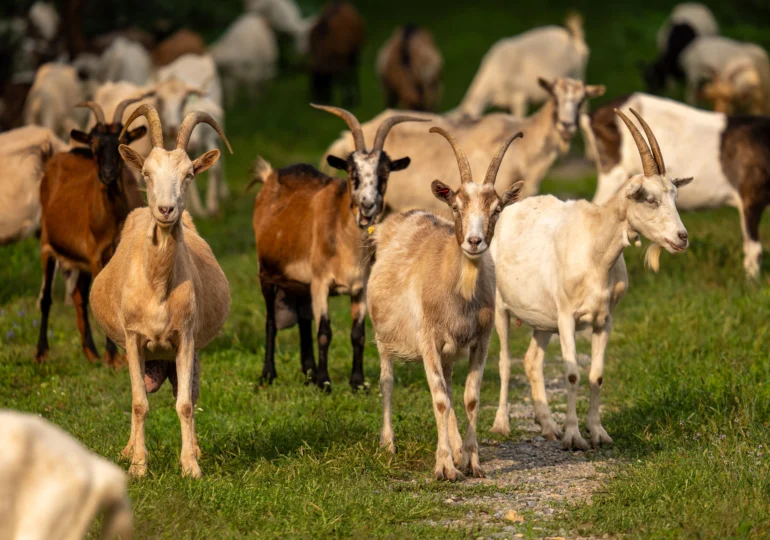
Europe is trying to change the way it fights wildfires. In addition to planes and intervention teams, authorities and specialists are increasingly talking about prevention measures, one of which is the use of herds of goats and sheep to clean up high-risk areas.
The idea is officially supported by the European Commission and major farmers’ organizations, and research shows that animals consuming dry vegetation and shrubs can slow down the spread of fires, writes Politico.
However, specialists point out that this method cannot work without financial support for animal breeders and without a change in strategy from the authorities, who continue to allocate most resources to extinguishing fires rather than preventing them.
Prevention starts before the fire starts
In France and Spain, where wildfires this summer have ravaged vast areas, firefighters are even facing a shortage of intervention aircraft.
At the same time, abandoned agricultural lands are invaded by shrubs and dry vegetation, and in many places, these are replaced by dense forests, which burn much more easily.
Data from the European Copernicus program shows that the largest fires in this period have broken out in extensive areas covered with forests and shrubs.
In Spain, studies have shown that controlled grazing has limited the spread of fires in regions such as Extremadura, Andalusia, and Valencia.
"Just as we understand the need to fund firefighters, we must also recognize the work done by shepherds," says Jordi Vendrell, director of the Pau Costa Foundation, a Spanish organization specializing in wildfire management.
Brussels wants to encourage grazing
The European Commission has included grazing among the measures through which agriculture can contribute to adapting to climate change.
In documents published this year regarding fire prevention and the future of the livestock sector, the European executive recommends using animals to maintain high-risk lands.
Furthermore, in the future Common Agricultural Policy, which will come into force from 2028, Brussels proposes the introduction of a "transition payment" for farmers who choose to focus on pastoral activities. In parallel, the Commission is working with the European Investment Bank on a financing mechanism for investments in the livestock sector.
The issue is not the lack of goats, but the lack of shepherds
Supporters of the project say that the problem is not the lack of lands where animals can graze, but the fact that fewer and fewer people choose the shepherd profession.
José María Castilla, a representative of the Spanish agricultural organization ASAJA, says that it is "impossible" to attract young people to goat breeding if the activity does not become profitable. He proposes the creation of a dedicated European fund, following the model of financial instruments used during the pandemic.
In Catalonia, the project known as "Fire Herds" is already in operation, funded in part by European funds. Goat and sheep breeders take their animals to graze in forests indicated by firefighters. Their products are sold with a special label indicating that they come from farms involved in fire prevention.
In other regions of Spain, cows or horses are also used for the same purpose.
Experts: without land management, fires will continue
Several European researchers criticize the fact that the European Union and national governments continue to focus almost exclusively on post-fire intervention.
Last year, the European Academies Science Advisory Council (EASAC) warned that current strategies are too focused on firefighting and too little on transforming landscapes that favor their spread.
Joe McNorton, a researcher in the Copernicus program, believes that grazing is an effective solution but not sufficient in extreme conditions when the wind can carry embers over areas already cleared of vegetation.
Professor Urbano Fra Paleo, from the University of Extremadura, says that using animals for grazing to prevent fires cannot be replaced.
"Decision-makers do not understand this. They only think about how to extinguish fires after they break out, not about how lands are managed to prevent such fires," the researcher says.
G.P.