
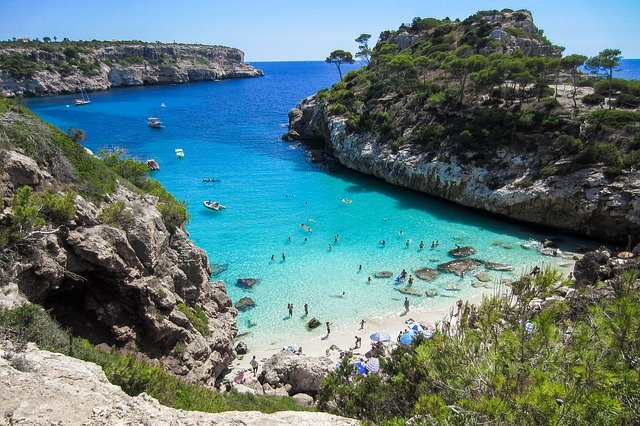
The seas around Europe have reached unusually high temperatures this summer, and the main culprit is global warming. In some areas, the water has been up to 6 degrees Celsius warmer than normal.
A new study conducted by researchers from World Weather Attribution (WWA) shows that climate change has fueled this year’s marine heatwaves and significantly expanded the affected areas. The consequences are already visible in marine ecosystems and the fishing industry, but they could also extend to land: very warm waters can favor stronger storms and accentuate the heat felt in coastal regions, writes Politico.
– [Climate Change Hits Europe’s Economy: The Bill Has Already Come](https://spotmedia.ro/stiri/opinii-si-analize/schimbarile-climatice-lovesc-economia-europei-nota-de-plata-a-venit-deja)
### Mediterranean at Record Temperature
The Atlantic and the Mediterranean Sea are currently much warmer than usual for this time of year.
„This summer, we have seen truly exceptional ocean temperatures around Europe,” says Catherine Gregory, a climate science specialist at the University of Bern and one of the researchers involved in the study.
In July, the average temperature of the entire Mediterranean Sea slightly exceeded 27 degrees Celsius, **the highest level ever recorded for this month**.
Further offshore, the values were even more spectacular. **A buoy west of Mallorca measured over 33 degrees Celsius**, and extreme temperatures were also recorded in the North Atlantic.
Researchers analyzed four regions: the eastern and western Mediterranean, the Atlantic in the Bay of Biscay and the Iberian Peninsula area, as well as the seas around Ireland and western Britain.
In the western Mediterranean, the Celtic region, and the Bay of Biscay-Iberian Peninsula area, July brought the most severe marine heatwaves recorded so far.
– [Why Europe Warms Twice as Fast as the Rest of the World. Four Key Factors](https://spotmedia.ro/stiri/mediu/de-ce-se-incalzeste-europa-de-doua-ori-mai-repede-decat-restul-lumii-patru-factori-cheie)
### How Significant Is the Contribution of Climate Change
To assess how much of this warming can be attributed to climate change, scientists compared the current situation with a simulated world where human-induced global warming did not exist.
The results show very significant differences. Climate change has raised temperatures by about 2 degrees Celsius in both the eastern and western Mediterranean. In the waters around the Iberian Peninsula, the contribution of global warming was estimated at 1.4 degrees, and around Ireland, at 1.3 degrees.
And the area affected by extreme heat has increased significantly. This year, approximately 90% of the Bay of Biscay and 80% of the western Mediterranean experienced unusually high temperatures. Without global warming, the proportion would have been only 40% in each of these regions.
In the eastern Mediterranean, the difference is even greater: marine heatwaves affected 70% of the area, compared to only 9% estimated by researchers in a world without climate change.
Around Ireland, the proportion is 80%, compared to approximately 30% in a scenario without global warming.
– [3 Reasons Why Europeans Are Suffocating from Heat](https://spotmedia.ro/stiri/opinii-si-analize/3-motive-pentru-care-europenii-se-sufoca-de-caldura)
### Some Species Disappear, Others Multiply
Oceans absorb most of the excess heat resulting from the burning of fossil fuels. And as the water warms up, marine life begins to change.
Species that can move migrate to cooler waters. Those that do not have this ability, such as corals and seagrasses, risk disappearing from certain areas.
„We have what we call winners and losers. Many species are becoming less numerous or disappearing completely, while others flourish and multiply,” explains John Bruno, an ecologist at the University of North Carolina and a study co-author.
The effects are already visible.
In the UK, fishermen have noticed that more and more octopuses are moving northward as waters warm. As these feed on crabs, their spread affects crustacean catches.
In France, the issue is different: jellyfish, favored by warmer water, have multiplied and have even reached the point of blocking the facilities of some nuclear power plants.
– [How European Companies Adapt to an Increasingly Extreme Climate: Investments, New Products, and Changes in Working Methods](https://spotmedia.ro/stiri/economie/cum-se-adapteaza-companiile-europene-la-o-clima-tot-mai-extrema-investitii-produse-noi-si-schimbari-in-modul-de-lucru)
### Warmer Water Can Fuel Strong Storms
However, the effects are not limited to what happens underwater. Very high sea temperatures can accentuate the combination of heat and humidity experienced by people living on the coast. At the same time, warm water favors the accumulation of more moisture in the atmosphere and provides more energy to storms.
Researchers cite the devastating floods in Valencia in 2024 as an example. „When sea surface temperatures are very high, they provide extra energy to storms,” explains Gregory.
The study comes after a summer in which Europe faced record heatwaves, drought, and wildfires on land. Researchers warn that the same warming that pushes temperatures to extreme values on the continent is rapidly transforming the seas around it.
G.P.