
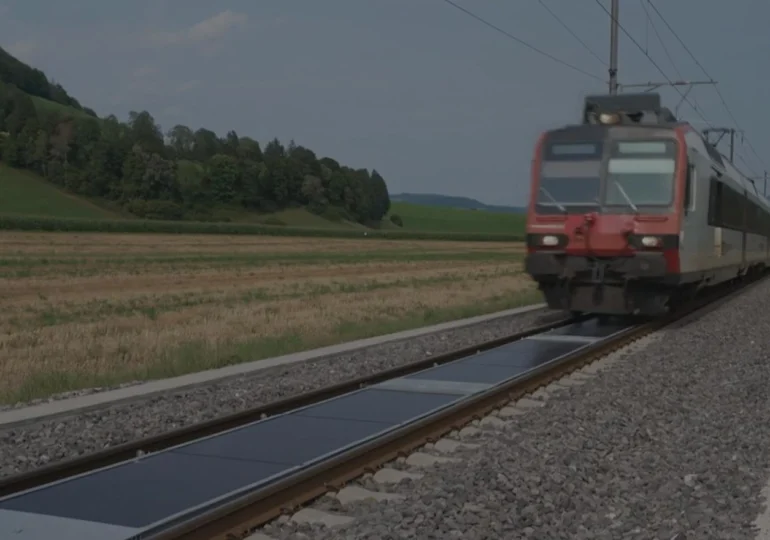
After the success of the first pilot project in Switzerland, Italy could become the next European country to install photovoltaic panels between railway tracks, turning the railway infrastructure into a source of renewable energy.
The Swiss company Sun-Ways, which last year inaugurated the world’s first such system, announced that it has signed an agreement with an Italian partner in contact with the administrator of the national railway network, Rete Ferroviaria Italiana. A pilot project is expected to be presented in the coming months, as reported by Euronews.
An experiment that exceeded expectations
The first stretch of solar railway was inaugurated in the village of Buttes, in the canton of Neuchâtel, on a 100-meter section of active line.
The installation includes 48 specially designed photovoltaic panels, with an installed capacity of 18 kWp. Although the project was initially conceived as a three-year test, the results obtained after just one year were good enough for the system to have a high chance of becoming permanent.
In the first year of operation, the panels produced approximately 16,000 kWh of electrical energy – equivalent to the annual consumption of a fully electrified home in the UK.

Low efficiency losses
Initially, horizontally mounted panels between the tracks may seem less efficient than those installed on roofs, which are tilted to capture more sunlight.
According to Sun-Ways, the production loss due to the lack of tilt is approximately 10%.
The company estimates that if the system were expanded throughout Switzerland's railway network, which spans over 5,300 kilometers, it could produce approximately one terawatt-hour of electrical energy per year, nearly 2% of the country's annual energy consumption.

How safety issues are addressed
The idea of mounting panels between the tracks raised safety concerns from the beginning. Experts warned that vibrations from trains could cause microscopic cracks in the panels, increasing the risk of fire, or that light reflections could distract locomotive engineers.
However, Sun-Ways states that the panels used are more durable than those mounted on roofs and are equipped with an anti-reflection coating.
In addition, the installation is constantly monitored with sensors, and trains are equipped with special brushes that automatically clean the panels' surface from dust and dirt.
The company claims that in the first year of operation, the system worked flawlessly and did not require any special maintenance operations.
Currently, the produced energy is delivered to the national electricity grid, but developers are working on a solution to directly power the railway infrastructure and even the electrified lines on which trains operate.
Growing interest in Europe and Asia
Following the results achieved in Switzerland, interest in this technology is starting to grow.
In addition to the project prepared in Italy, Sun-Ways has received approval from authorities to install a solar railway in South Korea. The company is also in discussions with partners from the Netherlands, China, India, and Singapore.
If the projects are successful, photovoltaic panels mounted between tracks could become an increasingly widespread solution for generating renewable energy, using existing infrastructure without occupying additional land.