
Romania’s expenses for Education and Research are far outside the range of other EU states, and the gap risks strongly affecting the country’s long-term competitiveness in two essential areas: human resources and internal innovation capacity.
The first component, the human resource, starts with the state’s allocations for the public education system, from primary school to university.
Romania, at the bottom of the EU in Education expenses, both in euros and as a percentage of GDP
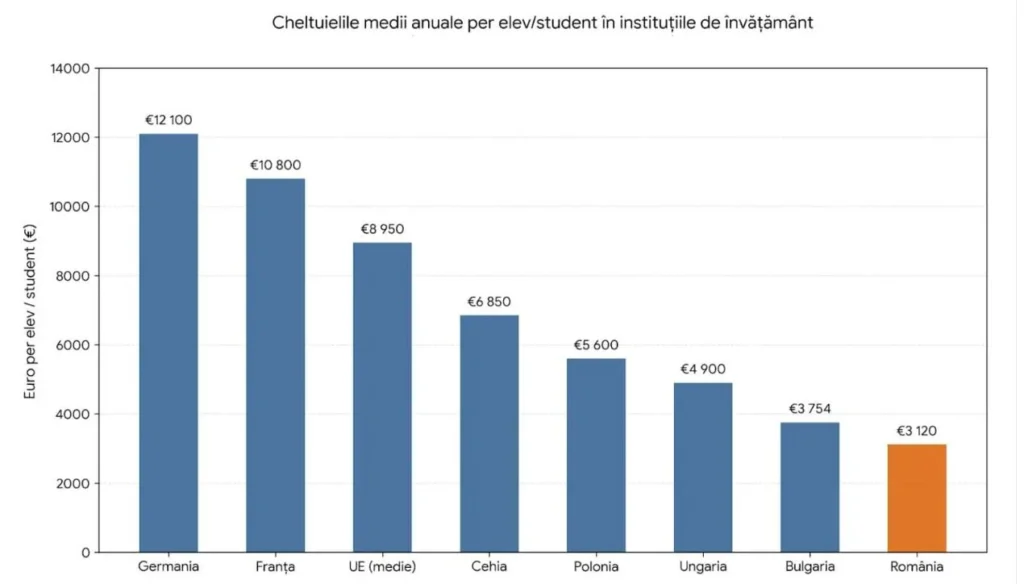
Regarding Education, Eurostat shows that in 2023 (the most recent year with detailed expenses), for most EU countries, the average annual expenses (from public and private sources) for all educational institutions, per student, ranged from 3,754 euros in Bulgaria to 15,323 euros in Denmark.
Outside this range were:
- Luxembourg, which recorded considerably higher average education expenses per student, at 27,531 euros
- Romania, with 2,775 euros, registering a much lower average.
Eurostat data shows that Romania combines a minimal share of GDP allocated to education with an extremely low gross amount per student and low investments in infrastructure, explaining the human capital and educational performance gaps compared to other European states.
Thus, while in the EU, public expenses for education average 4.7% of GDP, with European leaders like Sweden allocating 6.8% of GDP, Romania's share was only 3.0% of GDP.
Most member states allocate between 3.9% and 5.3% of GDP.
The general underfunding of 3.0% of GDP affects all levels of education. Although higher education receives a proportionate share similar to the EU average (between 20 and 26% of the total Education budget), the absolute volume of funds per student remains among the lowest in the EU, due to the very limited total budget envelope.
Read the full analysis Starting school. As an idea: How (little) "costs" a student in Romania, compared to other EU states on Curs de Guvernare