
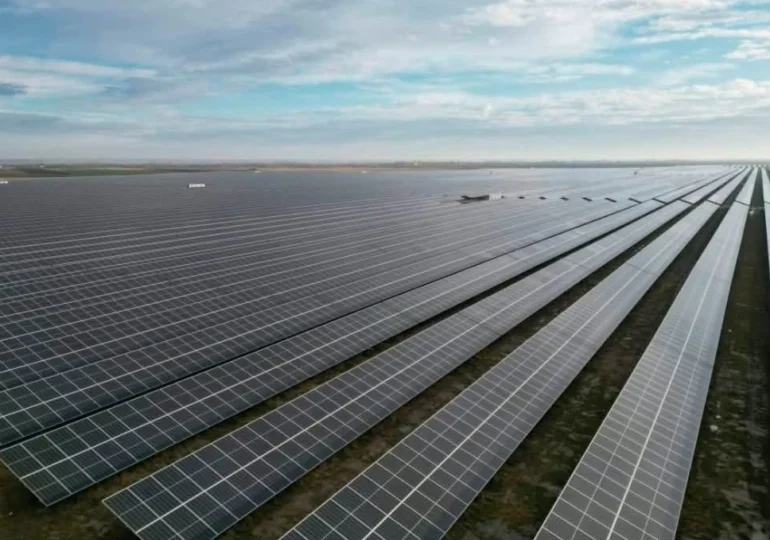
The project of the largest photovoltaic park in the EU has taken a significant step towards realization and could soon provide enough energy for nearly one million people.
The National Energy Regulatory Authority (ANRE) of Romania has issued the establishment permit for the Dama Solar photovoltaic park. This is granted when developers can demonstrate they have the necessary funding for large-scale infrastructure projects, reports Euronews.
The Dama Solar photovoltaic park, a project led by the company Rezolv Energy, will be located in the northwest of Arad County, near the border with Hungary.
The advantage Romania will have
With the goal of entering the commercial operational phase by 2030, the project will surpass the Witznitz photovoltaic park near Leipzig (Germany), which is currently the largest operational unit of its kind in the EU, as noted by the source.
Additionally, the project could support Romania's transition away from fossil fuels, an area where it has started to lag behind.
Romania generated only 9.78% of its electricity from solar sources last year, compared to the EU average of 13.1%, according to data compiled by the energy organization Ember.
Furthermore, the country fell behind the EU average in wind energy (12% compared to 17%), as well as bioenergy and nuclear energy.
Although most of Romania's electricity production in 2025 came from hydropower (24.3%), it largely relied on gas (16.9%) and coal (15.2%), with the latter being considered the most polluting energy source.
Energy production from gas and coal exceeds the EU average (16.8% and 9.18%, respectively).
How much energy will the solar park in Arad produce
The photovoltaic park will have an installed capacity of 1.24 GW when operational, according to Rezolv Energy.
Theoretically, it could produce a maximum of 10.86 TWh of electricity per year (more than double Romania's current solar energy production).
However, photovoltaic parks do not operate at maximum capacity throughout the year because they depend on specific weather conditions (clear skies and sunlight). Nevertheless, even if the park were to operate at an average of 15% of capacity in a year, a conservative estimate given its location, it could still produce 1.63 TWh of electricity.
Developers estimate that the annual energy production of the plant will be able to cover the consumption of over 280,000 households, meaning almost one million people.
Additionally, the project will create over 500 new jobs in the next three years.
Rezolv Energy states that the photovoltaic park will make a "remarkable contribution" to Romania's renewable energy targets for 2030 and is considering the possibility of adding "substantial energy storage capacities" in the future. This will help minimize the waste of solar energy produced during periods of low electricity consumption.
"A large part of low-quality agricultural land will be transformed into pasture, and vegetation will be managed through sheep grazing," the organization adds. "The project will also include an 82-hectare natural reserve, one of the largest private nature restoration initiatives associated with a photovoltaic project in Southeastern Europe," mentioned Rezolv Energy.
T.D.