
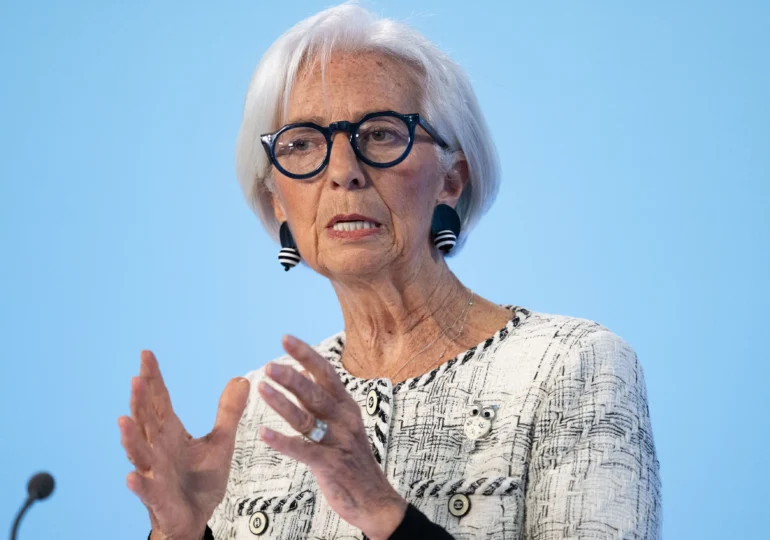
Europe can no longer rely on the economic model that has brought it prosperity in recent decades, and if it does not address its internal problems, it risks falling behind in the race for artificial intelligence, warns European Central Bank President Christine Lagarde.
World trade is becoming increasingly fragmented, the cheap energy on which the European industry relied has disappeared, and the security guarantees traditionally offered by the United States can no longer be considered a certainty.
Lagarde made this analysis on Wednesday in Geneva during a meeting of the International Business Council of the World Economic Forum, according to the speech published by the ECB.
„Taken together, these changes suggest that Europe’s post-war growth model is eroding. And it is unlikely to return to the form we have known,” said the ECB chief.
### [Warning from the Commission for Romania: The economic model that brought it to 78% of the EU average has reached its limits. Future growth depends on innovation and technology](https://spotmedia.ro/stiri/economie/avertisment-al-comisiei-pentru-romania-modelul-economic-care-a-adus-o-la-78-din-media-ue-si-a-atins-limitele-cresterea-viitoare-depinde-de-inovare-si-tehnologie)
### What has changed for Europe
Lagarde explained that Europe’s economic development after World War II was based on three major advantages.
The first was the expansion of world trade. Europe became one of the most open economies in the world and benefited greatly from globalization. However, the situation is changing rapidly: last year alone, over 2,500 trade restrictions were introduced globally.
The second advantage was a strong European industry, long supported by access to relatively cheap energy. This advantage has also diminished.
China now competes directly with the euro area in nearly 40% of the sectors where Europeans have a competitive advantage, compared to about 25% in the early 2000s.
At the same time, energy prices have risen sharply. Last year, electricity prices for large energy-consuming industries in the EU were, on average, over twice as high as in the United States and about 50% higher than those in China.
The third advantage was a relatively stable international order based on rules and supported by US security guarantees. This framework allowed European companies to build their supply chains primarily based on costs and efficiency.
Now, geopolitical tensions are changing the calculations. Economic dependencies can become vulnerabilities, and companies are more cautious when deciding where and how much to invest.
### [The world’s first Quantum Artificial Intelligence Data Center will be in Cluj](https://spotmedia.ro/stiri/it/primul-centru-de-date-din-lume-cu-inteligenta-artificiala-cuantica-va-fi-in-cluj)
### Europe risks missing the AI revolution
Lagarde warns that Europe has already fallen behind in the first digital revolution, with much of the gains from new technologies going to other regions of the world.
„We cannot afford to repeat this experience with artificial intelligence, the second digital revolution,” warned the ECB chief.
The issue is not necessarily a lack of investments. European companies already spend significant amounts on AI, but the European market remains fragmented, and firms face difficulties when trying to expand across multiple states and attract sufficient funding.
As Lagarde points out, too few European companies reach global sizes, and new technologies spread more slowly in the economy.
The gap compared to the US is huge. The most valuable 34 European technology companies listed on the stock market together are worth approximately 1.37 trillion euros. In comparison, the seven major American technology groups known as the „Magnificent Seven” together have a value of over 23 trillion dollars.
### [“Made in Europe” or “made at home”? What do Europeans choose when public money is at stake](https://spotmedia.ro/stiri/economie/fabricat-in-europa-sau-fabricat-acasa-ce-aleg-europenii-cand-sunt-in-joc-banii-publici)
### Solutions proposed by Lagarde
However, Europe also has significant advantages: a single market of approximately 450 million consumers, strong industries, and the most extensive network of trade agreements in the world.
The problem is that this huge market does not yet function well enough as a single market.
One of the solutions discussed at the European level is the „EU Inc.” project, through which a company could register once and then operate throughout the Union under a common set of rules.
In parallel, the EU is preparing reforms for the integration of capital markets, so that European firms can more easily find the funds they need to grow.
In Lagarde’s vision, if barriers between European economies are reduced, the size of the EU can once again become an advantage: innovative companies could grow faster, new technologies could spread more easily, and domestic demand could further support Europe’s economy.