

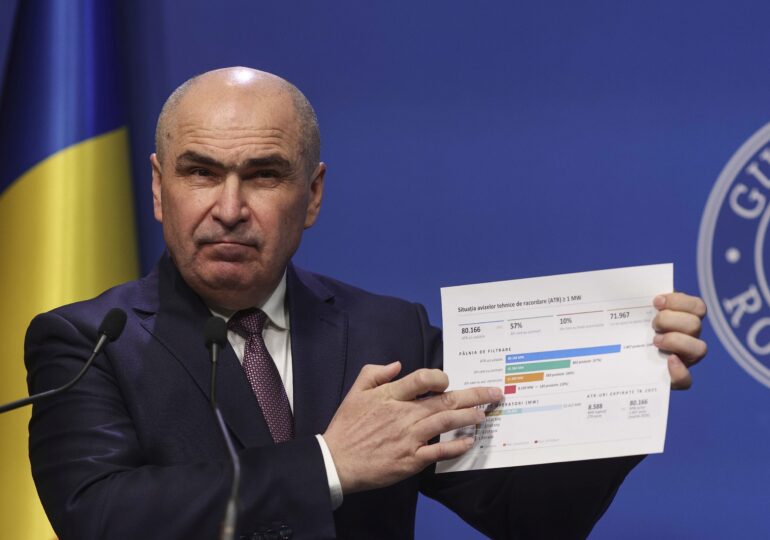
Prime Minister Ilie Bolojan, alongside Energy Minister Bogdan Ivan, presented on Wednesday the main directions of reform in the energy sector during a press conference focused on investments and price reduction.
The head of the government emphasized that energy is a key area for the economy and that prices depend on both production capacities and market rules.
"One of the most important areas for Romania is electricity, and energy prices are influenced both by production capacities and market regulations. We need to improve our production capacities to lead to lower prices," stated the Prime Minister.
Five directions for cheaper energy
After analyzing the sector's issues, the Government is focusing on five strategic directions.
- Unlocking viable energy projects by releasing network capacities and reducing access costs to electrical grids. This means abolishing speculative technical connection permits that block or increase access to electrical grids.
- Improving the performance of state energy companies.
- Reducing market distortions in the energy market.
- Increasing storage capacities for renewable energy.
- Supporting strategic investments in the energy sector.
The Prime Minister criticized the current connection system, where many projects are artificially blocked. "Instead of the 9,000 megawatts needed by the economy, we issued permits for 80,000 megawatts (...). Out of the 80,000 megawatts, only 8,000 megawatts have progressed. This means that 90% of the projects are speculative," he said.
He explained that many investors do not intend to actually build production capacities. "Those who obtained these projects do not intend to develop them but aim to sell them."
The Government is preparing stricter rules. "We need to tighten regulations, significantly increase guarantees, impose firm deadlines (...). If deadlines are not met, those who provided the guarantees should lose them," the Prime Minister stated.
State companies at the center of the reform
Bolojan emphasized that major state companies dominate energy production and directly influence prices.
"The majority of energy in Romania is produced by state companies, and three companies – Hidroelectrica, Nuclearelectrica, and the Oltenia plant – represent over 60% of production," he said.
The Prime Minister criticized the evaluation method of managers. "Today, in many companies, we have performance indicators that are not relevant (...)."
The proposed solution: audit and clear criteria. "We need to audit all management contracts, revise performance indicators that are clear and measurable. If they perform well, great; if not, they should be replaced," said Ilie Bolojan.
Spotmedia.ro broadcasted LIVE TEXT the main statements of the Prime Minister and the Energy Minister:
Prime Minister Ilie Bolojan:
One of the most important areas for Romania is electricity, and energy prices depend on both production capacities and market rules. We need to improve our production capacities to lead to lower prices.
After analyzing the issues we face, we are pursuing five strategic directions. These are:
- Unlocking viable projects by releasing network capacities and reducing access costs to electrical grids. This means abolishing speculative technical connection permits that block or increase access.
- Improving the performance of state companies in the energy sector. Any improvement will result in quantities
- Reducing market distortions in the energy market. We need to reduce volatility in this market, reduce quantities traded on daily markets, expand quantities traded long-term with end customers, encourage suppliers doing these, including reducing outstanding payments to be settled with them.
- Increasing storage capacities. We have a significant share of fluctuating energy from wind and solar. In the coming years, we should focus on storage to balance these markets.
- The fifth direction is to support strategic investments in the energy sector. From large interconnections and cross-border networks, to large investments in production, both in band, which are at least 10% of total production, to accelerating investments over a significant value, simplifying authorization processes and expropriation procedures.
These are actions for the short and medium term that we need to follow.
Unlocking viable projects by releasing network capacities. We need to abolish technical connection permits that block or increase access. Instead of the 9,000 megawatts needed by the economy, we issued permits for 80,000 megawatts, so nearly ten times the power we need.
In the last 3 years, we had the largest increases - 27,000 megawatts, 30,000 megawatts. The majority of these technical connection permits were issued in the last three years. We see that less than 10% of these permits have progressed. Out of the 80,000 megawatts, only 8,000 megawatts have progressed. This means that 90% of the projects are speculative. Those who obtained these projects do not intend to develop them but aim to sell them. In any case, they cannot be viable.
Without clear regulations, these speculative procedures were allowed. Especially Transelectrica, which issued over two-thirds of these powers holding these permits, depending on contacts with Transelectrica, were resolved sooner or later.
What do we need to do? We need to tighten regulations, significantly increase guarantees, impose firm deadlines for investments to be completed. If deadlines are not met, those who provided the guarantees should lose them in favor of Transelectrica or other network owners or in favor of the state.
A 20% increase in guarantees is low. The Government will send proposals to ANRE so that by the end of the month, we will have new regulations.
Spain, seeing a large number of speculative projects, took serious measures. We should set guarantees that amount to 10% of the investment value.
By the second half of this year and at the latest next year, we could have permits remaining in the market for serious companies with financing. We will be able to release the networks and allow serious investors to make these investments, but for that, we need to rid the networks of technical connection permits.
It is important for Transelectrica to have a strategy regarding Romania's needs.
The majority of energy in Romania is produced by state companies, and three companies – Hidroelectrica, Nuclearelectrica, and the Oltenia plant – represent over 60% of production; if we include the power plants in major cities on gas, we reach over two-thirds. Any improvement in the performance of these companies will be reflected in prices.
The current leadership of these companies was selected based on the corporate governance ordinance.
A group of consulting firms conducted competitions, and in the end, individuals connected to the governmental sector and political area won. It's not a problem, but when they take office, they need to do a good job.
Today, in many companies, we have performance indicators that are not relevant, so if the indicators are not met, you should lose your mandate. If at the Oltenia plant there were clearer indicators, the managers would be more interested in completing projects.
The current leadership of these companies was selected based on the corporate governance ordinance.
A group of consulting firms conducted competitions, and in the end, individuals connected to the governmental sector and political area won. It's not a problem, but when they take office, they need to do a good job.
Today, in many companies, we have performance indicators that are not relevant, so if the indicators are not met, you should lose your mandate. If at the Oltenia plant there were clearer indicators, the managers would be more interested in completing projects.
At Romgaz, at Hidroelectrica, if there were unequivocal criteria, the leadership would be much more interested in carrying out investments.
We need to audit all management contracts, revise performance indicators that are clear and measurable, and conclude new management contracts with the current leadership. If they perform well, great; if not, they should be replaced.
Energy Minister Bogdan Ivan:
I want to focus more on the segment of electricity production in our country and the projection we have for Romania by the end of 2026, the end of 2027, and the end of 2030. In terms of investments that we anticipate to be completed and inject energy into the grid by the end of 2027, we will enter with approximately 5,800 megawatts, of which 3,600 renewable, the difference - gas.
Through PNNR and the modernization fund, by the end of this year, we will have a total of about 2,000 megawatts per solar, 350 megawatts on wind, 2,200 megawatts on gas. The two plants in Arad and Constanța, plus Iernut and Mintia.
The Prime Minister responded to journalists' questions
How do you view the CNA decision to revoke RealitateaTV's license?
Ilie Bolojan: I haven't followed in detail, but I believe that freedom of expression and respect for the law should not be in contradiction, and the courts will decide.
Did you refuse to meet with the Minister of Agriculture?
Ilie Bolojan: Each minister has the opportunity to contact me daily or once a week at government meetings. I spoke with the Minister of Agriculture; there was a meeting in the energy group that we had once every 2-3 days recently, and I canceled the meeting with him half an hour before. He did not contact me at another time. If we focus more on working internally, I am confident that we will achieve results.
The AUR party has started to support more projects submitted by the PNL. If PSD leaves the government, do you rely on AUR's votes for a minority government?
Ilie Bolojan: Parliamentary groups of the parties often decide on various subjects as they see fit. I believe that Romania needs a stable government that should rely on predictable votes, on coalition votes, that is the best solution.
How do you see the evolution of prices?
Ilie Bolojan: If the crisis in the Gulf continues, there will be effects in the market. If these things drag on, the indicators we estimated in the budget will be affected. Depending on the situation's evolution, we will adapt.
Is the PSD's decision heading towards breaking the coalition? Are you prepared to lead a minority government or will you resign?
Ilie Bolojan: I am the Prime Minister of Romania, I have a responsibility in this capacity, and I do what is within my power to honor this responsibility. The best situation for Romania is to have a government based on a stable parliamentary majority. Any other options can be discussed hypothetically, but they are not good options for Romania.
Has the Minister of Justice consulted you regarding proposals for leading the prosecutor's offices?
Ilie Bolojan: I have not been involved in this procedure and have not been consulted. I have other concerns than these aspects falling under the Ministry of Justice's competence.
Why is there no change at Transelectrica? When will Romanians see cheaper energy?
Ilie Bolojan: To change leadership, you need to have a legal possibility. If contracts were made as a reward for those who have taken up positions, and not as a challenge, it means the contract is unbalanced. What we proposed and all agreed upon is that these indicators need to be reviewed. We aim to conduct these audits by the end of this month.
I believe that if the two measures - supporting investments and storing and improving strictly applied regulations - from the fall, we should see some effects, and from next year, we should see significant drops.
President Nicușor Dan said that a crisis scenario on energy is being worked on. What does this mean?
At this moment, there are no supply problems for the Romanian market. We ensure that the interventions we make in the market keep the Romanian market competitive. Different working hypotheses can be worked on, but we do not currently have such problems.
Is it necessary for the president to push the governing parties to remain in power? Does he play the role of a mediator?
Ilie Bolojan: It is one of the tools that the president has at his disposal, the competence of a mediator.
Where do you get the money for Pfizer?
Ilie Bolojan: The Ministers of Health and Finance are traveling to the United States for this - negotiations with Pfizer. In over 2 weeks, we will receive the court's reasoning, then there will be another 2 months in which it would be good to find a formula to stop the penalties during the negotiations and to find a formula until an appeal or not - it will be analyzed with the law firm and with Poland. We will also seek support from the European Commission. We are looking for a formula either for staggered payments or for this amount to be converted into delivered medicines.
