
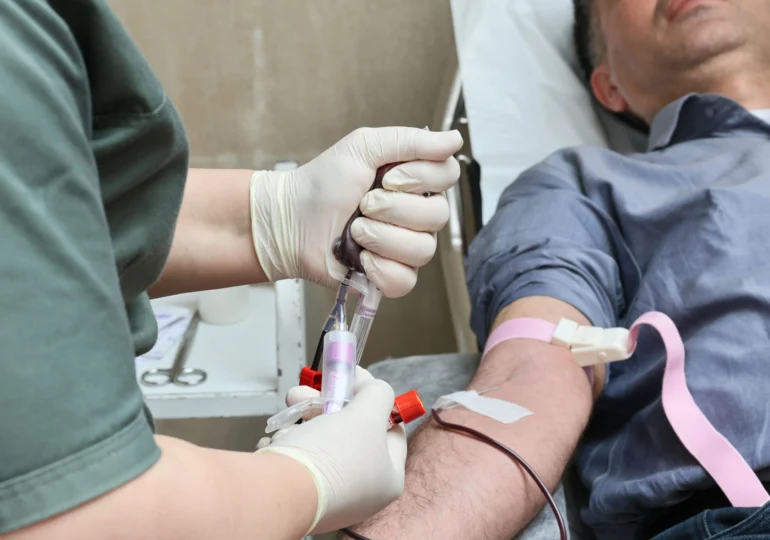
A Romanian who donates blood can obtain a higher interest rate by investing their savings in government bonds. The facility, introduced to encourage donation, has also become a source of funding for the state: since the beginning of 2025, the tranches dedicated to donors have attracted approximately 2.8 billion lei.
The Romanian program is featured in an article published on Friday by Bloomberg, which explores how governments are trying to attract more individual investors to meet their borrowing needs.
The publication cites the example of Ionuț Nedelea, a 46-year-old project manager. He donates blood several times a year and uses the certificate received to purchase Fidelis government bonds from the tranches reserved for donors.
A Higher Interest Rate for Donors
At the September Fidelis edition, donors were able to purchase bonds in lei with an annual interest rate of 7.3% for a period of two years. The offer also included a tranche in euros dedicated to them, with an annual interest rate of 5% for three years. The condition is to present a document proving the blood donation during the specified period for that issuance.
According to data presented by Bloomberg, the special tranches have attracted around 2.8 billion lei since the beginning of 2025, equivalent to approximately 604 million dollars.
The facility aims to achieve two objectives: to encourage blood donation and to attract the population's savings to government bonds. When purchasing such a bond, the investor lends to the state, and the state pays the promised interest and returns the invested amount at maturity.
Why Is the State Seeking Funds from the Population
The bonds for blood donors are just a part of the money that the state borrows from the population. Taking into account the two programs aimed at individuals, Tezaur and Fidelis, they cover almost a fifth of the amount that Romania needs to borrow to cover its budget deficit and repay maturing debts, according to Bloomberg.
For the state, these investors can represent a more stable source of funding: many hold the bonds until maturity. However, preferential interest rates come at a cost, borne by the budget.
The Treasury chief, Ștefan Nanu, defends the additional interest offered to donors through the program's social benefit. "Our goal is not to enrich some people, but to support blood donation," he told Bloomberg.
For those who invest, the interest rate difference matters. Laviniu Beze, a representative of an association of individual investors, says he donates blood four times a year and that government bonds now represent 40% of his portfolio. "I have trading in my blood," he joked, according to the same report.
Bloomberg places Romania's example in a broader trend: more and more countries are trying to attract the population's savings to government bonds. In the countries analyzed by the OECD, states owed individuals 11% of the total public debt in 2024, a share more than twice as high as in 2021.