


Public administration and state-owned companies in Romania have fewer and fewer young employees and rely heavily on personnel close to the end of their professional careers.
Data published by the Government regarding the age structure of employees in public institutions and state-owned companies show a public sector dominated by employees nearing the end of their careers.
Approximately 55% of employees are between 45 and 59 years old, and estimates indicate that over half of the current workforce could retire in the next 15 years, while young people under 25 represent a very small segment.
The statistics were published on a new transparency platform launched by the Executive, which centralizes information about public administration and state-owned companies.
Nearly 219,000 civil servants are between 45 and 49 years old
The graph on “The number of insured persons in public institutions by age categories” shows that the peak is in the 45-49 age category, where there are 218,777 employees.
Close behind is the 50-54 age group, with 218,708 individuals, followed by the 55-59 age category, with 207,643 employees.
In practice, only these three categories account for over 645,000 individuals in the public system.
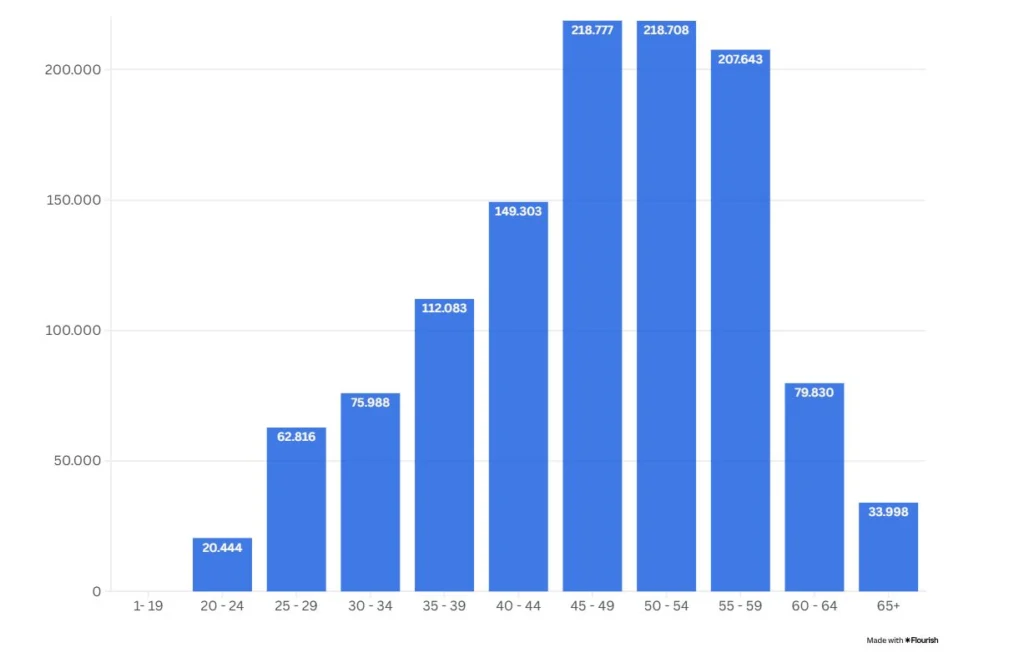
Conversely, the number of young people is much lower. In the 20-24 age category, there are only 20,444 employees, over ten times fewer than in the dominant age groups in administration. The 25-29 age category counts 62,816 individuals.
The data also show that after the age of 35, the number of employees increases rapidly: 112,083 individuals in the 35-39 age group and 149,303 in the 40-44 age category.
Overall, data published by the Government show that over 1.1 million employees work in public institutions in Romania, with the majority concentrated in the 45-59 age groups.
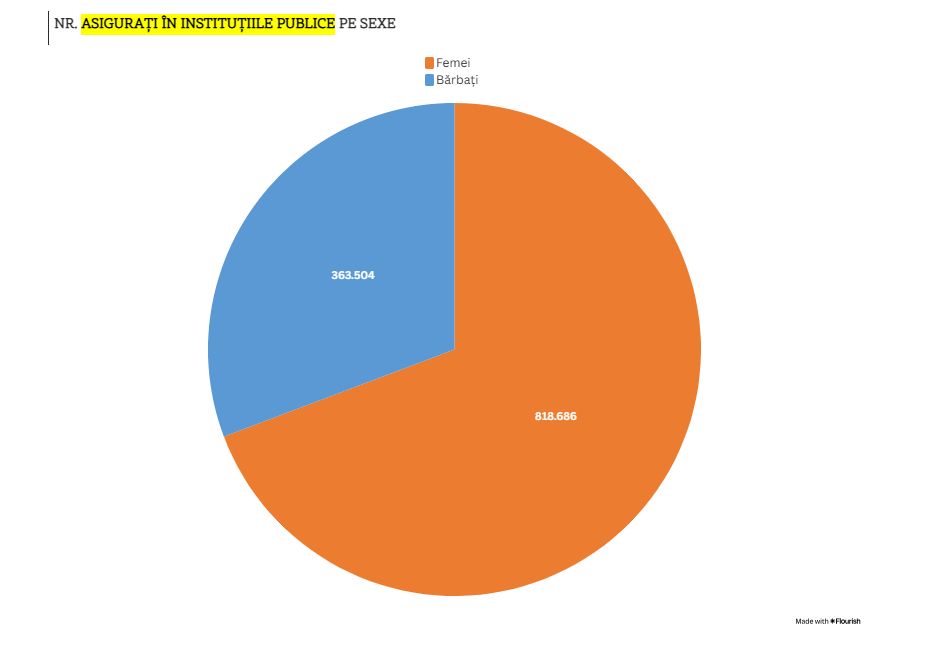
The public sector is dominated in terms of gender structure by female employees. According to data published by the Government, women represent approximately 69% of employees and insured individuals in public institutions, while men account for nearly 31%.
State-owned companies also have employees nearing retirement
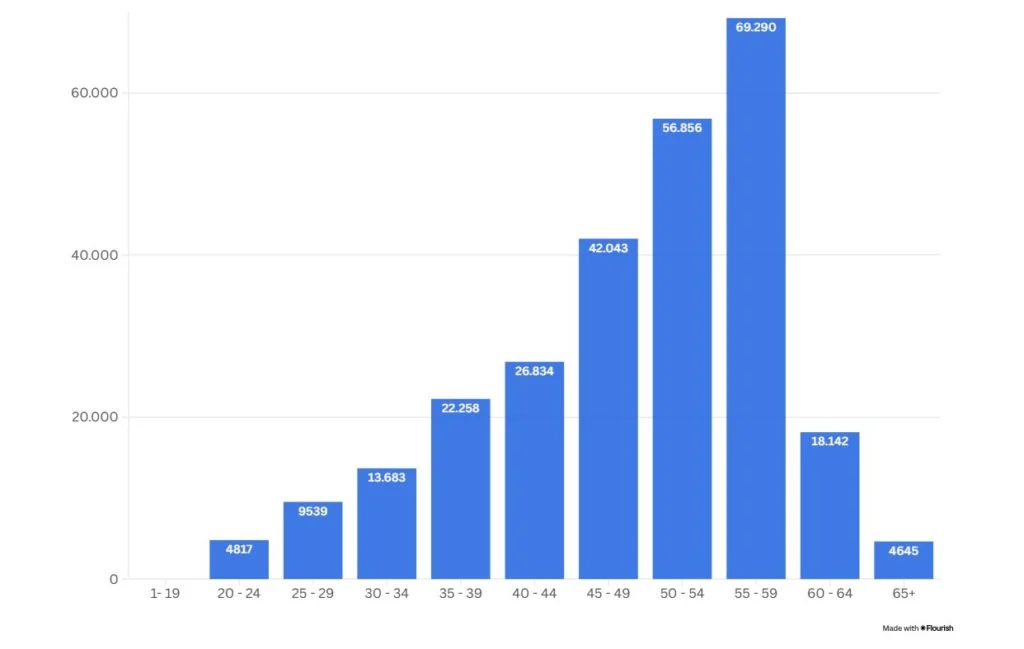
State-owned companies have nearly 258,000 employees, with the most numerous categories being those close to retirement age.
The largest category is 55-59 years old, with 69,290 employees.
Following are the age groups of 50-54 years old, with 56,856 individuals, and 45-49 years old, with 42,043 employees.
On the other end, the 20-24 age group has only 4,817 individuals, and the 25-29 age category has 9,539 employees.
The data thus indicate that even state-controlled companies are facing a pronounced aging of the workforce and difficulties in attracting young employees.
What does the platform launched by the Government represent?
The data was published on an online transparency platform launched by the Government, which centralizes information about employees in public institutions and state-owned companies. According to the official presentation, the platform brings together data from multiple state administrative sources and allows their visualization in the form of interactive graphs and statistics.
The Executive specifies that the information is centralized based on records regarding employees in the public sector.
In the project description, the Government states that the purpose is "to increase transparency and public access to relevant information about public administration and state-owned companies."
Authorities claim that the platform was designed to provide "a clear and accessible picture of the structure of the public sector" through periodically updated visual representations.