
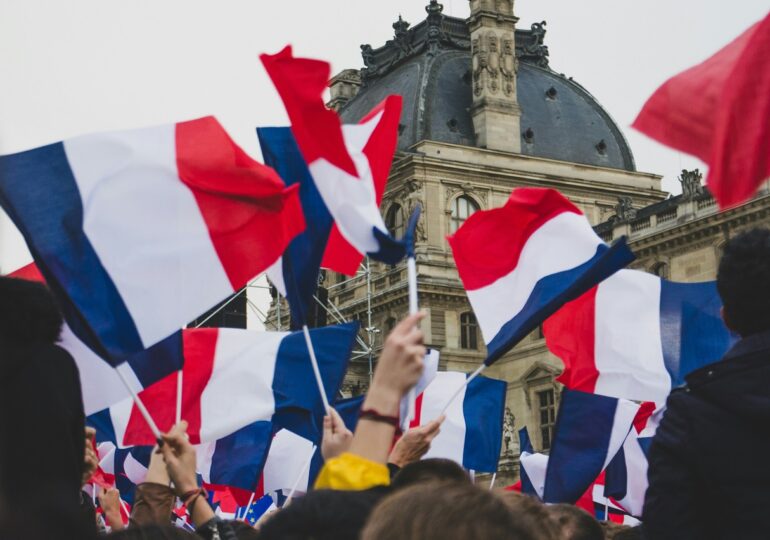
France, once observed the French travel writer Sylvain Tesson, „is a paradise inhabited by people who think they live in hell.” As the campaign for next year’s presidential elections heats up and new candidates emerge one after another, the country seems engulfed in an increasingly oppressive atmosphere.
If the elections were held now, Marine Le Pen, the anti-immigration populist leader, would have a serious chance of reaching the Élysée Palace, considering the voters’ disappointment with the entire political class and the growing feeling that „we have already tried all other options.”
However, a lot can happen between now and April 18, 2027, the date of the first round. France, after all, is a country where political surprises sometimes come out of nowhere, writes Paul Taylor, a researcher at the European Policy Centre, in an editorial for The Guardian.
In the spring of 2011, Dominique Strauss-Kahn, then the director of the IMF and a highly regarded former Finance Minister, was the frontrunner for the Socialist Party's candidacy in the 2012 presidential elections. It was anticipated that he would defeat the conservative President Nicolas Sarkozy. However, a sex scandal shattered his political career, and François Hollande, a socialist politician previously considered without real chances, ended up at the Élysée.
Five years later, in 2016, former conservative Prime Minister François Fillon was the clear favorite for Hollande's succession. Then it was revealed that he had provided his wife with fictitious parliamentary jobs paid with public funds. Fillon finished third, and victory went to a young centrist outsider, without a party and without a traditional political network: Emmanuel Macron.
Major Implications Not Only for France
To understand the atmosphere in which next year's campaign is unfolding – elections with major implications not only for France but also for Europe and the Western alliance – it is worth taking a closer look at the elements that make the dissatisfaction of the French somewhat different from the crises experienced by other developed democracies.
It is true that politics has become harsher and more polarized in many countries. Other major European economies are stagnating. Traditional parties are losing ground and fragmenting, facing both the rise of right-wing populist nationalists and a new radical left, often ecologist. All this is overlaid with the frenetic pace of social networks and round-the-clock news.
Nevertheless, France has some historical particularities that give this crisis a unique character. This is the conclusion reached by Paul Taylor in a recent discussion with Michel Wieviorka, one of the most renowned French sociologists and author of numerous studies on French society.
France was the first major centralized state in Europe, and the tradition of strong state intervention in the economy dates back to the time of Cardinal Richelieu, Louis XIV, and his minister Jean-Baptiste Colbert in the 17th century. This tradition was resumed in the 20th century by Charles de Gaulle and the post-war governments, which used a strong economic planning apparatus to accelerate industrial modernization. The nuclear program, the aerospace industry, and major public infrastructure projects were among the results of this policy.
The Tradition of Protest
This legacy partly explains why the French have such high expectations from the state and are willing to accept very high levels of taxation, income redistribution, and public spending. France is among the world's major economies with the highest shares of public spending in GDP.
But the same tradition also contributes to the accumulation of a very high public debt. France's debt-to-GDP ratio, at around 118%, is one of the highest in Europe and continues to rise rapidly.
"The French are very attached to public services and are deeply concerned about their deterioration," says Wieviorka. This deterioration is evident in public education, as well as in the judicial system, police, tax administration, and healthcare services, a situation further exacerbated by the Covid-19 pandemic. "They feel that we were once a great country, and now we are falling apart."
There is another French particularity: the centuries-old tradition of protest, sometimes violent. From peasant revolts and barricades in Paris in the 16th and 17th centuries to the French Revolution of 1789, the revolt against authority has been considered by a significant part of society not only acceptable but legitimate.
Jean-Paul Sartre summed up this mentality with the famous phrase: "It is right to revolt."
And the French trade union movement was formed in this spirit. Its origins can be traced back to anarcho-syndicalism before the Communist Party came to exert dominant influence. Unlike British or German unions, French trade unionism did not develop the same tradition of compromise and negotiated reforms.
The French executed their king in the 18th century, just as the English had done in the previous century. However, it took France nearly a century to definitively abandon the monarchy, after two royal restorations and two empires.
The Separation of Church and State
The French left continued the fight for republican principles and emerged victorious in the confrontation with authoritarian forces supported by the Catholic Church during the Dreyfus affair at the end of the 19th century. From this confrontation emerged the strict separation between Church and state, as well as the principle of laicity – laïcité – which still enjoys broad support in French society today.
At the same time, however, the decline of Christian identity and religious practice in France coincided with the rise of Islam, especially among the immigrant population. This phenomenon has fueled fears that conservative and far-right politicians have amplified, alongside the new media empire built by billionaire Vincent Bolloré.
These fears have contributed to the rise of the National Front, the far-right party founded by Jean-Marie Le Pen in 1972. Wieviorka describes it as the "pioneering national-populist party of Europe," as it placed combating immigration at the center of its program.
In 2018, Jean-Marie Le Pen's daughter, Marine, renamed the party Rassemblement National (RN – National Rally), in an attempt to improve its image and make it more acceptable to a wider electorate.
The party has its ideological origins in the political environment of the Vichy regime, which collaborated with Nazi Germany. In the meantime, traditional antisemitism has been replaced by anti-Islamic rhetoric, and RN supports the concept of "national priority," whereby French citizens are supposed to receive priority for certain social benefits, housing, and medical services.
Another important particularity is represented by the French political and administrative elite. After World War II, it was rebuilt on meritocratic principles, including the establishment of the National School of Administration (ENA), an institution designed to train senior public officials and leaders of major nationalized enterprises.
Many graduates of this system later entered politics. Over time, however, the system has become rigid and has produced an elite that tends to reproduce itself – the so-called énarques. They are increasingly perceived as detached from the problems and concerns of ordinary French people.
Profound Lack of Optimism about the Country's Future
All these factors contribute to explaining the population's state of mind on the eve of the electoral campaign: a profound lack of optimism about the country's future, unease about national identity, the deterioration of public services and the cost of living, as well as a deep disappointment with a political class perceived as incapable of solving these problems.
To Wieviorka's list, Paul Taylor adds another element: a widespread lack of economic realism and the conviction that what the French call "public money" – what the British or Germans would call "taxpayers' money" – is practically unlimited.
This lack of economic realism makes France particularly receptive to solutions that promise money without real costs. An example is RN's fantasy that debt and budget deficit would evaporate if the government stopped social benefits for immigrants and drastically reduced its contribution to the EU budget.
On the other hand, the radical left politician Jean-Luc Mélenchon argues that France could simply "at no cost" cancel 18% of the debt held by the European Central Bank and confiscate all inheritances exceeding 12 million euros.
It is not surprising, therefore, that politicians proposing less spectacular and harder-to-sell solutions – such as raising the retirement age or reducing certain social benefits – have little success with the electorate.
One of the most famous slogans of the student revolts of May 1968 said: "Be realistic, demand the impossible."
Today, the great risk is that the French will vote with instinct, not reason. At a time when France and Europe face such great geopolitical and fiscal risks, the outlook is deeply worrying.