
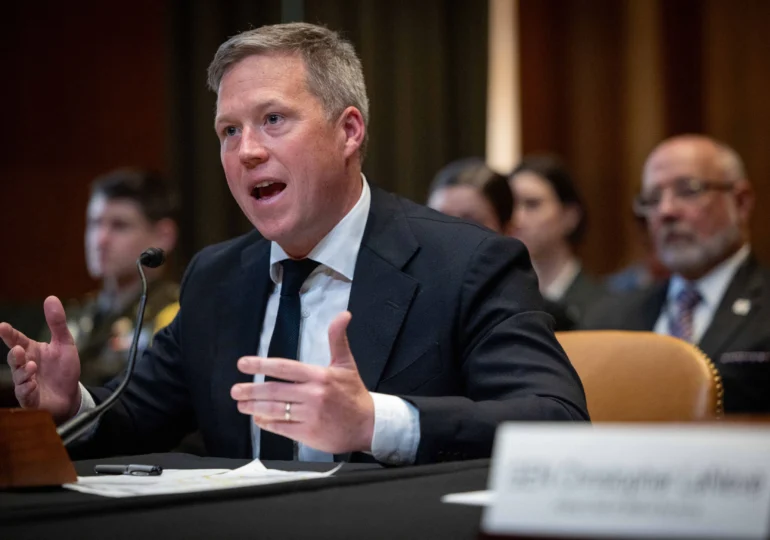
The Secretary of the Army spoke directly to Trump about issues within the American ground forces and the conflict with Pentagon chief, Pete Hegseth. A few days later, he resigned.
Last week, at a meeting held at the White House, Secretary of the Army, Dan Driscoll, directly presented his concerns about the future of the Army under the leadership of Defense Secretary, Pete Hegseth, to President Donald Trump.
The discussion revealed how tense the relationship had become between the two Pentagon leaders and how deep the leadership crisis within the institution had grown, according to four individuals familiar with the conversation, cited by The Atlantic.
Trump was reportedly surprised when Driscoll informed him of how many generals and other high-ranking officers had been dismissed or removed since Hegseth took over the Pentagon. Driscoll explained that the Army cannot achieve the transformation it needs if it loses so many of its leaders.
According to one source, Trump expressed concern about the extent of the losses in Army leadership. Driscoll then told the president that he intended to resign. And now his departure has become a reality.
Hegseth's purge of the military leadership has been so extensive that, following Driscoll's departure, the largest branch of the American army remains without a permanent civilian leader, without a Senate-confirmed Army chief, without a confirmed general to lead operations, and without a confirmed commander of US troops in Europe.
Following the dismissals over the past year, the US Army - with over 450,000 active-duty soldiers deployed worldwide - has fewer generals than at any other time in recent history.
Driscoll's direct intervention with Trump, just days before his departure, represents one of the most clear public expressions, at a high level, of the concerns within the Pentagon regarding the pressures exerted on the Army. Among these are Hegseth's interventions in personnel decisions and the increasing demands generated by the conflict with Iran.
White House spokesperson Anna Kelly stated that Driscoll had been "very effective" in improving military preparedness and promoting administration priorities.
"The United States Army is stronger than ever because of its work," Kelly wrote in a statement.
Driscoll's spokesperson declined to comment, and Driscoll did not respond to requests for statements. However, a person familiar with his resignation stated that Driscoll had expressed concerns to the administration about the transformation and operational capacity of the Army, especially regarding Hegseth's obstruction of these efforts by dismissing the generals responsible for them.
Hegseth did not immediately offer a comment on Driscoll's departure.
Hegseth and the Army Transformation
Since arriving at the Pentagon last year, Pete Hegseth - a former Fox News anchor who has become one of the favorite figures of the MAGA base - has sought to fundamentally reshape the Army.
Hegseth has criticized what he calls a "woke" army, advocated for leniency towards soldiers accused of war crimes, and promoted a vision of the military focused on combating progressive ideology.
He has installed generals who share his vision in influential positions, intervened to block the promotion of lower-ranking officers, and eliminated much of the diversity programs.
The consequence, according to his critics, is an Army from which many experienced leaders have disappeared and a increasingly conflictual relationship between the Army Secretary and the Pentagon chief.
Hegseth has ended the careers of dozens of officers, without always offering clear explanations. Now, the conflict has also led to the departure of the Army Secretary.
Driscoll's Departure Strengthens Hegseth's Position
Driscoll's resignation leaves the Pentagon even more firmly under the control of Hegseth and the MAGA agenda.
Driscoll was close to Vice President JD Vance, a relationship that gave him direct access to the White House. At times, he represented a counterbalance to Hegseth's impulses - but this influence had its limits.
Some current and former defense officials even consider that Driscoll's hostility towards Hegseth paradoxically contributed to the further purging of military officers.
Driscoll's departure had been expected for months, but the prospect of him being replaced by someone closer politically to Hegseth is already causing concern within the Army.
"What happens then? Damage for an entire generation," said a defense official.
Two Veterans, Two Styles
Driscoll arrived at the Pentagon in February 2025. He came from a military family with three generations of military service and had much in common with Hegseth, his new boss.
Both enlisted during the American wars following 9/11 and served in Iraq. Hegseth, who was part of the National Guard, also served in Afghanistan.
Both returned from war with harsh criticisms of American military interventions abroad and the institutional rigidity of the army.
Both studied at Ivy League elite universities: Hegseth at Princeton and Harvard, and Driscoll at Yale Law School, where he befriended Vance.
Both unsuccessfully attempted to enter politics and both hinted at a possible return to the political arena.
During his tenure as Army Secretary, Driscoll frequently reminded those around him that he had direct access to the vice president. According to individuals familiar with the situation, he told some that he aspired to one day run for the presidency of the United States - an ambition also attributed to Hegseth.
However, the differences between the two were evident in terms of temperament and political style.
Hegseth, who needed Vice President Vance's decisive vote to be confirmed by the Senate after failing to garner support from any Democrat, is one of the most loyal representatives of the MAGA agenda in the Trump administration.
He publicly boasted about dismissing "woke" generals, challenged military personnel who criticized him to resign, and repeatedly attacked the traditional press.
Driscoll supported the administration's policies, but did so in a much more conciliatory manner. This approach gained him support or at least the openness of many lawmakers, unlike Hegseth's combative style before Congress.
Unlike the Secretary of the Navy, Hung Cao, who adopted Hegseth's partisan and aggressive tone on social media, Driscoll avoided endorsing some of the most controversial decisions of the Pentagon chief or most of his priorities related to cultural wars.
Driscoll had good relations with the press, cultivated contacts with lawmakers from both parties, and sought to attract leaders from the tech industry to accelerate the transformation of how the Army wages war.
These relationships brought him additional responsibilities within the administration, including leading the Bureau of Alcohol, Tobacco, Firearms and Explosives and later serving as an unofficial mediator in the issue of the war in Ukraine.
However, all of this was a problem for Hegseth.
Military Personnel, Main Source of Conflict
Appointments and promotions within the Army have become one of the main points of contention between the two.
Hegseth did not hesitate to remove or promote officers according to his own criteria, sometimes in ways that deeply dissatisfied other Pentagon officials.
Driscoll supported General Randy George, the Army Chief of Staff. George's name had appeared on a list distributed before Trump's return to the White House, with senior officers considered to be dismissed for alleged deviations from the MAGA agenda.
Driscoll's support may have given George a reprieve. However, ultimately, Hegseth dismissed the general in April.
A few months later, Chris Donahue, a four-star general and commander of US forces in Europe and Africa, was also removed.
Since George's dismissal, the Army no longer has a permanent chief.
General Christopher LaNeve, chosen by Hegseth as the second-highest officer in the Army, has temporarily taken over this position. According to defense officials, LaNeve often directly consulted Hegseth for decisions, bypassing Driscoll.
Hegseth is expected to nominate LaNeve for the position of Army chief. However, there are already signals from Capitol Hill that he may face challenges in the confirmation process, largely due to congressional opposition to Hegseth.
"We will not reward Hegseth for what he has done to the Army," said a congressional staff member.
An Increasingly Politicized Army
The US Army has long prided itself on reflecting the diversity of American society. However, under Hegseth's leadership, women and minority members have been removed or hindered from advancing in their careers.
The armed forces have traditionally sought to remain apolitical. Under Hegseth, critics say that this principle is being tested: military personnel are allegedly being evaluated not so much based on their combat experience, but on perceived loyalty to the administration.
Among the dismissed generals are some of the most experienced and decorated officers in the Army.
Each departure like this means the loss of decades of experience and investments in the training of a soldier. At the same time, serious questions arise about how future officers will be able to advance in a structure from which so many experienced leaders are being removed.
Who will replace Driscoll?
In the short term, it is expected that the Under Secretary of the Army, Michael Obadal, will take over Driscoll's duties.
In the longer term, however, many Pentagon officials fear that the administration will nominate Sean Parnell, the Pentagon's spokesperson and another Army veteran, to fill the position.
Parnell, who unsuccessfully ran for the U.S. Senate in Pennsylvania, shares Hegseth's combative style and his interest in cultural and personnel issues.
Like Hegseth, Parnell lacks experience in leading a large organization and would likely face a tough confirmation hearing in the Senate.
An Army secretary more concerned with politics and probably less experienced and less well-connected than Driscoll could keep the institution embroiled in the administration's cultural and ideological disputes.
Instead of focusing on long-term planning and transforming its military capabilities, the Army risks remaining absorbed in political and ideological battles in Washington.
And this, argue Driscoll and other officials, is exactly what the Army can least afford at this time.