
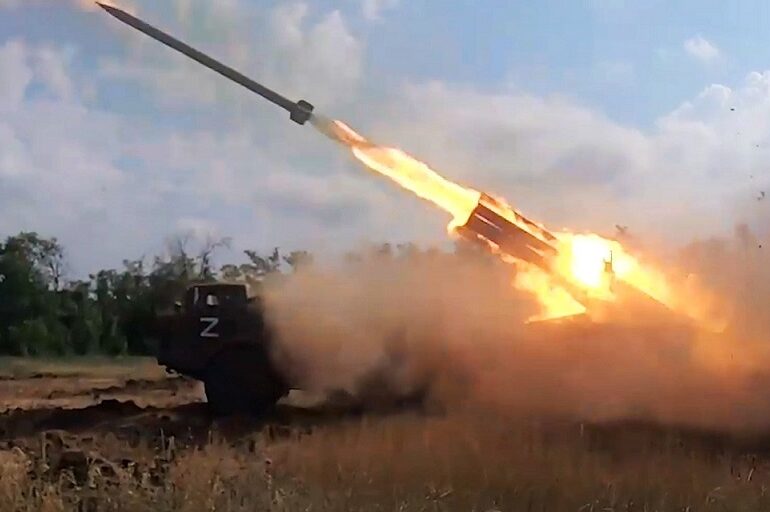
From the beginning of 2026 until the morning of August 27, Russian forces launched at least 1,858 missiles of various types at Ukraine.
However, the number does not reflect the whole picture. In almost eight months, the nature of the Russian missile attack campaign has changed considerably, writes Ukrainian journalist Dmitro Shumlianskyi in an editorial for Kiev Independent.
After massive salvos of cruise missiles in February - a significant portion of which was intercepted by Ukrainian air defense - Moscow has increasingly shifted towards large-scale ballistic and quasi-ballistic missile attacks.
These are much harder to intercept, especially at a time when Ukraine is facing a shortage of interceptors for Patriot systems.
Russia has identified this vulnerability and is taking advantage of it. For anyone closely following the Russo-Ukrainian war, a natural question arises: how long can Moscow sustain such a pace of attacks?
To answer, we must first analyze how the Russian missile campaign has changed in recent months.
After a peak of 296 missiles launched in February, the attacks temporarily slowed down in March and April. Then, towards the end of spring, the pace increased sharply: at least 235 missiles were used in May, 227 in June, 474 in July, and 195 in the first 27 days of August.
But the truly significant change is not just in the number of missiles, but also in their type.
Ballistic Missiles Take on an Increasingly Central Role
Ballistic and quasi-ballistic missiles have come to occupy an increasingly important position in the Russian campaign. Since the beginning of the year, Russia has used at least 794 Iskander-M, RM-48U, and KN-23 missiles, accounting for 43% of the total missiles launched at Ukraine.
After their numbers dropped to 39 in March and 61 in April, the use of these weapons increased to 107 in May, 134 in June, and 174 in July. Approximately 89 were launched in the first 27 days of August.
In the case of RM-48U missiles, the increase was even more spectacular: from about 15 per month in the first half of the year to 46 in just the first 20 days of July.
Cruise missiles remain an important component of the arsenal as well. Since January, Russia has used 866. Of these, 529 were Kh-101, representing over 61% of all cruise missiles launched.
The use of Kh-101 has also intensified: 119 were launched in July, compared to 111 in February, with at least another 34 launched in the first 27 days of August.
On the other hand, Kalibr missiles have been used at a relatively low rate: 126 launches since the beginning of the year and only eight in August.
Increased Use of Supersonic Weapons
Summer brought a strong increase in the use of tactical and supersonic weapons as well.
In July, Russia launched 72 Kh-59/Kh-69 missiles — over five times more than the previous monthly record in 2026. The increase occurred in the context of the Russian campaign against Ukrainian ports and ships in the Black Sea.
The use of Zircon missiles also rapidly increased: from just three launches in May to 15 in June and 24 in July. Another 15 were recorded in August. Out of the 80 Zircon missiles launched by Russia this year, approximately two-thirds were used in the summer months.
Regarding Onyx missiles, the situation is even more interesting. No launches were recorded in the first six months of the year, after which Russia suddenly launched 25 in July and at least another 16 in August.
A similar pattern can be observed with supersonic guided air-to-surface Kh-31 missiles. The main variants are designed to target radar systems of air defense and other ground targets.
Russia has used 63 Kh-31 missiles since the beginning of the year, with 27 in July alone — more than in the first six months combined. At least 17 more were launched in the first 27 days of August.
Overall, these data indicate a deliberate intensification of pressure on Ukrainian air defense, which is already heavily taxed. Moscow is increasingly resorting to weapons that are harder to intercept or that can contribute to neutralizing systems defending Ukraine's airspace.
And this leads to the essential question: if Russia continues to consume missiles at such a rate, how long can it continue?
Is Russian Production Keeping Pace?
For several important types of missiles, Russia has either met or even exceeded production targets.
For Iskander-M, the target remained at 60 missiles per month, but 65 were produced in July.
Regarding Kh-101, production reached 87 units, compared to a monthly target of 72. Kalibr production was 29, compared to a target of 26.
According to the deputy chief of the GUR, Vadim Skibitsky, a significant portion of the new Kalibr missiles are intended for arming Russian ships and submarines.
For Onyx and Zircon, the numbers are particularly impressive. Russia had already met its annual production target for Onyx - 60 missiles - by August 3, even though the year was only halfway through.
As for Zircon, production was 57.1% above the annual target of 36 missiles.
However, there is a significant issue: consumption is starting to catch up with and, in some cases, even exceed production. This is especially true for systems intensively used in recent months.
RM-48U production remained at about 40 missiles per month, according to both the April estimate and the plan for August.
Kinzhal is a special case. In April, production capacity was estimated at about 10 missiles per month. However, series production was later suspended, with missile fuel and other resources redirected to prioritize ballistic missiles.
Production of Kh-32 was also suspended. In April, it was estimated at up to eight missiles per month.
How Extensive Are Russia's Reserves?
Existing stocks are as important as production. Russia entered 2026 with considerable reserves, but the situation varies greatly from one type of missile to another.
For example, Kh-101 reserves have decreased from about 150 to at most 100 missiles, despite almost continuous production. This suggests that missiles are quickly transferred from factories to operational units rather than accumulating in warehouses.
Iskander-M stocks have decreased due to intense use since May. Zircon reserves seem to have dropped from up to 230 missiles in spring to about 120 during the summer.
The situation is more comfortable for Kalibr, where Russia still has over 450 missiles.
Onyx stocks are still substantial. By August 27, Russia had used 41 missiles, even though all 60 planned for the entire year had already been produced.
Some of these reserves may consist of older versions of Onyx, which have proven less effective against ground targets. This allows Moscow to gradually replace them with more modern variants.
RM-48U stocks also remain significant and could partially offset the depletion of Iskander-M missiles. However, the disadvantage is lower precision and a smaller warhead.
Regarding Kh-35, the situation is more challenging to evaluate separately. The April estimate indicated a combined stock of up to 2,600 Kh-29, Kh-31, Kh-35, Kh-58, and Kh-59 missiles. Most of these are likely old Soviet Kh-29 short-range action missiles.
Numbers Must Be Viewed Cautiously
There is, of course, a certain margin of uncertainty.
Intelligence estimates are by nature approximate, and declared production capacity on paper does not always translate into actual production.
Nevertheless, the general trend is becoming increasingly clear.
A War Determined by Production Capacity
Russia's missile arsenal cannot simply be described as either "growing" or "declining." The situation varies significantly from one type of weapon to another.
Zircon and the Iskander-M/RM-48U/KN-23 ballistic missile group are being consumed faster than they can be produced during peak usage periods.
Kh-101, on the other hand, are being used at a rate roughly in line with Russia's current production capacity.
Kalibr benefits from a considerable reserve, as average production exceeds the rate at which these missiles are used against Ukraine.
And Onyx stocks remain significant, although consumption in July and August has surged and already exceeded the average production rate.
Kh-35 only sporadically appears in available reports. Doubling the production target for July, however, suggests that Moscow prioritizes this weapon and does not currently face an immediate shortage.
As a tactical cruise missile mainly targeting front-line targets, Kh-35 may not consistently appear in the public reports of the Ukrainian Air Force.
Regarding Kinzhal and Kh-32, they have shown insufficient efficiency and have temporarily lost their status as priority weapons.
The conclusion is uncomfortable precisely because it does not allow for a simple prediction: it is unlikely that Russia will simply "run out of missiles."