

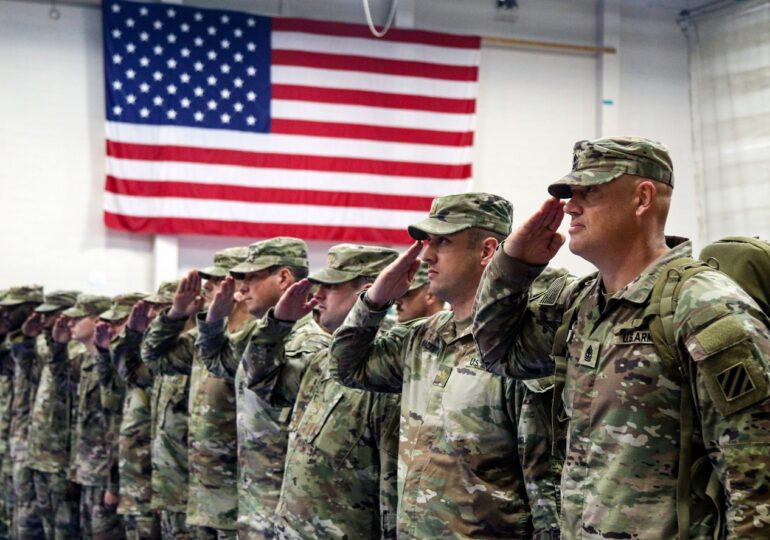
American policymakers are signaling to European leaders not to expect major withdrawals of American troops in the near future, tempering widespread fears in the continent’s capitals.
European officials have expressed concerns that American President Donald Trump could withdraw tens of thousands of American soldiers to encourage allied countries to spend more on their own defense, while the Pentagon focuses on the Western hemisphere. However, officials in Washington now say that any withdrawal will be limited, according to government officials from seven different European countries cited by POLITICO.
Instead, the United States will make specific adjustments and small troop withdrawals, leaving the vast majority of American combat troops and materials in place.
What America Expects from Europe
"We have received conflicting signals, such as small-scale redeployments of forces that will not be replaced, but this administration has realized that a stable Europe is important, and the signals we are receiving are not indicating a major withdrawal, not now," said a NATO military officer.
The issue will likely be addressed during Thursday's defense ministers' meeting at NATO headquarters in Brussels. Pentagon's policy chief, Elbridge Colby, will attend in place of Defense Secretary Pete Hegseth, which is seen as an insulting snub from the American defense chief.
Colby, considered a hardliner towards Europe and the architect of the new US defense strategy, is not expected to unveil new plans. But it will be "fairly clear that the US expects Europe to mobilize quickly and signal that, although changes may not be immediate, they will come," another NATO official said, speaking on condition of anonymity, like others consulted by the cited publication.
The Defense Department did not respond to requests for comment.
Europeans Will Cover Gradual Withdrawals
There are also legal obstacles to a major withdrawal. According to the National Defense Authorization Act passed by Congress last year, Washington must maintain a minimum presence of 76,000 soldiers in Europe. The US currently has around 85,000 soldiers on the continent.
This issue is expected to overshadow many of Colby's meetings with NATO allies at this week's Munich Security Conference.
Unlike last year's speech by Vice President JD Vance, who heavily criticized Europe, Secretary of State Marco Rubio will deliver a speech at Munich this year, described by an American official as a classic foreign policy speech. He will express support for the alliance while also calling for reforms and highlighting the shift in American policy to focus on the Western hemisphere and Asia, the individual said.
The majority of troops, air bases, and training ranges operated by the US in Europe will largely remain the same," said a second officer from a NATO member state. Some units may be relocated to different countries in the coming years, but officials on the continent largely believe that European allies will be able to absorb any gradual reductions.
Americans Hand Over Command of Two Command Centers
However, a few changes are underway. One of them is a plan to withdraw about 200 American soldiers from various European commands. This will not happen immediately, but the troops serving these planning and administrative roles will not be replaced once their individual missions end, allowing European and Canadian forces to take their place.
The US is also pushing for the replacement of senior commanders at many top NATO command centers.
The UK will take control of NATO's Joint Force Command in Norfolk, Virginia, from the US, and Italy will take over command of the Joint Force Command in Naples. Both are currently led by American officers. Additionally, Germany and Poland will assume control of the Joint Force Command in Brunssum, the Netherlands. The center, led by a German general, specializes in multinational forces.
Meanwhile, the US will take over command of the Allied Maritime Command - which coordinates NATO maritime forces - headquartered in the UK.
The decision to transfer American command from Naples and Norfolk to Europeans "was jointly taken by all allies," said an American defense official. The transfer is part of the Trump administration's efforts to promote "European leadership in European defense," allowing the US to focus its efforts on the Western hemisphere and the Pacific, he added.
US Ambassador to NATO Matthew Whitaker on Tuesday rejected suggestions that the role changes mean Washington is withdrawing from the alliance.
"President Trump has specifically stated that we are dedicated to NATO and will continue to be present," he told reporters. "But... anything that allows our allies to step up and do more and take greater leadership within the alliance is good news."
US Withdraws Several Hundred Soldiers from Romania
Recall that President Donald Trump announced at the end of October that the United States will withdraw several hundred soldiers from Romania, but approximately a thousand will remain to ensure the operation of the strategic bases in Deveselu and Câmpia Turzii.
Specifically, Washington has decided to halt the rotation of a brigade with elements deployed in several allied states in Europe. However, about a thousand American soldiers will remain in Romania, continuing to participate in deterrence and collective defense missions.
The Defense Ministry clarified that it was informed about the expected decision and that Romania was officially informed, maintaining constant contact with Washington.
Meanwhile, thousands of American soldiers will also be withdrawn from Hungary and Slovakia, as part of a broader process of "resizing" US presence in Eastern Europe.