
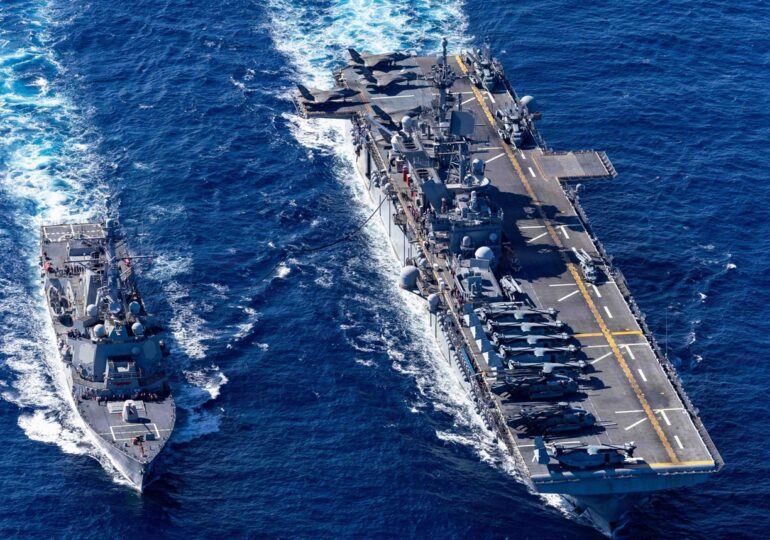
There are four fundamental reasons why the United States will not attempt to militarily secure the strait without first completing the initial phase of the military operation. An expert explains why this aspect has not been a central point of the American campaign so far.
Jennifer Parker, who served for 20 years in the Royal Australian Navy, explained to The Conversation what kind of military force would be needed to reopen the strait for commercial maritime transport and why the US has not taken this step yet.
Geography plays an important role, she points out. Iran dominates the northern part of the Persian Gulf, the Strait of Hormuz, and the Gulf of Oman. This proximity allows them to use cheaper weapons, such as drones, to target ships.
A two-phase campaign
Creating the conditions to safely pass commercial vessels—or at least to reduce the risk hanging over them—requires a two-phase campaign.
The first phase is eliminating Iran's ability to target ships. There are two ways to do this, the expert explains:
- convincing or forcing Iran to stop attacking ships.
- eliminating Iran's ability to attack ships by destroying radar installations, command and control structures, and bunkers along the coast.
The US has air power, intelligence services, surveillance, and reconnaissance to identify and destroy most of these targets. Locating and destroying Iranian drone stocks will be more challenging, as they can be stored almost anywhere, so information will be crucial.
Once the risk is reduced through a bombing campaign, the second element to bring ships back through the strait is a reassurance campaign.
This requires early warning aircraft and maritime patrol aircraft to monitor not only the strait but also the Gulf of Oman, the Persian Gulf, and along the Iranian coast.
Fighter jets should be stationed above the strait and the gulf, as combat air patrols and helicopters should be ready to act against attacks, if necessary.
Additionally, the US should station warships to provide occasional escort. However, if the presence of mines in the strait is confirmed or even suspected, this complicates things. The US would need an extensive mine-clearing operation, which takes time.
4 reasons why the US does not secure the strait
According to the expert, there are four major reasons why the US will not attempt to militarily secure the strait without first completing the initial phase (eliminating Iran's ability to target ships). She also explains why this aspect has not been a central point of the campaign so far.
- Firstly, it would divert military resources, such as aircraft, needed elsewhere to fulfill Trump's war objectives.
- Secondly, to make the strait safe for maritime transport, the US would actually need to secure not just the water but also the land on both sides of it. This would likely require ground forces—or perhaps raids on the Iranian coast—which would be complex and risky for the American military.
- Thirdly, securing maritime transport would require a significant number of military ships. Realistically, one or two military ships would be needed for each escort operation. A larger convoy than this would present an increased risk of attack, unless the US and Israel have dramatically reduced Iran's ability to target ships.
- Fourthly, the military must weigh the risk to its resources against the benefits of opening the strait. An American warship has a crew of over 200 people. Considering Iran's ability to strike ships with naval drones, aerial drones, and cruise missiles, is it worth endangering this personnel before reducing threats from the Iranian coast?
Another obstacle: mines
Iran doesn't need to physically place mines, just to convince the US and other parties that it has done so. This is enough to deter civilian ships from wanting to transit the strait, Parker points out.
Although this has not been publicly confirmed, she believes it is unlikely that Iran would lay mines on a large scale. For two reasons:
- Firstly, Iran's economy relies on its ability to transport its own oil from Kharg Island in the Persian Gulf through the strait. Iran has other ports outside the strait, but these cannot accommodate larger vessels, so mining would interfere with Tehran's trade.
- Secondly, some information has suggested that Iran has used acoustic mines, a type of influence mine that detonates based on an acoustic "signature," essentially the noise a ship makes as it moves forward. While this technology certainly exists, it is unlikely that such mines would be designed to reliably differentiate between commercial vessels under the Iranian flag and those under the flags of other countries.
What's the number 1 priority
Although there has been much debate about regime change in Tehran, the Trump administration has been clear on its four key military objectives. Namely, the destruction of:
- Iran's capacity to launch ballistic missiles
- its nuclear capabilities
- the Iranian navy (which has largely been achieved)
- Iran's proxy networks, including Hezbollah in Lebanon, which has been targeted by Israel in recent weeks.
Eliminating Iran's nuclear and ballistic missile capabilities requires many aircraft and massive amounts of heavy weaponry—as demonstrated by the clear bombing campaigns of the US and Israel.
Diverting these resources to secure the Strait of Hormuz could undermine the achievement of these military objectives, the expert emphasizes.
T.D.