
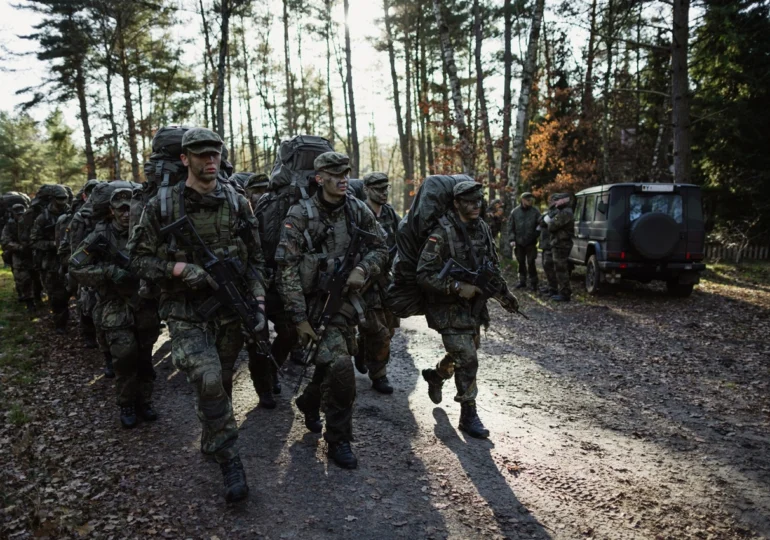
Thousands of Ukrainian soldiers have been trained in Germany after the Russian invasion. Now Ukrainian war veterans are training German troops, sharing their experience in drone-dominated warfare, as Berlin intensifies its preparations for a potential conflict with Russia.
The first Ukrainian combat-experienced instructors arrived in Germany to train units of the German army (Bundeswehr), according to Lieutenant General Christian Freuding, Inspector of the German Army.
Freuding stated in an interview with the German newspaper Welt that the training began before Easter at several military schools of the Ground Forces, with the aim of adapting German soldiers to the realities of modern warfare.
Ukrainian instructors focus particularly on drone protection and their effective use in battle. They will also target artillery strikes, armored operations, engineering, and command and control systems, areas where Ukrainian forces have rapidly evolved in combat conditions.
Freuding emphasized that the instructors are not staff officers but soldiers with direct, practical combat experience.
Ukrainian specialists are currently conducting training at the Tank Forces School, the Engineering Forces School, and a center dedicated to unmanned systems training. A similar preparation is expected to take place in the artillery schools in the coming days.
Berlin and Kiev agreed in February that Ukraine would send experienced personnel to the training centers of the German Ground Forces to share lessons learned from the large-scale Russian invasion, as noted by Kiev Post.
Freuding told Reuters at the beginning of March that Ukrainian military trainers will assist in the training of the German army as Berlin accelerates preparations for a potential Russian attack on NATO by 2029.
According to the official, the first group consists of several dozen instructors who will train German troops for several weeks. Berlin has „high expectations,” mentioning that the Ukrainian army is currently the only force with extensive combat experience on the front line against Russia, he said.
Since 2022, Germany has trained thousands of Ukrainian soldiers on Western systems, including Leopard tanks, Marder infantry fighting vehicles, artillery, and air defense platforms.
Since then, Ukrainian forces have developed advanced tactics and operations, especially in the use of drones and highly digitized data-driven warfare, Freuding stated.
He added that the instructional role of Ukrainians reflects a partnership of „equality” between the two countries.
Freuding warned that the deadline for a possible large-scale Russian attack is rapidly approaching, referring to Western intelligence assessments indicating the year 2029. He emphasized that „that’s almost tomorrow,” adding that there is no time for delaying preparations.
Germany unveiled its first defense strategy after World War II on Wednesday, naming Russia as the main threat to European security and warning of a potential confrontation with NATO.
Defense Minister Boris Pistorius stated that Russia’s rearmament shows its willingness to use force to achieve geopolitical objectives and weaken the alliance by separating Europe and Canada from the United States.
The strategy combines military doctrine with long-term development plans for the Bundeswehr. It also highlights ongoing hybrid threats – including cyber attacks, sabotage, disinformation, and espionage – and calls for a sustained response.
Germany aims to expand its armed forces to at least 460,000 troops, integrating reservists and reintroducing potential conscription to build the strongest conventional force in Europe.
The plan emphasizes „informational superiority,” with extended cyber and space capabilities, as well as long-range precision strike systems inspired by lessons from the Ukrainian battlefield, especially drone warfare.
Berlin also intends to acquire JASSM-ER cruise missiles for F-35 fighter jets, strengthen air defense, and modernize military administration through digitization and artificial intelligence.
However, key details remain secret to avoid disclosing strategic plans.
T.D.