
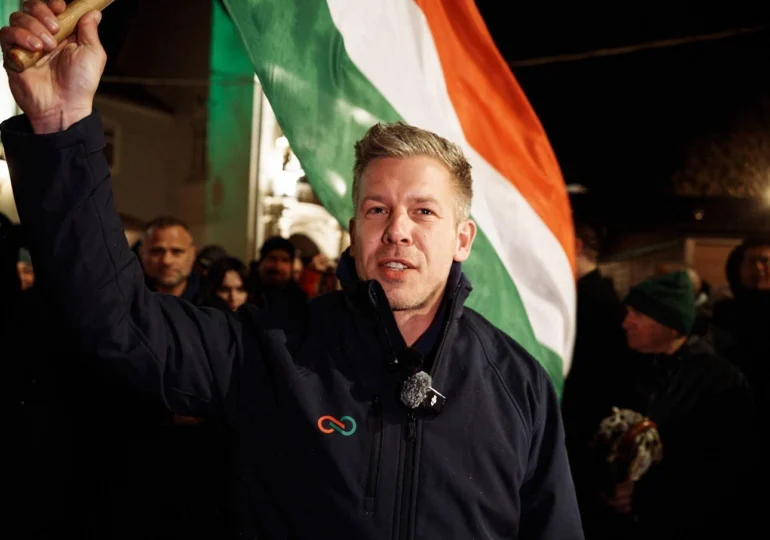
The new Prime Minister of Hungary aims to establish closer ties with Austria and other nations in Central Europe to have more influence in Brussels.
The upcoming leader of Hungary seeks to revive Central Europe’s influence by leveraging its imperial past. Peter Magyar says he will strengthen relations with neighboring states, especially with Austria, based on strong economic ties and a common history rooted in the Austro-Hungarian Empire of the late 19th century, writes Politico.
"We used to share a country, and Austria is a key economic partner of Hungary. I would like to strengthen the relationship between Hungary and Austria for historical, cultural, and economic reasons," Magyar said after his victory over Viktor Orban in the Hungarian elections earlier this month.
Magyar defeated Orban thanks to his promise to reset Hungary's relations with the EU. However, he envisions doing this within a strengthened bloc of Central European nations, led by right-wing leaders with similar ideas, whom he believes share a cultural perspective, economic interests, and conservative views on all aspects, from migration to energy policy.
With the significant exception of Poland, these countries - positioned between Western Europe and Russia - have also traditionally shown a greater willingness to maintain commercial ties with Moscow, the publication notes.
What alliance Magyar is preparing
The new Hungarian leader has already publicly presented how he could realize his vision for a Central European bloc. At a press conference earlier this month, he proposed merging the Visegrad Group - an informal alliance between Hungary, Poland, Czech Republic, and Slovakia - with the Slavkov format, a cooperation framework involving Austria, Czech Republic, and Slovakia.
"I believe this is in the interest of each country, including Austria and Hungary. So, I hope we can make progress here," Magyar said.
As a clear signal of this strategy, Magyar stated that his first visits as Hungary's prime minister at the beginning of May will be to Warsaw and Vienna.
Visits to Warsaw and Vienna
Although considering Austria a more natural ally, the new Hungarian leader has much to learn from Polish Prime Minister Donald Tusk and his efforts to restore liberal democracy after years of populist rule, including how to unlock EU funds withheld due to rule of law concerns, Politico emphasizes.
"The visit to Warsaw aims to exchange experiences on transitioning back to a liberal democracy. The visit to Vienna is more about European politics and the need to develop our own proposals within this region," said Emil Brix, a former Austrian diplomat and historian who studied the end of the Austro-Hungarian Empire.
Austrians are interested: together is better
The Austrian government appears receptive to this idea. A high-ranking Austrian diplomat stated on condition of anonymity that there is inherent logic in strengthening collaboration among Central European states within the EU, following the Benelux model. "We are countries of approximately the same size, with many common interests, and together we would be more relevant in terms of voting capacity," the diplomat told Politico.
For the conservative Austrian government, deepening ties with Hungary has long been a strategic ambition.
In the early 2000s, before several former communist countries joined the EU, Austrian leaders proposed a renewed alliance with Central Europe. The effort ultimately failed, hindered by fears in Poland and Slovenia that Vienna was seeking to reaffirm its hegemony more than 80 years after the collapse of the Austro-Hungarian Empire.
Now, a more confident and prosperous Hungary is proposing a closer alliance. Polish leaders, considering the country's increasing economic and military power, no longer feel threatened by this prospect, experts say.
Relationship with Austria prepared in Munich
Austrian conservatives also see a new opportunity now with Orban's departure.
Magyar and Austrian conservative Chancellor Christian Stocker have begun laying the groundwork for post-Orban relations between their countries at the Munich Security Conference in February, according to two individuals present at the meeting. Leaders discussed Magyar's inaugural visit to Vienna and how to improve conditions for Austrian companies doing business in Hungary, according to a senior Austrian government official.
It is expected that in Vienna, the new Hungarian prime minister will attempt to develop a common position on migration and discuss the fate of the Central European University - which relocated its main campus from Budapest to Vienna in 2019 following Orban's campaign against the institution - said a high-ranking Austrian diplomat.
What unites Hungary and Austria and what sets them apart
The two nations are already closely linked economically. Austria is the second-largest investor in Hungary after Germany, with investments exceeding 11.7 billion euros. Approximately 134,000 Hungarians work in Austria, many of them as commuters.
The Austrian National Bank stated in a report last year that growing trade links with countries in Central and Southeast Europe have a stabilizing effect on the Austrian economy amid increasing global trade uncertainty.
However, certain different choices of Central European countries will certainly complicate efforts to create a closer alliance, the publication points out.
Regarding Ukraine, for example, Austria and Poland actively support additional EU aid for the country invaded by Russia. The three countries also have divergent views on Ukraine's accession to the EU.
The first Hungarian prime minister who understands how the Brussels machinery works
Despite these differences, experts argue that there are strong common interests among Central European countries, especially regarding economic initiatives and large-scale infrastructure projects.
"If these countries could present integrated coordinated proposals and projects, this would strengthen their position in terms of distributing funds and cohesion money from Brussels," said Reinhard Heinisch, a political scientist at the University of Salzburg.
Magyar's intention to build a Central European alliance could also be rooted in understanding how power actually operates in Brussels. The new prime minister spent almost a decade there as a diplomat in Orban's regime before parting ways with the populist Fidesz party and becoming a Member of the European Parliament with his own conservative political force, Tisza.
"He is practically the first Hungarian prime minister who perfectly understands how the Brussels and EU machinery works," said Stefano Bottoni, a professor specializing in Eastern Europe at the University of Florence. "And if you want to have more influence in Brussels, if you want to be a counterbalance to the [larger] countries - France, Germany - then you need to unite your forces."
T.D.