
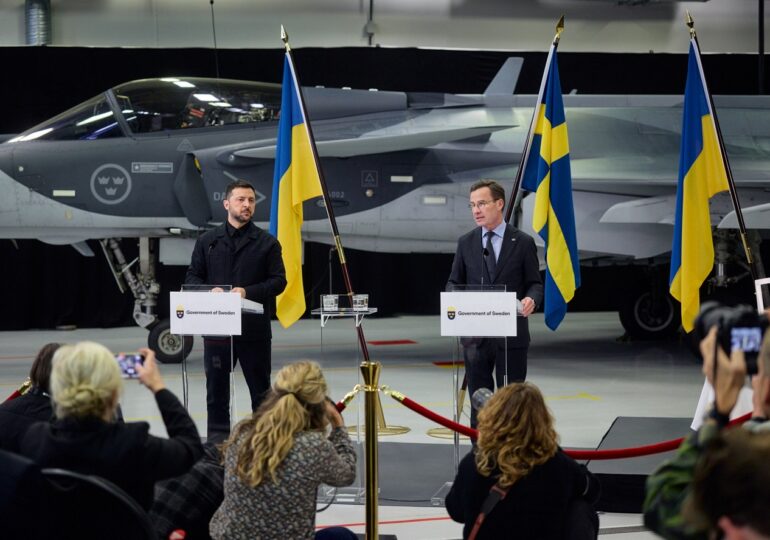
Something concrete and indisputable has emerged from the diplomatic turmoil generated by Donald Trump’s attempts to end the war in Ukraine. The conflict in Ukraine has become Europe’s war. In fact, it is unlikely to be America’s problem for a long time.
The approximately 20-point peace plan of the Trump administration, as guided by envoys Steve Witkoff and Jared Kushner, leads nowhere. Vladimir Putin’s own words are very clear in this regard. In a bellicose speech delivered on the same day, the Russian president threatened to completely isolate Ukraine from the Black Sea in retaliation for a series of attacks on tankers with ties to Russia.
This is not a man thinking about reaching an agreement. Putin is the obvious obstacle, as shown in an analysis published by Sky News.
None of these words surprised European and British leaders, who are doing what they usually do when the situation seems grim. The UK, France, Ireland, Germany, and other countries have issued grand statements like "we will support Ukraine as long as necessary."
But this time is different. European leaders will have to treat Ukraine as an emergency - or face the consequences. Currently, they hold a position that many consider absurd.
Europeans pay, but don't sit at the table
Europe is currently financially supporting the Ukrainian government. The funding, which was split in half with the Biden administration, has been fully taken over by Europe. Additionally, Europeans pay for all American weapons through a NATO facility called PURL.
Thus, Europe is involved - it pays the bills. But where are the Europeans at the negotiating table? They are not there at all. The Russians don't want them, and the Americans don't seem very interested. When US Secretary of State Marco Rubio met with a Ukrainian delegation to discuss the peace plan in Geneva, he said he knew nothing about European counterproposals.
"It's extraordinary that Europe foots the bill but struggles to make itself heard. This shows a lack of vision, coordination, and leadership across the entire continent," said Marc De Vore of St Andrews University.
Former Lithuanian Foreign Minister Gabrielius Landsbergis is thoroughly exasperated with Europe's inefficiency.
"If you are a European leader and you ask your team to book your next flight to Washington to talk to daddy (Trump, ed.) please don't do it. Not without a plan, not with your hat in hand, don't humiliate us all in front of the cameras in the Oval Office. Europe is our continent, our future is decided here, not there. We are not poor, we have options, we can finally decide to help Ukraine to the fullest...," he wrote.
Ukrainians talk of betrayal
This frustration is shared by Ukrainians, who have started using a different word to describe this relationship - betrayal.
Inna Sovsun is a deputy in the Ukrainian parliament. Her husband, a war doctor, serves on the front lines. "People on the front line are truly disappointed by the whole situation, and it really feels like a betrayal. The challenge is much bigger than which village will be controlled by whom in Donbas. It's about what the future of civilization looks like. Does the barbaric version of Russia win? If you're not willing to fight for it, these values don't matter much, do they?"
A nightmare scenario for Europeans
It is not surprising, perhaps, that analysts and other experts are trying to envision what Ukraine would look like if forced to capitulate. The idea is that Europe won't like what it sees.
Imagine an unstable nation on Europe's border, with a Russian leader asserting control through proxies or various groups fighting for dominance. The population is restless, with thousands of men traumatized by war, and millions of refugees seeking shelter in Europe.
Economists have tried to outline such scenarios in numbers, with one group estimating Europe's costs at around 3 trillion euros in additional defense and refugee-related expenses if Ukraine is seriously weakened.
A major test for Europe
For Europeans, a test of their resolve is already at hand. The EU must agree on a plan to seize frozen Russian assets, worth up to 210 billion euros, as a means to finance the financially struggling government in Kiev.
The issue is legally controversial, with countries like Belgium, where a large part of the money is located, concerned about assuming responsibility. But Ukrainians see it as a simple matter of commitment.
"Given the stakes, there just needs to be a stronger political will. That's what is hard for us to understand. (They) say all those good things, the right things, but that doesn't matter much," says Inna Sovsun.
T.D.