
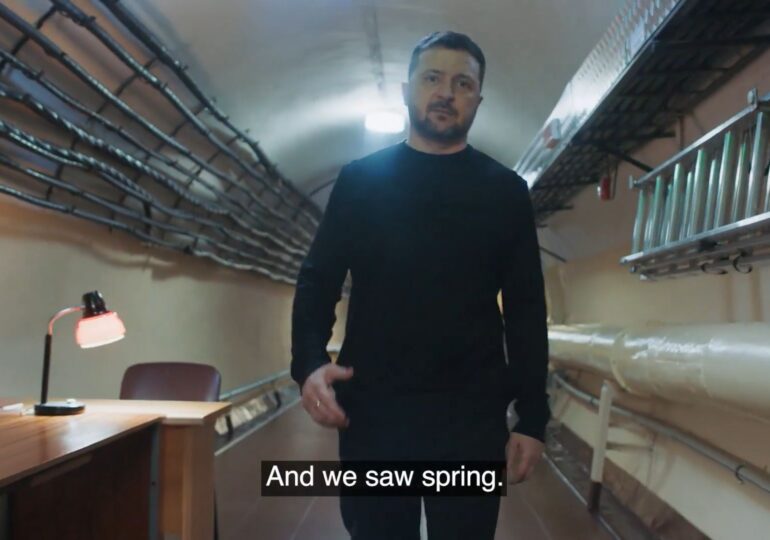
On the fourth anniversary of the large-scale Russian invasion, Ukrainian President Volodymyr Zelensky released a 19-minute video recording from an underground bunker complex located beneath Kiev.
It is the first time since the beginning of the war that the head of state shows the public the secret location from which essential defense decisions of Ukraine, including counteroffensive actions, were coordinated.
Soviet labyrinth transformed into a command center
The complex, built in the Soviet era and later modernized, is a true underground city: tunnels, offices, meeting rooms, and secure rooms designed to ensure the continuity of governance in wartime conditions.
"Many things have been accomplished right here," Zelensky says in the recording as he walks through the bunker corridors.
According to him, the spaces were organized to serve the Presidency, the Government, and the Parliament, with each institution having dedicated areas within the fortified infrastructure.
"Here Ukraine resisted"
The Ukrainian President recounts that in the early days of the invasion, hundreds of people worked in the underground network.
"Our team was here, the Government, daily meetings with the military, calls, searching for solutions, everything necessary for Ukraine to resist," he states.
One of the rooms, a small chamber located under Bankova Street - the address of the presidential administration headquarters - holds a special significance for the leader in Kiev.
"In this office, in this small bunker room under Bankova Street, I had my first discussions with leaders from around the world at the beginning of the war," Zelensky declares.
The moment of the call from Washington
In the footage, Zelensky also recalls the phone conversation he had, in the early hours of the invasion, with former U.S. President Joe Biden.
"Here I heard 'Volodymyr, there is a threat, you need to leave urgently. We are ready to help you leave,'" recounted the Ukrainian leader.
His response has since become emblematic of Ukraine's resistance: he refused evacuation. He asked for weapons, not 'a taxi.' Four years after that moment, the message remains unchanged.