

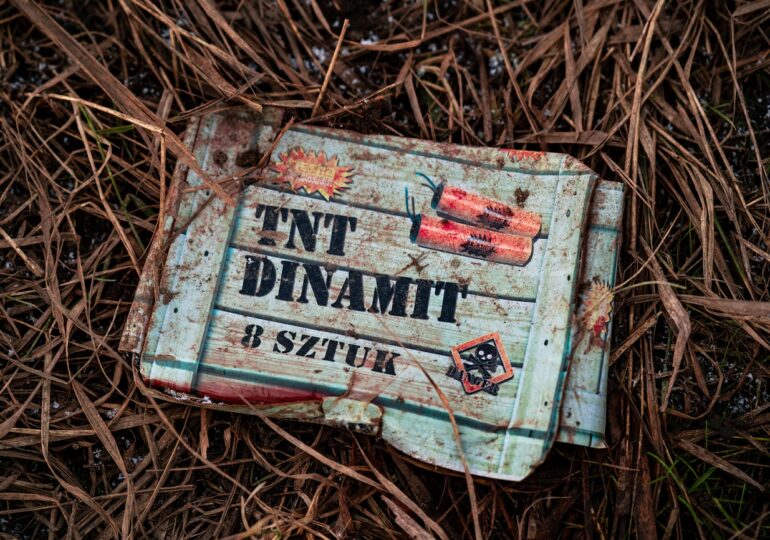
If an army needs ammunition larger than a bullet, then it needs TNT. However, Europe has only one factory producing it, in Poland. An entrepreneur aims to produce 4,500 tons of explosive annually in the heart of Scandinavia.
A few minutes from the Swedish town of Nora lies a quiet forest area, behind a group of holiday homes, located near a lake where the morning mist slowly rises. You wouldn’t think it could be the perfect place for an explosives factory, but Joakim Sjöblom is convinced he can make it work there.
He plans to build a new factory for one of the most dangerous processes in the arms industry - the production of trinitrotoluene, known as TNT, for NATO.
"My daughter turned one month old today. And that was one of the key reasons why I decided to do this: to make sure she doesn't face a conflict as she grows up," explained Sjöblom to Business Insider.
TNT production is extremely dangerous and creates toxic by-products. Sweden Ballistics AB, Sjöblom's group, is now awaiting a court decision before obtaining construction permits for a semi-automated factory. The next step for the ambitious CEO will be to raise approximately $90 million.
There is a great need for TNT
If an army needs ammunition larger than a bullet, then it needs TNT. Introduced in the arms trade in 1902, the compound is still the global reference for the explosive power of ammunition, from mortar shells to hand grenades and bombs, notes the American publication.
In North America, TNT is not produced, and Europe now has only one factory, in Poland, producing TNT according to NATO standards. India and China are two of the world's largest suppliers, meaning that arms manufacturers largely rely on Asia for anything beyond the capacity of the Polish facility - a vulnerability in case of a major war.
Lukas Bauer, an expert in TNT at Ludwig-Maximilian University in Munich, told the American publication that, in general, it is quite easy to find the necessary materials to produce TNT. "All of these chemicals are relatively inexpensive and can be obtained in large quantities," said Bauer, who is not involved in Swebal's project, adding that TNT production generally costs less than $20 per kilogram.
It's not usually the supply that's the main issue, but the process of manufacturing TNT according to NATO standards, which is extremely toxic. And even though the final product is generally quite stable, its manufacturing poses a higher risk of accidental detonation.
This is partly why the West has been content to leave production to Asia after the Cold War.
TNT production in Europe is also more expensive but fits perfectly into the new requirements of the European Union for arms manufacturers. Last year, the EU set a target for 60% of its defense acquisitions to come from internal sources by 2030.
A niche with secure sales
Sjöblom founded Sweden Ballistics AB, or Swebal, in 2024, after selling his fintech company, Minna Technologies, to Mastercard in the same year. Also last year, Sweden joined NATO.
Swebal has applied this year for an environmental permit to produce an annual capacity of 4,500 tons of TNT, enough for approximately 450,000 artillery shells, as NATO seeks to increase artillery ammunition production.
The Swedish company expects to start construction early next year and begin production by 2028.
Sjöblom is banking on his company's major advantage - the European supply chain. Swebal intends to source 100% of its raw materials from Sweden and the Baltic Sea region.
However, Sjöblom and his co-founder, engineer Carl Duforce, are not the only ones looking to enter the TNT market.
And Romania enters the game
The Finnish government announced in January that it is building a TNT factory, scheduled for completion by 2028. Work is also underway to resume production at a Czech-Greek TNT factory in a city in the greater Athens area.
Additionally, a significant project was announced in Romania as well.
Across the ocean, the US Army has tasked Repkon USA with producing TNT at a new factory in Kentucky by November 2028.
The demand growth is fueled by an expanding Western push to drastically increase ammunition production. NATO warned in June that Russia produces about four times more artillery shells than the entire Western alliance, despite its economy being 25 times smaller.
Sjöblom said that currently, the TNT market is not even close to meeting the needs of the West and is confident that there will be many requests for the company's annual production capacity of 4,500 tons for at least 10 years.
"If all these ongoing projects are completed, we are not even halfway to matching what Russia can produce," he estimated.
How to build a TNT factory
Sjöblom's project is now awaiting environmental permits, which will be issued in December.
The regulatory requirements in Sweden for this type of factory are strict, even though Stockholm is now open to strengthening defense.
For two years, Swebal conducted 14 on-site studies for environmental approval, checking protected animal species, ancient remains, and other elements that could hinder construction work.
The company also has an option agreement to purchase a portion of the surrounding forest as a reserve measure to ensure a wide uninhabited perimeter nearby. Permits allow for the storage of up to 25 tons of TNT on-site and must include plans for preparedness for unforeseen situations in case of an explosion.
The project includes securing a three-acre perimeter with electrified and barbed wire, surveillance cameras, and a 24/7 security team.
The factory will include several dozen acid tanks connected to a 27-meter tower for concentrating raw materials indoors. In the center of the factory, these chemicals are pumped to be transformed into TNT inside a 370-square-meter complex, surrounded by a set of thick earth walls, six meters high.
A risky adventure
Swebal estimates it will need about 80-90 million euros to build the TNT factory. The company announced in June that it has raised $3.5 million from investors.
Although the demand for TNT is high, they know they are embarking on a risky adventure. "Our risk appetite as a startup is extremely high because we have nothing to lose," said Sjöblom.
TNT production involves the repeated mixing of chemical toluene with concentrated sulfuric and nitric acid, which are corrosive and can release toxic fumes. This process generates a lot of heat, which, if not controlled, can cause a detonation.
And we have recently seen what happens when something goes wrong in such a factory. Just last month, a powerful explosion occurred at a military explosives factory in the American state of Tennessee.
For these reasons, Swebal plans to have only two rooms where workers are regularly present at the factory - a laboratory for testing the final product and a fortified control room. "Our vision is to fully automate this process," said Sjöblom about the manufacturing process.
But there is also the issue of waste. Purifying TNT according to NATO standards creates a byproduct called red water, which Bauer, the energy expert, described as "toxic and carcinogenic wastewater."
In the past, companies used to discharge the red water into waterways, he said, but now they usually store it in basins to be safely incinerated.
Sjöblom said that Swebal will transport its red water to a third-party waste management company, located a 45-minute drive from the factory site. "We will have no destruction on-site," he added.
The world is upset about losing trees and squirrels
It's easy to imagine, building an explosive factory nearby is not good news for anyone. Duforce moved from February to the nearby town of Nora to talk to the locals. Some are not thrilled about the construction of the TNT factory near their summer houses.
However, the two entrepreneurs are banking on the fact that Swebal will soon become the second largest employer in the area and already sponsor tennis and padel clubs in the neighborhood.
Moreover, the region is accustomed to the arms industry. Swebal's new unit is built along Sweden's "military belt": across the lake lies an old dynamite factory from the time of Alfred Nobel.
The Swebal factory will rely on a daily transport of about nine trucks delivering the material, so an access road must be built.
Sjöblom said that the idea of increased traffic has bothered some nearby residents, but he believes that Europe still needs to build an arsenal to deter Russia.
"People are not happy that trucks will pass by and they are not happy that trees will fall and there won't be as many squirrels," he said as he walked along the abandoned railway, under the shade of an imposing forest. "Well, if a war breaks out, maybe there won't be any trees. And there won't be any squirrels left."