
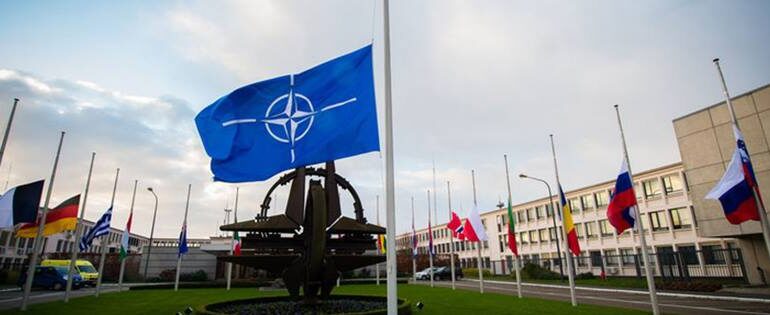
In July 2018, the new and shiny NATO headquarters in Brussels was ready to host its first summit. Dignitaries from around the world gathered in the arched buildings designed to resemble interconnected fingers.
But the Europeans organizing the event were uneasy. The guest of honor, formally, President Trump, had spent months questioning the need for the U.S. to belong to an organization that emerged from the ashes of World War II as a bulwark against Moscow’s aggression, writes The Atlantic in an analysis of NATO’s future.
He was soon to spoil the festivities. During a closed-door meeting with other leaders, the president erupted into a tirade, chastising other states for not allocating 2% of GDP for defense, demanding better relations with Russia, and threatening to withdraw the United States from NATO if he didn't get what he wanted.
Trump eventually relented. But just the following week, he met with Vladimir Putin at a summit in Helsinki and repeatedly sided with the Russian leader, who had made it a goal to undermine the alliance. Almost eight years later, Putin could see his wish fulfilled.
Moscow could emerge as one of the winners of the war
Trump is now demanding that NATO help the United States reopen the Strait of Hormuz, a vital route through which 20% of the world's oil passes, which Iran effectively closed in response to U.S. and Israeli attacks.
NATO refused. And while Russia plays only a marginal role in this crisis, Moscow could emerge as one of the winners of the war. The standoff over the strait has created a new unexpected tension between Trump and NATO, one that may not completely destroy the alliance, but could fundamentally weaken it.
"I think he has already made NATO dysfunctional in practice in the context of Iran," a senior European Union diplomat, speaking on condition of anonymity, told The Atlantic.
He also made a grim prediction: Trump's possible reaction could be to reduce the number of American troops on the continent. "If we weren't expecting troop withdrawal, we should be," he said.
Trump had hoped the attack on Iran would follow the model of the operation in Venezuela to capture Nicolás Maduro: a swift blow to remove the existing leadership and allow for the installation of a more compliant figure.
Although Ayatollah Ali Khamenei is dead and thousands of Iranian military targets have been hit, the hardline leaders in Tehran remain in power, launching missiles at neighbors in the Persian Gulf and blocking access to the Strait of Hormuz - just as the Pentagon and military experts had anticipated for decades. General Dan Caine warned Trump before the invasion, but he ignored the warning, believing Iran would capitulate.
He was wrong. Iran closed the strait. Oil prices have risen by over 40% in the past month, and gasoline costs have skyrocketed for Americans. Any U.S. effort to reopen the route would involve major risks. While the Iranian navy has been severely affected, they could still mine the waters of the strait. A single attack - with a drone, fast boat loaded with explosives, or missile - could damage an oil tanker or American military ship.
If American special forces were deployed on the ground, losses would be inevitable. Therefore, Trump has asked for help from other states, especially European allies.
Refusal and frustration
Many European governments do not want to be drawn into a military action and are frustrated that they were not consulted before the war. Additionally, there are ongoing grievances regarding Trump's attempts to force Denmark to cede control of Greenland.
For many officials, this was a turning point. Europe's repeated offers - access to bases, mineral resources, and others - were ignored, and at the World Economic Forum in January, some began to wonder if the U.S. military could invade Greenland. Trump eventually stepped back (for now), but the damage was already done.
In recent days, a few states have offered assistance: France has sent warships, and the UK has allowed the use of its military bases. NATO Secretary-General Mark Rutte has promised support from alliance members. However, no one has taken on the dangerous task of escorting tankers through the strait.
Trump reacted furiously, calling NATO members "cowards" and stating that "without the U.S., NATO is a paper tiger". He warned that the alliance has a "very bad" future if it does not change its direction.
Trump's revenge
White House officials say there are no active discussions about the U.S. withdrawing from NATO, but they acknowledge that the allies' cold response has infuriated Trump.
Legally, such a withdrawal would be difficult and could trigger a constitutional crisis. Even without a formal withdrawal, Trump has other options: he can reduce funding, refuse to uphold Article 5 (collective defense), or withdraw troops from Europe, weakening the continent's defense against Russia.
In fact, Trump has long threatened such measures. In 2020, the Pentagon announced the reduction of troops in Germany. Although Congress partially blocked the plan, pressure on allies to contribute more continued. Allies tried to appease him, including by increasing defense spending.
However, signs of withdrawal have emerged, including the reduction of troops in Romania. Many analysts have seen this as a sign of the alliance's slow unraveling.
Even close allies of Trump, such as Finnish President Alexander Stubb, have acknowledged a "rift" in the alliance.
Meanwhile, Russia has sought to exploit the situation, offering support to Iran and easing some sanctions. Russian commentators have seen this as a sign of weakening U.S. positions.
It was a victory for Putin. And an even greater one could follow.