
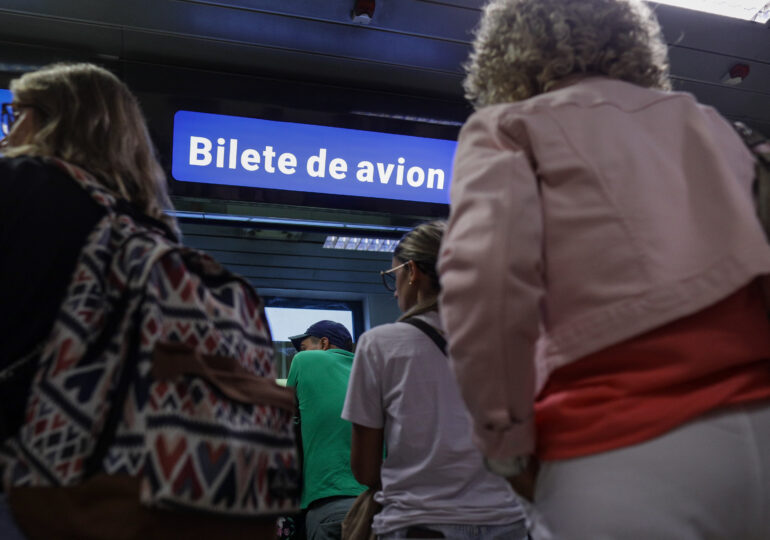
The number of canceled flights at airports in Romania has significantly increased in the first months of this year, due to the sharp rise in aviation fuel prices. The most affected is Henri Coandă Airport in Bucharest, where the cancellation rate is 30 times higher than in the same period last year.
According to an analysis conducted by AirAdvisor and cited by Cotidianul, the cancellation rate at Otopeni Airport has increased from 0.10% in 2025 to 3.15% between February and May 2026. The most affected were flights to European cities where significant Romanian communities are located, such as London, Paris, Brussels, and Frankfurt.
According to the analysis, Otopeni Airport has the highest rate of canceled flights among the major European airports included in the study, and the average flight delay has reached 124 minutes.
Issues Across the Country
Significant increases in cancellations are also reported at other airports in Romania.
In Cluj-Napoca, the cancellation rate has risen from 0.03% to 2.47%, while in Sibiu it has reached 9.26%, the highest value recorded in the country. Problems are also reported in Craiova, where the cancellation rate has reached 1.91%.
At the same time, Brasov Airport is facing punctuality difficulties, with the delay rate approaching 5%.
Rising Kerosene Prices Impact Airlines
The analysis attributes part of the problem to the increase in operational costs for airlines. Industry experts explain the situation by the significant rise in fuel costs. The price of kerosene has nearly doubled in 2026, affecting especially low-cost carriers and short routes, where fuel represents a significant portion of the total flight cost.
For this reason, airlines have canceled approximately 13,000 flights in Europe just in the month of May, particularly abandoning flights considered less profitable.
The phenomenon also affects other major European airports, including London Heathrow, Naples, Oslo, and Amsterdam, but the analysis shows that the impact is particularly strong in Romania.
Brussels: Passengers Are Entitled to Compensation
The European Commission has stated that fuel price fluctuations represent a normal commercial risk and cannot be invoked by airlines to avoid compensating passengers.
"The fact that a situation is inconvenient from a commercial point of view does not turn it into an extraordinary circumstance. European legislation draws this distinction precisely and exists precisely for such situations. Passengers affected by cancellations are entitled to compensation. The evolution of fuel prices does not change this," said Anton Radchenko, CEO of AirAdvisor.
Depending on the flight distance, passengers affected by cancellations can claim compensation of up to 600 euros, as well as ticket reimbursement or redirection to another flight.
Experts recommend keeping all travel documents and receipts for any additional expenses, and complaints can be filed both with the airline and with the Romanian Civil Aviation Authority or the National Authority for Consumer Protection.
What Airlines Are Planning If the Kerosene Crisis Deepens
Major European airlines have announced that they are already working on emergency plans in case kerosene supply becomes a problem in the coming months. According to scenarios discussed in the industry, the first flights to be sacrificed could be those scheduled around noon, considered less critical for the overall passenger flow and airport connections.
Operators are also considering reducing flights on days with lower traffic, such as Tuesdays, Wednesdays, and Saturdays. On the other hand, flights on Mondays, Fridays, and Sundays, when demand is highest, are expected to be protected as much as possible. Companies are thus trying to maintain essential connections for business travelers and passengers in transit.
Another scenario involves eliminating some domestic routes and short flights that have railway alternatives.