
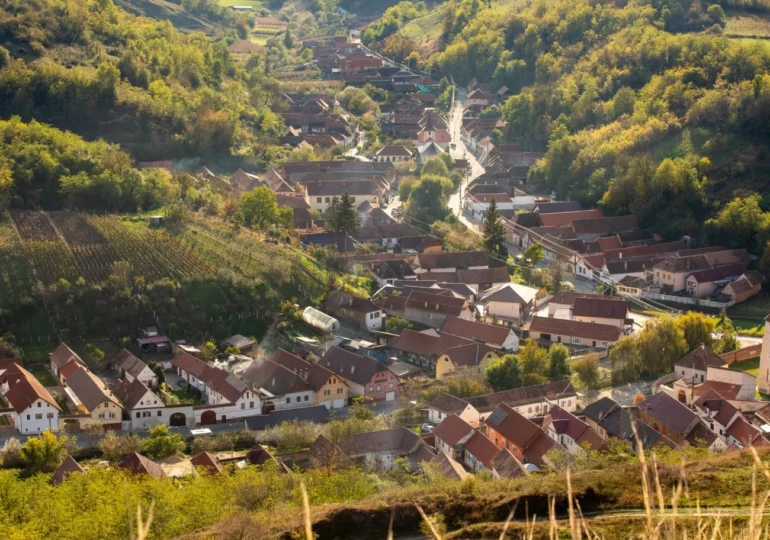
On a three-day hike on the Via Transilvanica, a journalist gave up the usual attractions related to Dracula legends and instead discovered medieval villages, ancient forests, and a rich, living history.
Erin Vivid Riley, a travel journalist, combined a few days spent on Via Transilvanica with a visit to the cities that serve as gateways to the region: Cluj-Napoca and Brașov.
She admits, in a report published in the New York Times, aptly titled "Transylvania, where meadows roll and Dracula legends fade," that before coming to Romania, this region seemed more like a universal symbol than a real place.
Since Irish writer Bram Stoker published "Dracula" in 1897, Transylvania has become the quintessential setting for the gothic horror genre in the collective imagination. Recently, this destination has returned to Hollywood’s attention, serving as inspiration for Robert Eggers' 2024 film "Nosferatu" and providing the backdrop for certain scenes in the Netflix series "Wednesday," she writes.
Sighișoara, "a true time capsule"
Beyond landscapes seemingly taken from fairy tales, with majestic castles, fortresses perched on hills, and villages with pastel-colored houses, she discovered a culture shaped by the influences of the Huns, Saxons, Ottomans, Habsburgs, Hungarians, as well as by the process of rediscovery and rebuilding after the communist period.
The journalist notes the modern atmosphere of the city of Cluj-Napoca: "With a modern air, typical of a cosmopolitan center that has recently benefited from European funds and accelerated development of the tech sector, Cluj-Napoca displays a countercultural spirit while simultaneously embracing its not-so-distant communist past."
From there, she headed to Sighișoara, a city that seemed to her "a true time capsule."
Incursion into the land of bears
With only three days available to explore Via Transilvanica on foot, she chose a short, easily accessible section without a car, aiming to concentrate as many sights as possible over a minimal distance — a segment of about 48 kilometers in the middle part of the route. Starting from Sighișoara, she spent a night in the village of Criț, with the final destination being the village of Biertan, dominated by a fortified church.
From the very first kilometers, she spotted tracks on a muddy forest road. Between 10,000 and 13,000 brown bears live in Romania — the largest population in Europe, excluding Russia, the journalist notes. Overall, she felt at ease, although hiking alone, with average physical fitness but above-average backpacking experience.
Two villages seemingly taken from fairy tales
In Criț, a village with about 500 inhabitants, she noticed the castle that belonged to the Bethlen family — one of the most influential families in the region — from the 14th century until the building’s nationalization in 1949.
The next morning, she walked about 24 kilometers to Biertan, "another village seemingly taken from fairy tales," noting the view from above of the medieval settlement — with its imposing church situated on a hill and surrounded by houses with red roofs. The visit inside the church, which for centuries was the residence of the Saxon Lutheran bishop, was, however, less impressive.
Instead, the discovery of what can be described as a "marriage prison," arranged near the fortified walls of the church, turned the entire trip into a memorable experience. The exhibit, which includes two mannequins in a small barred room, illustrates an old Saxon Lutheran tradition: married couples considering divorce were locked together to try to resolve their disagreements and reconcile.
Something beyond fiction
The journalist also included Brașov in her itinerary, a city more oriented toward tourists, with shops selling "Dracula" themed products and tour operators promoting visits to Bran Castle, located nearby, the "lair" of the famous vampire.
Following the advice of the guide who led her through Sighișoara, she preferred to go to Sinaia and visit Peleș Castle, "a much more enchanting place."
What followed exceeded all her expectations, she confesses: "Its traditional exterior, in Neo-Renaissance style, hides absolute opulence inside. Each of the approximately 160 rooms is a maximalist ode dedicated to a certain subject. Forty types of wood, crafted with rich ornamental details, fill the central atrium. Huge Murano glass chandeliers and an Italian Paonazzo marble fireplace adorn the Florentine Hall. Another room houses an astonishing collection of 1,600 pieces of weaponry, ranging from executioners’ swords to horse armors."
"Everything surpassed anything my imagination could have conjured," writes the journalist. It was more of a "castle" than any encountered in King Arthur’s legends or animated fairy tales. It was, like much of Transylvania, something beyond fiction, she concludes.
T.D.