

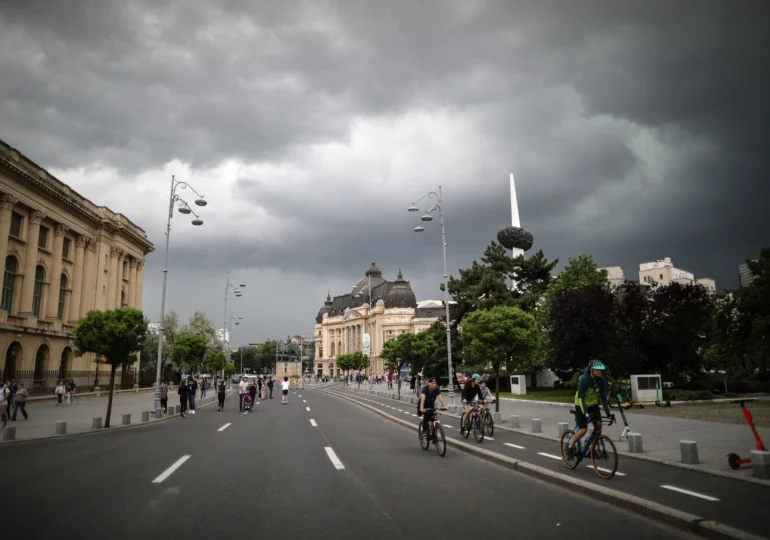
Bucharest ranks second to last in an air quality ranking comparing 40 major European cities. The Romanian capital scored only 17.9 points out of 100, being outperformed negatively only by Athens, according to a study published Tuesday by the European campaign Clean Cities.
Also on Tuesday, the National Environmental Guard announced that it supports the pollution reduction measures submitted by the City Hall of Bucharest and the Ministry of Environment to the European Commission. The institution highlights that, in the last six years, Bucharest City Hall has been fined 480,000 lei for failing to meet air quality obligations.
Bucharest, nearly last place. What the study shows
The European ranking “Free to Breathe” 2026, conducted by the Clean Cities campaign, places Bucharest 39th out of 40, with an F grade, the lowest possible.
According to Agerpres, the study uses data from the European Environment Agency and analyzes pollution levels, compliance with future European limits, progress over the last decade, and measures adopted in transport.
Bucharest is among the 18 cities analyzed that currently do not meet any of the four revised European air quality standards, which will become mandatory in 2030.
Some of the study’s results illustrate the scale of the problem:
- Nitrogen dioxide (NO2), a pollutant mainly originating from road traffic, has an average concentration of 32.2 micrograms per cubic meter, over 60% above the European limit set for 2030. Bucharest has the third highest concentration among the cities analyzed, after Athens and Turin.
- Fine particulate matter PM2.5 reaches an average of 15.8 micrograms per cubic meter, nearly 60% above the 10 microgram limit planned for 2030.
- Only 7% of main roads have protected bike lanes, compared to the 33% average of the cities included in the ranking.
- No street around schools is closed to car traffic through a “school street” program, with Bucharest being one of the ten cities in the study in this situation.
There is also a positive indicator: 29% of the Capital’s bus fleet consists of electric buses and trolleybuses, above the 27% average of the analyzed cities.
Over the last decade, nitrogen dioxide concentration in Bucharest has decreased by 27.5%, but progress is slower than the 35.1% average recorded in the ranking.
The study does not represent an official assessment of compliance with European legislation and does not compare all cities on the continent, but 40 major cities based on common indicators.
Fines worth hundreds of thousands of lei for Bucharest authorities
On the same day the study results were published, the National Environmental Guard announced it supports the implementation of pollution reduction measures included in documents sent to the European Commission by Bucharest City Hall and the Ministry of Environment. The institution states that local authorities have been repeatedly sanctioned for failing to meet air quality obligations.
In the last six years, Bucharest City Hall has received fines totaling 480,000 lei, and sanctions applied to sector city halls amounted to 172,500 lei, according to the Environmental Guard’s statement, conveyed by News.ro.
The institution’s general commissioner, Andrei Corlan, claims that the measures requested by inspectors following controls are now included in the plan submitted to the European Commission. “This means that control activities are not limited only to constant pressure through fines, but also include concrete measures that, as we see, can be adopted and implemented in the near future,” Corlan said.
He warned that air pollution in Bucharest cannot be solved through isolated interventions but requires coordinated and planned measures.
Measures promised to the European Commission
According to the Environmental Guard, road traffic and home heating together generate 84% of PM10 emissions in Bucharest. Over 18,000 homes in the Capital still use solid fuels for heating, which contribute to particulate pollution.
Among the measures communicated to the European Commission is the inclusion of 15,000 homes in a program to replace current heating systems with low or zero-emission solutions.
Authorities also propose changing the way streets are cleaned: banning blowers and dry sweeping, using street vacuum cleaners with HEPA filters, and pressure washing sidewalks and gutters.
The Environmental Guard recalls that last winter it imposed fines of 800,000 lei on sector city halls and some businesses for improper road cleaning after spreading anti-skid materials, which contributed to increased particulate pollution.
Measures regarding home heating are part of a broader plan that also includes restrictions for highly polluting vehicles.
The City Hall’s plan also includes traffic restrictions for polluting cars in certain city areas, as well as support measures for replacing heating systems using solid fuels.
The municipality’s documents show that the measures could reduce local emissions but do not guarantee compliance with all new European limits in 2030.
The National Environmental Guard announces it will continue inspections in Bucharest and the metropolitan area and will monitor the implementation of measures committed by authorities before the European Commission.