

The price of Brent crude oil surpassed $90 per barrel on Friday evening, for the first time in nearly two years, after the Middle East conflict triggered a wave of disruptions in energy markets, and Iran restricted maritime transport through the Strait of Hormuz, a key point for global energy trade.
The European oil price surged by over 5%, exceeding $90 per barrel, the highest level since April 2024, amid the escalation of the Middle East conflict, which severely disrupted global oil supply. The upward trend continues on Friday evening – the price has crossed $92 per barrel:
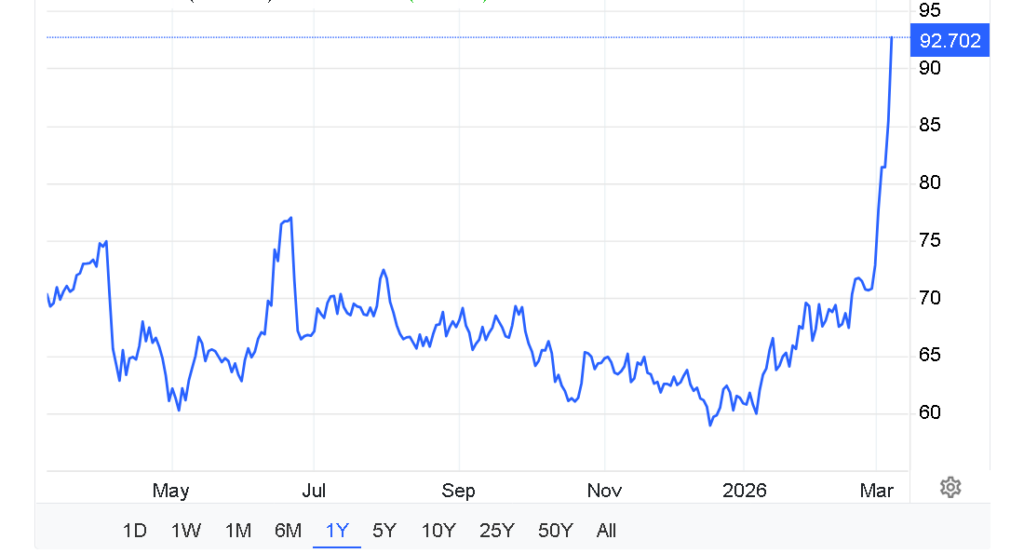
Oil prices recorded the strongest weekly growth since the extreme volatility during the COVID-19 pandemic in the spring of 2020, as the Middle East conflict blocked energy transport and exports through the Strait of Hormuz.
Last year, an estimated 20 million barrels of oil and petroleum products were transported through the Strait of Hormuz each day, according to the International Energy Agency (IEA).
Approximately 20% of global oil demand transits through this maritime route daily. With the strait blocked for seven days, around 140 million barrels of oil – equivalent to about 1.4 days of global demand – did not reach the market.
The shock to global oil supply has led to a price increase of over 20% this week.
Prices rose even as President Donald Trump indicated "imminent action" to alleviate price pressure, and the Treasury Department eased restrictions on India's purchases of Russian oil.
In the absence of a halt to hostilities, analysts at Goldman Sachs cited by the Wall Street Journal warned that in the event of further disruptions, oil prices could exceed $100 per barrel, while in Europe, diesel prices are heading for a weekly gain of over 50%, and central banks are concerned about the potential return of high inflation.