

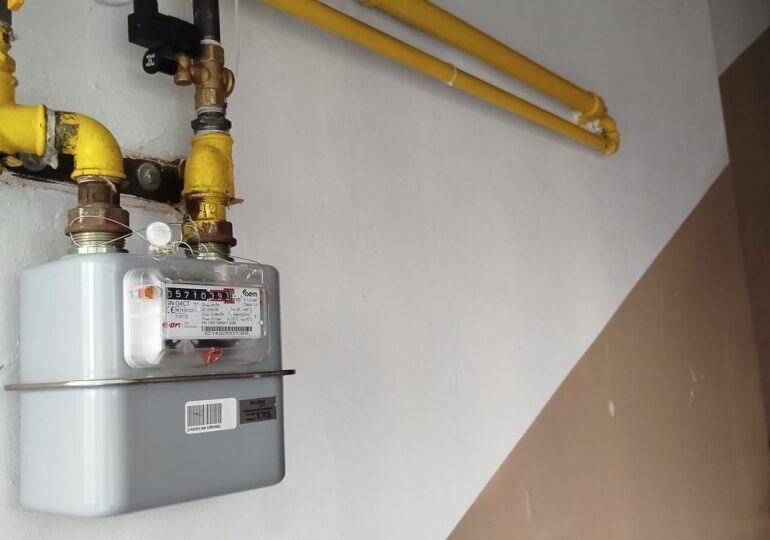
The government has decided to maintain capped gas prices for household consumers until next spring. Prime Minister Ilie Bolojan announced, after the government meeting, that the Executive has adopted an emergency ordinance extending the current mechanism until April 2027.
„The most important document adopted today is related to maintaining gas prices for households in Romania, so for household individuals, from April this year until April next year,” the prime minister said at a press conference at the Victoria Palace.
– [Impact of the war: Gas prices in Europe increase by 25%](https://spotmedia.ro/stiri/economie/efectul-razboiului-pretul-gazului-in-europa-creste-cu-25)
### Government cites global market volatility
Ilie Bolojan explained that the decision comes in the context of tensions on international energy markets, which can indirectly influence prices in Romania.
The Prime Minister pointed out that, although Romania and the European Union are not highly dependent on supplies from the Gulf region, global developments inevitably have effects on prices.
„We are in a situation where, even though the European Union or Romania are not highly dependent on supplies from the region, because prices in these gas markets, in fuel (…), are formed globally, there are inevitably marginal effects on us,” Bolojan said.
He emphasized that disruptions in supply chains and emotional market reactions can cause price increases, and where the state can intervene – as is the case with the gas market – the government has decided to act.
In fact, the Minister of Energy, Bogdan Ivan, announced yesterday that the government is preparing a normative act whereby the price of natural gas for household consumers [is set to remain at the current level of 0.31 lei/kWh for another year](https://spotmedia.ro/stiri/economie/pretul-gazelor-pentru-populatie-ar-putea-ramane-plafonat-la-031-lei-kwh-pana-in-2027).
„We ensure that prices will not be higher than they are today for household consumers, namely the capped price until March 31 of 0.31 lei/kWh. This places us in a zone of average costs compared to the EU average,” the minister added.
### Government seeks solutions for fuels
At the same time, the Prime Minister also stated that the Executive is monitoring developments on the global market and is trying to limit the impact on the Romanian economy, including regarding gasoline and diesel prices.
„We have discussed with Minister Ivan to limit the effects on the Romanian economy, on the cost of supplying diesel, gasoline. Inevitably, what happens on the global market influences us,” Bolojan said.
According to the Prime Minister, stabilizing the market would also depend on developments in the Middle East and the resumption of traffic through the Strait of Hormuz, one of the main transportation routes for oil and gas.
„The hope is that, in the shortest possible term, things will be clarified (…) to open up circulation through the Strait of Hormuz, so that tankers and the global supply system can return to a normal circuit,” he said.
– [OPEC+ confirms an increase in oil production above previous forecasts. The Hormuz issue – What experts say, what are the scenarios, estimates, and impact](https://spotmedia.ro/stiri/economie/opec-confirma-o-crestere-a-productiei-de-petrol-peste-prognozele-anterioare-problema-ormuz-ce-spun-expertii-care-sunt-scenariile-estimarile-si-impactul)
### Plan to reduce electricity prices
The Prime Minister announced that the government is also preparing a plan to reduce electricity prices, which is expected to be presented by the end of March.
The measures discussed include unlocking grid connection capacities, increasing storage capacities, and accelerating investments in energy infrastructure.
„This decrease cannot be achieved overnight, but there are several important directions to have effects starting this year,” Bolojan explained.
The Prime Minister pointed out that investments in energy production and networks are essential for reducing costs in the long term. „Only by increasing production capacities can we, in real terms, reduce prices,” he said.
In this context, the government also aims to improve the management of state energy companies, such as Nuclearelectrica, Hidroelectrica, or Transelectrica, which play a major role in the energy system.
„Every improvement at a company that is a key operator means better prices, means greater efficiency,” the Prime Minister stated.