
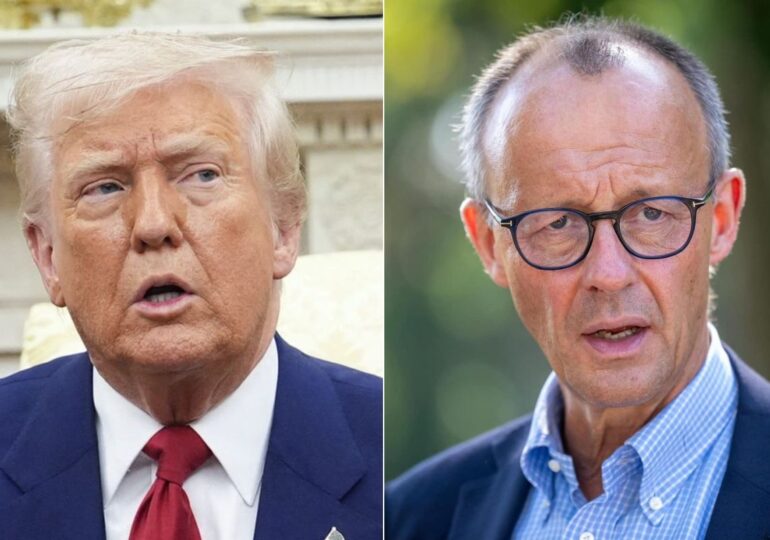
President Donald Trump announced that he is considering withdrawing some of the US troops from Germany, triggering confusion and concern in Washington. Defense officials say they had no plans for this and quickly tried to determine if the White House leader intends to follow through with the idea.
Politico describes the surprise reaction within the Pentagon and the implications for NATO.
Pentagon Caught by Surprise
Trump's social media post was the first source from which many officials learned about the possibility of withdrawing hundreds or even thousands of American troops from Germany.
A congressional advisor explained that "the Pentagon did not expect this and was not planning any reduction of troops." However, he added that "we must take him seriously because he was serious in his first term," referring to the 2020 order to withdraw 12,000 troops, which was not implemented.
The decision contradicts a recent Pentagon assessment of the global deployment of troops, completed after months of analysis, which did not recommend major withdrawals from Europe.
Harsh Attacks on Berlin
The announcement comes amid a new escalation of rhetoric by Trump towards Europe and, especially, Germany.
Just days after Chancellor Friedrich Merz said that the US is "humiliated" by Iran in negotiations, Trump publicly urged him to "spend more time" to stop the war in Ukraine and solve Europe's internal problems "and less time meddling in the affairs of those who are eliminating the Iranian nuclear threat."
Delicate Moment: Announcement Comes After Discussion with Putin
The timing raises even more questions. Trump made the announcement just hours after a phone call with Russian President Vladimir Putin, who has long been calling for a reduction of NATO presence in Europe.
At the same time, the German Defense Chief, General Carsten Breuer, was in Washington for discussions on Berlin's new defense strategy.
After the meetings, Breuer emphasized that "for Germany, it is clear that it must take on more responsibility" in defense matters.
Europe Reacts More Critically
Berlin reacted with surprise, especially since recent discussions with American officials were considered constructive.
A German official harshly criticized Trump's approach, stating that "his policy based on brutal threats has reached its limits" and that "his rhetoric has eroded."
He warned that "the withdrawal of American troops from Germany would seriously weaken even the United States" and questioned "when will the adults in Washington come to the forefront."
Huge Costs and Logistic Problems
A rapid withdrawal would be difficult to implement, especially given the US involvement in the conflict with Iran.
Germany hosts between 35,000 and 40,000 American troops and provides free land for bases, as well as logistical support. Two major US commands and the largest American military hospital outside the country operate here.
Analyst Todd Harrison warns that the move would involve high costs: "There are relocation costs, and depending on the destination, significant construction costs may arise."
He explained that, for example, "we do not have facilities to host them in Poland," which would require long-term investments.
Essential Strategic Role for the US
The American military presence in Germany is crucial for Washington's global positioning and deterring Russia.
The air bases allow for rapid deployment of troops to the Middle East and Africa, and the training grounds and military hospitals are essential for US and NATO operations.
In this context, a recently passed law prohibits reducing American forces in Europe below 76,000 without an official risk assessment.
Cautious Reactions in Congress
Although Republicans have criticized previous ideas of withdrawal from Europe, the current reactions are more reserved.
Senator Kevin Cramer said, "We need to better understand the strategy behind this decision," emphasizing that Ramstein Air Base is "strategic and important."
Senator Mike Rounds believes that Trump's statements may be more of a reaction to comments from Germany and that it is more relevant "to look at concrete actions, not public statements."
G.P.