

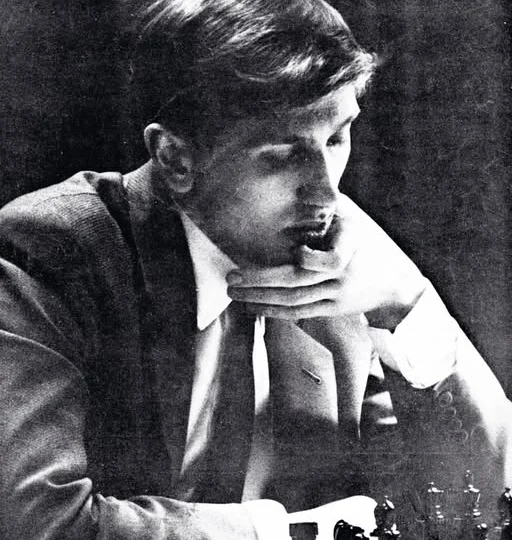
In these days, at Samarkand, nearly 2,000 players from over 200 federations sit in front of a chessboard every day. It’s the Chess Olympiad, one of the world’s largest international competitions. There’s no stadium, no noise from the stands, and no opponents physically clashing. There are only 64 squares, two armies, and a few hours where every decision can change everything.
And perhaps that’s why, watching the games at Samarkand, it’s worth going back more than six decades, to another Chess Olympiad and one of the most controversial and fascinating figures the sport has ever known: Bobby Fischer.
He was only 19 when he arrived at the Olympiad in Varna, Bulgaria, in 1962. But he was no longer seen as a prodigy. He was already an opponent that the grandmasters feared. And that autumn, he was about to play one of the games that would go down in chess history.
A Kid Against the Legends
Fischer didn't have an ordinary childhood. He had learned chess from a young age and had become obsessed with the game. Winning wasn't his only interest. He wanted to understand everything. Openings, variations, positions, sacrifices. He spent hours analyzing games and studying moves.
At 19, however, he found himself in a world dominated by giant names.
The Soviet Union was the absolute force in world chess. Champions like Mikhail Botvinnik, Mikhail Tal, and Tigran Petrosian represented a chess school that seemed almost unbeatable. Fischer, however, came with an ambition that would define his entire career: he didn't want to be just the best American. He wanted to be the best in the world.
In Varna, he played for the United States on the first board. That meant, almost every time, he would face the opponents' best players. He had nowhere to hide.
And Then Came Miguel Najdorf
On September 28, 1962, Fischer sat across from Miguel Najdorf. Najdorf was already a legend. A grandmaster from Argentina, one of the most well-known players of the era, and, above all, the man whose name had become synonymous with one of the most complex and spectacular variations in chess: the Najdorf Sicilian.
For a chess enthusiast, what was about to happen was almost symbolic.
The young Fischer was going to play against Najdorf using the very opening that bore his name. As if a young boxer had entered the ring using his opponent's favorite punch.
Fischer started with 1.e4. Najdorf responded with 1...c5. The Sicilian followed.
And then Fischer began to build something that, at first, didn't seem spectacular.
By the sixth move, Fischer played 6.h3. An apparently modest move. But behind it lay the idea of an attack.
Fischer Didn't Just Want to Win. He Wanted to Break the Position
Najdorf continued aggressively, and Fischer began to push his pieces toward the opponent's king. On move nine, Fischer played 9.c4. It was a pawn sacrifice. In chess, offering material to the opponent without immediately getting something in return may seem like madness. But there are moments when material matters less than time, space, and initiative.
Fischer saw something. The lines were opening up. The black king was starting to become vulnerable. And then came the moment that would turn the game into a memorable one. After 13.Qa4+, Fischer sacrificed a rook with 14.Rxe4.
A rook. One of the important pieces in the game. For someone looking at the board without understanding the idea behind the move, the gesture seems absurd. Why give away such a valuable piece?
Because Fischer wasn't playing for material anymore. He was playing for the attack.
24 Moves and the End
After the sacrifice, Fischer's attack became increasingly strong. Najdorf's king was pushed into an extremely difficult position, and the white pieces began to coordinate around it.
Fischer continued to find the precise moves. On move 23 came 23.Bxf7+, and just one move later, after 24.Be6, Najdorf resigned. The game was over. Fischer had won. Twenty-four moves, writes ChessLab.
The young American had defeated Miguel Najdorf in a game that would be considered one of the most spectacular of the Olympiad in Varna.
And perhaps the most beautiful detail is that Fischer had beaten Najdorf using the very Najdorf Sicilian, the opening named after his opponent, as shown in one of the stories on the official website of the former great American chess player.

But Fischer Was Not Invincible
The story becomes even more interesting if we remember that the same Olympiad was not a demonstration of perfection.
Fischer had defeats as well. In the final round, he lost to the great Yugoslav grandmaster Svetozar Gligorić in an extremely complicated game.
And during the competition, he also had a famous draw with the world champion Mikhail Botvinnik. Fischer reached a position where victory seemed possible, but the game ended in a draw.
Perhaps this is one of the most interesting parts of the story. Genius doesn't mean winning every game. It means having the courage to try things that others don't see.
A Moment When the World Began to See Him Differently
In Varna, Fischer scored 11 points out of 17 games played, one of the strongest individual performances by a player on the first board at an Olympiad up to that point.
But numbers don't tell the whole story. Because in chess, sometimes, a single game can say more about a person than an entire results table. The game with Najdorf shows a Fischer willing to take risks. To sacrifice. To venture into the unknown. To believe in an idea before others can see it.
And perhaps here lies one of the fascinating lessons of chess. The greatest players don't necessarily see more moves than others. Sometimes they see the same board differently.
Why Are We Still Fascinated by Bobby Fischer?
Ten years later, Fischer would become the world champion after his famous duel with Boris Spassky in 1972. But his story from Varna is interesting precisely because it happens before that moment.
It's the story of a young man who wasn't yet a world champion but already behaved like someone convinced he could get there. And perhaps this is one of the most beautiful ideas that sports offer us: sometimes, before the world recognizes a champion, there is a period where only he knows what he can become. The rest still wonders. He keeps playing.
64 Squares and a Whole World
Today, at Samarkand, hundreds of teams play for their countries. Games will be won, games will be lost, surprises will happen, and new stories will likely emerge that we will tell decades from now.
That's how sports work. Every generation has its champions, its madmen, its geniuses, and the people who, for a few hours, manage to make the impossible seem natural.
In 1962, in Varna, one of those people was a 19-year-old kid who stood in front of a legend and started sacrificing pieces as if he already knew how the story would end.
Perhaps that's why we still remember the game between Fischer and Najdorf.
Not for the 24 moves.
But for the courage behind them.
Because, sometimes, before the world calls you a genius, there must be a moment when you have enough confidence in your own vision to sacrifice something valuable for an idea only you can see.
And on the chessboard, as in life, the most spectacular victories don't always come when you have all your pieces.
Sometimes they come when you have the courage to give up one of them.