
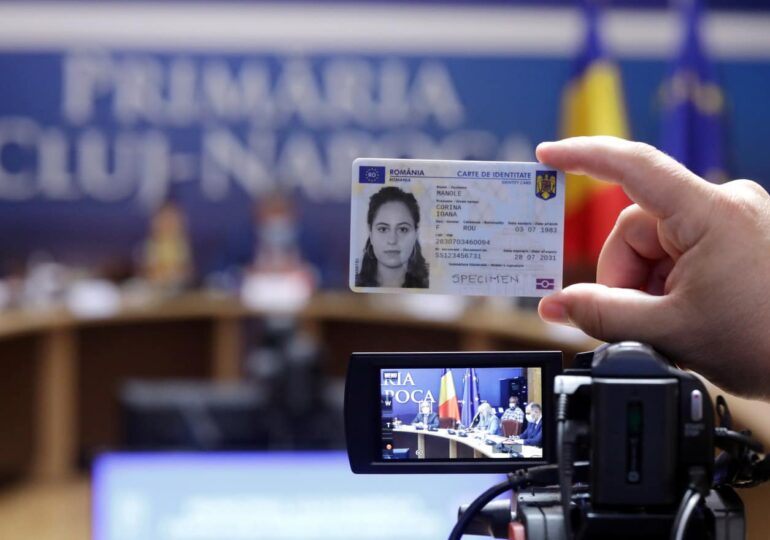
Romanians who are obtaining a new identity card and wish to establish their residence in a property that does not belong to them no longer need to come to the counter together with the owner. The owner’s consent for „receiving in space” can now be transmitted online through the platform of the Ministry of Internal Affairs.
The service has been available since August 6 and can be used for both the Electronic Identity Card (CEI) and the Simple Identity Card (CIS).
The novelty was confirmed by the General Directorate for Person Records (DGEP) for Profit.ro. The institution is preparing to expand the service also for establishing residency, known as the "floating visa."
The owner no longer needs to come to the counter
Consent for receiving in space is generally required when a person wants to establish their residence at an address where they are not the owner of the property.
Previously, the owner had to appear at the person records service to give their consent. If they were unable to attend, the declaration could be made, under the law, in front of a notary public or a police officer, or at a diplomatic mission or consular office for Romanians living abroad.
The new procedure eliminates this trip.
How to give consent online
The "Expressing Consent for Receiving in Space" service is available in the IT services HUB of the Ministry of Internal Affairs and can be used by property owners.
To access it, a validated account on the platform is required. Authentication can also be done with the Electronic Identity Card, ROeID, or the access data from Ghișeul.ro.
The owner enters the "Personal Identity" section, selects the service for expressing consent, and fills in the details of the person they are receiving in space.
Regarding the document proving the right of use over the property, there are two options: the applicant can present it in original at the counter, or the owner can upload an excerpt from the land registry obtained online from ANCPI, not older than 30 days.
The declaration is electronically transmitted to the person records service. The officer finds it in the system based on the owner's personal identification number provided by the person applying for the new identity card and attaches it to the application.
Next is the "floating visa"
Currently, the facility is available for the issuance procedures of CEI and CIS, but the Ministry of Internal Affairs intends to expand it.
"We are considering expanding this service also for the residency establishment procedure, so that the facility can be used, in the future, for this purpose as well," DGEP officials specified for Profit.ro.
For the owner, the change means avoiding the trip to the Person Records and, in certain cases, the costs associated with obtaining a declaration from a notary public.
For minors, the rules are different. Generally, a separate declaration for receiving in space is not required if the child's residence is established at the address of the parent they live with. Proof of address is provided through the parent's identity document accompanying the child.
What happens if the land registry excerpt cannot be obtained
If the land registry excerpt cannot be obtained or uploaded online, the owner can still give consent through the MAI HUB.
In this case, the owner hands over the original document proving the property right to the applicant, who presents it at the counter when submitting the identity card application. The owner no longer needs to accompany them.