
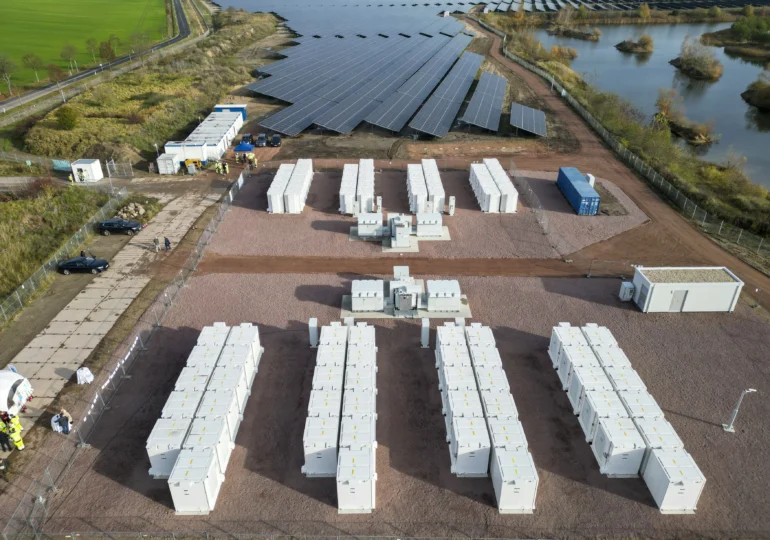
Bulgaria has increased its energy storage capacity in batteries by 1,000 MW in just one month. This is more than the entire installed capacity currently in Romania.
ENTSO-E data as of August 17 shows that Bulgaria has reached operational storage systems with a total capacity of 5,406 MW, excluding pumped hydro storage plants. On July 10, the level was 4,405 MW, indicating an increase of almost 23% in a month, according to an analysis by Profit.ro.
In comparison, Romania had storage installations with a capacity of 989.3 MW and a capacity of 1,974.7 MWh at the end of July, according to the most recent data from Transelectrica.
Thus, the difference is significant: Bulgaria now has an installed battery capacity over five times larger than Romania.
However, Romania is trying to reduce this gap, and the government has just announced a new financing scheme for batteries.
- The largest energy storage installation in batteries in Romania receives funding from the World Bank
Romania prepares new investments in storage
Interim Prime Minister Ilie Bolojan announced on Tuesday evening that 150 million euros have been allocated through the Modernization Fund for new autonomous energy storage installations in batteries directly connected to the National Energy System.
The program's target is to install a new storage capacity of at least 2,174 MWh. Projects can be submitted between September 1 and October 30, 2026, and the funded installations must be operational within 48 months of contract signing.
Bolojan argues that storage development is essential to better utilize energy produced during the day when there is a surplus of solar energy and low prices, and to reduce expensive imports during peak evening hours.
In recent days, the Prime Minister has also discussed the introduction of new rules for prosumers. One of his proposals is that in the future, new prosumers injecting energy into the grid must also have storage capacities.
What are all these batteries used for
Batteries do not generate energy but allow storing electricity when there is high production and lower consumption, for later use when demand increases.
In the case of Bulgaria, they can absorb the surplus produced by solar panels during sunny hours when energy is cheap, and deliver it to the grid in the evening when solar production diminishes, and consumption and prices rise.
According to the Bulgarian publication Kapital, the storage capacity of batteries installed in Bulgaria would exceed 16,200 MWh. This does not mean that batteries can replace nuclear or coal power plants: they must first be charged and can only provide energy for a limited number of hours.
However, they offer the energy system significant flexibility, especially during periods of high solar energy production.
How did Bulgaria get here
The rapid expansion in recent weeks is largely related to projects funded through the PNRR and the Restore 1 and Restore 2 programs for independent storage systems.
The projects were to be completed by July 31, and by the end of August, they must pass technical tests and complete a full charging and discharging cycle.
The two programs include over 110 projects, and the European support contracted for battery systems is approaching 700 million euros.
Energy was cheaper in Bulgaria
The development of storage is starting to be reflected in the energy market, although batteries are not the sole factor determining prices.
From August 1-16, the average price on the next-day market was 132.2 euros/MWh in Bulgaria, according to Kapital's calculations. In Romania, the average was 146.4 euros/MWh, and in Hungary, it was 147.5 euros/MWh.
Thus, the energy traded on this market was about 10% cheaper in Bulgaria than in Romania in the first half of August.
Batteries become even more important during challenging periods for hydro production. In the first 16 days of August, hydro power production in Romania was about 24% lower than in the same period last year, as reported by Profit.ro.
Storage systems alone cannot compensate for the lack of energy caused by prolonged drought, but they can more efficiently utilize solar production during the day and reduce the need for expensive energy during peak evening hours.