
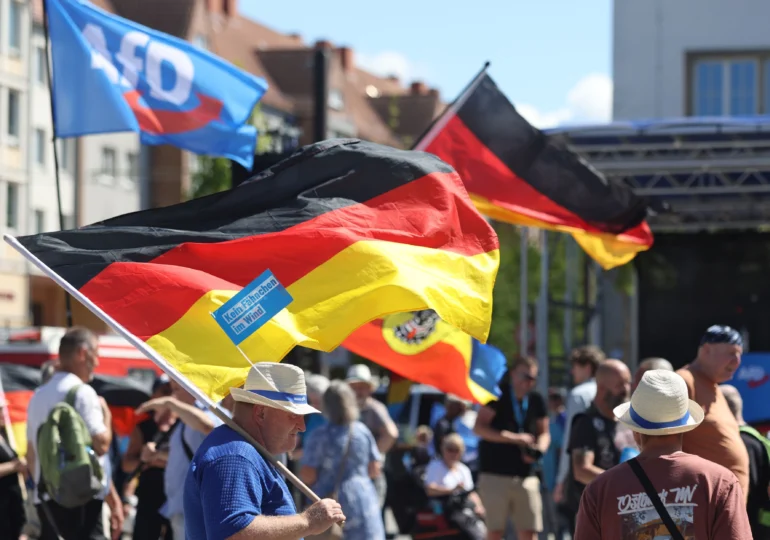
The rise of the Alternative for Germany (AfD) party is not only fueled by dissatisfaction with immigration, economic decline, or the weakening of the German industry. Behind its success lies nostalgia for a simpler and easier-to-understand society, as well as the feeling of many voters that they have lost their identity and pride.
AfD is currently the party with the highest support nationwide and is approaching the moment when it could lead a German state for the first time. In the regional elections on Sunday, the party ranked first in Mecklenburg-Western Pomerania and third in Berlin.
On the other hand, Chancellor Friedrich Merz's Christian Democratic Union (CDU) obtained very poor results, which he himself called "a disaster." The election will fuel discussions about the possible replacement of the chancellor before the end of his term, writes Steven Erlanger in an analysis published by the New York Times.
Nostalgia for a country that may never have existed
AfD exploits one of the elements that most populist parties, especially those on the far right, have in common: nostalgia for a lost society and nation over time, even if their image is idealized or partially imaginary.
"Today we live in a fragmented world with growing inequalities, where there are no longer common themes or a shared story to unite us," explains economist Mohamed A. El-Erian, a professor at the Wharton School of the University of Pennsylvania.
The feeling of insecurity drives many people to seek refuge in the past. Life is remembered as simpler, families seemed to have a clearer structure, and Western societies were largely Christian and less diverse.
Far-right parties in Europe present this image of the past as preferable to the present. At the same time, they downplay uncomfortable episodes from their own countries' history: Benito Mussolini's fascism in Italy, collaboration with the Nazis, Soviet occupation, or social inequalities during the Margaret Thatcher era.
In France, the Rassemblement National (RN) party, a favorite in polls ahead of next year's presidential elections, has built much of its ideology around French identity. The party evokes figures like Joan of Arc but pays less attention to the collaborationist regime in Vichy.
Similar ideas about national values, assimilating migrants, and giving preferential treatment to citizens also appear in Geert Wilders' Party for Freedom, the Sweden Democrats, or Reform UK led by Nigel Farage.
White and Christian culture presented as threatened
Beyond promises to limit immigration and deport illegal migrants or those who commit crimes, these parties argue that national identity is under threat.
They describe European culture as primarily white and Christian, endangered by globalization, Islam, and the weakening of national identity in institutions like the European Union.
Similar ideas are promoted by the MAGA movement in the United States. American Vice President JD Vance has warned of a possible "death of civilization" in Europe and the US, stating that a person's origin may matter more than their adherence to a country's values.
In his recent book, "Communion," Vance sees the transition from the "Western Christian civilization" to "global secular liberalism" as one of the causes of racial tensions, the weakening of traditional marriage, and demographic decline.
American Secretary of State Marco Rubio has described Christianity as a "sacred heritage" and "an unbroken link between the Old World and the New World."
Why the AfD message resonates especially in eastern Germany
The desire to reclaim a perceived lost identity is particularly strong in former East Germany. The reunification in 1989 was experienced by many East Germans more as a peaceful takeover by West Germany.
West Germans came as a new elite and took over the leadership of companies or closed them down. Up to a quarter of the East's population moved to the West, including many young women. "It was more German. Not a little America like the West was," says Anna Wenske, a 69-year-old woman from Thuringia, about the identity of former East Germany.
AfD leaders like Björn Höcke exploit this rupture and suggest that West Germans are no longer truly German but culturally colonized Americans. "They give people with an inferiority complex the feeling that they were the better Germans, that they are authentic, and that they represent the future," explains sociologist Steffen Mau, born in East Germany.
Many East Germans also believe they opposed the Soviet occupiers more than they opposed the influence of American culture in West Germany. At the same time, the communist regime presented itself as the heir to resistance against Hitler and did not adopt the "culture of guilt" that marked West Germany after the war.
"More Bismarck, less Hitler"
For younger generations, the war and the crimes of Nazism no longer represent personal responsibility. The AfD message, which calls for Germany's achievements to be placed ahead of collective guilt, becomes attractive as a result.
Just as Donald Trump tried to get American institutions to talk less about slavery and more about heroes like George Washington, AfD wants to change education, museums, and public media. The goal is to reduce the emphasis on Germany's guilt and promote national pride and greatness.
"More Bismarck, less Hitler," summarized Hans-Thomas Tillschneider, AfD vice president and education officer in Saxony-Anhalt.
Germany is going through a "psychodrama related to its own history," according to German-American political scientist Yascha Mounk. The discussion about right-wing populism is, in part, a confrontation about how Germany's past should be interpreted.
AfD wants to abandon the current "Erinnerungskultur" - Memory Culture built around Nazi crimes - and replace it with a prouder national perspective.
Political scientist Ivan Krastev believes this change marks the end of the "long 20th century in politics." He says that responsibility for the crimes of Nazism can no longer be used to stabilize the German political system.
Nostalgia is not for communism
Especially in East Germany, nostalgia does not necessarily concern the communist regime or the Nazi period. People long for the communities that were torn apart after the massive population exodus and for the peaceful life they believe they once understood. "They are nostalgic for the world they thought they understood, and now they live in a world they no longer understand," explains Ivan Krastev.
The pride people felt for their own lives was not acknowledged after reunification, he adds. And people deprived of pride are easily drawn to parties that talk about grandeur, greatness, and regaining respect.
This phenomenon is not limited to Germany. The same messages are found in the speeches of Jordan Bardella, president of RN in France, or of former General Roberto Vannacci, who founded the National Future party in Italy, positioned to the right of the party led by Giorgia Meloni.
Failures of liberal democracy
The next important tests will come in the elections scheduled for next year in France, Italy, Poland, and Spain, countries where far-right parties are trying to push politics in their direction.
The West has become too confident in the stability of democracy and has started to take it for granted, warns economist Daron Acemoglu, Nobel Prize laureate and author of the book "What Happened to Liberal Democracy?"
The rise of populism and the democratic regression are fueled by the failures of liberal democracy.
The first failure is economic: the growth of inequalities and the lack of policies to better distribute prosperity.
The second is cultural: top-down politics, which treated less educated or less advantaged voters with contempt and ignored their concerns.
Into this void entered the far-right parties.
"A population that feels insecure and associates globalization and transnational identity with insecurity is very receptive to this type of identity politics, seen from a nationalist-conservative perspective," concludes British analyst and German citizen John Kampfner.
G.P.