
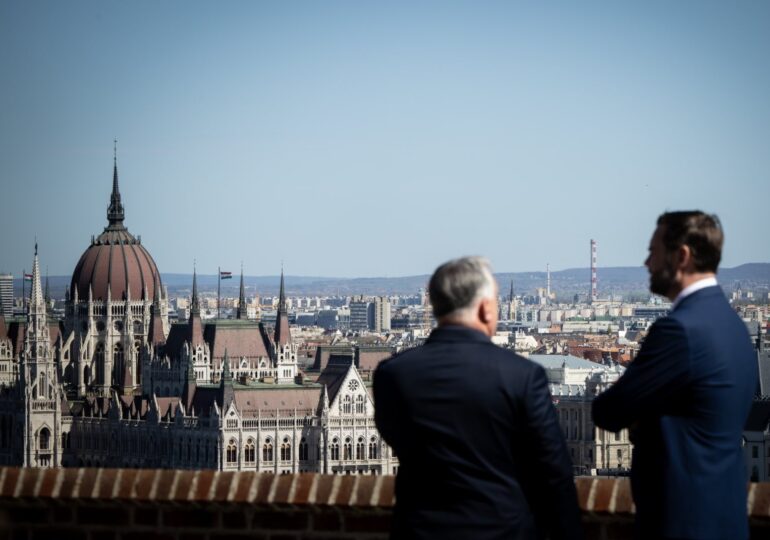
The Vice President of the United States mocked the European Union while openly supporting Viktor Orban. But the political show he endorsed in the Hungarian capital may not only be about supporting the Hungarian Prime Minister.
US presidential campaigns usually kick off in the Iowa State Fare or another prestigious American arena. JD Vance chose Budapest, as reported by The Atlantic.
The American Vice President visited the Hungarian capital to align himself in the most visible way with Prime Minister Viktor Orban, who is fighting to stay in power in the parliamentary elections scheduled for Sunday.
The US government's support for Orban was already clear. President Trump issued a "complete and total endorsement" on social media. Secretary of State Marco Rubio, the most credible threat to Vance's Republican presidential nomination in 2028, traveled to Budapest in February and stated, "Your success is our success."
Vance couldn't be left behind.
Hungary doesn't matter to the USA, but it's important for Vance
Hungary has relatively little material value for the United States. It's a landlocked country with less than 10 million inhabitants, representing about a quarter of a percent of US trade. It contributes negligibly to NATO, the unit of measurement the Trump administration uses to quantify the value of its European partners.
However, Hungary matters to Vance because it matters to the MAGA intelligentsia - the heads of think tanks, Substack writers, and X influencers who help shape the agenda of the modern Republican Party, notes the publication.
Many "guardians" of Republican values view Hungary as a model. In their minds, Orban shows how you can abandon conservative subtleties and seize control of state institutions to promote a certain vision of the good life, one that upholds Christianity as the basis of society while punishing adversaries, including leftists, immigrants, and sexual minorities. So, the Hungarian elections have become the first stop in the 2028 presidential competition, the publication notes.
The trip to Budapest, which took place five days before the start of voting in Hungary, couldn't have come at a better time for Vance, whose image as an anti-interventionist contradicts Trump's decision to wage war against Iran.
In Budapest, he allowed himself to keep a certain distance from the American president's threats to eliminate Iranian civilization. The Vice President was in his comfort zone there, invoking fears of "woke" indoctrination and inciting Hungarians in a speech against multinational institutions and affirming their belief in sovereignty.
The American tradition Vance and Trump trample on
Vance's appearance alongside Orban in the final days of the Hungarian campaign breaks with American political tradition. US presidents and vice presidents have rarely openly intervened in elections in other countries, notes The Atlantic.
Barack Obama warned against Brexit during a visit to the UK a few months before the 2016 referendum, saying that leaving the European Union would put the country "at the back of the queue" for trade talks. But his comments didn't endorse a specific party or candidate. Bill Clinton visited Israel in 1996 and spoke warmly about Shimon Peres, who was then competing against Benjamin Netanyahu. But he didn't express support.
There is a long history of US covert influence in foreign elections, especially in Latin America. However, one of the reasons the activity remained secret was to provide plausible deniability to the occupants of the White House.
Clearly, Vance didn't bother with such subtle constraints. His intervention was all the more unusual as he accused the EU, which has supported Hungary's economic development over the past two decades, of meddling in the country's elections, the publication points out.
"What happened in the middle of this election campaign is one of the most serious examples of foreign electoral interference that I have seen or read about," Vance declared during a joint press conference with Orban. "The bureaucrats in Brussels have tried to destroy Hungary's economy. And they did it all because they hate this man," he said, attempting to reframe the EU's financial sanctions imposed on Hungary for violating the rule of law as attempts to interfere in elections.
Vance's willingness to support conspiracy theories invented by Orban has strengthened a new convergence. Orban's party, Fidesz, enjoys support from both Washington and Moscow, while many of the Hungarian Prime Minister's counterparts are aligned on the other side. They haven't issued any support, but quietly hope that Orban will lose to Péter Magyar, a former loyalist of Orban who defected two years ago and now leads a new party, Tisza, leading in most polls.
Hungary comes out wrinkled in comparison to Romania
Vance and Orban spoke in front of the press, proclaiming the Hungarian-American Friendship Day. Vance easily navigated through areas of bilateral engagement, including energy, production, and technology. These were less important, he said, than what he called "moral cooperation" that ensures people can have children and those children won't be indoctrinated in school.
In their statements, both governments are dedicated to "defending the idea that we are founded on a certain Christian civilization and Christian values that inspire everything, from freedom of speech to the rule of law, to the respect of minority rights and the protection of vulnerable individuals."
Vance called Hungary a model for the rest of the EU. However, The Atlantic points out a few things Vice President of the USA didn't mention:
- In 2023, Orban's government approved the pardon of a man convicted of covering up child sexual abuse.
- A government report published by Orban's opponent found that more than one in five children in state institutions were abused.
- Hungary's maternal mortality rate is over twice the EU average.
Furthermore, Hungary used to be about 30% richer than its neighbor, Romania, according to one indicator; now Romania is leading, the publication notes.
The EU bureaucrats Vance criticized have funded nearly all of Hungary's public development projects. The source of this statistic is not a woke university but the US State Department. Meanwhile, public contracts disproportionately flow to the Prime Minister's allies, the publication cited.
The culture of clientelism in Hungary is one of the reasons why some Western officials doubt Orban can lose, despite polls showing his party trailing the opposition.
Large segments of society have become dependent on Fidesz for their well-being. Vance also ruled out the possibility of defeat. "Viktor Orban will win," he said, turning to the Prime Minister and asking, "Viktor, is that right?" How could Orban miss such a well-served ball at the net? "That's the plan," he replied.
A cheap political show: Vance called Trump
From the Prime Minister's office, Vance went to a sports arena on the other side of the city to greet Fidesz supporters. A pensioner was waiting in line. "He came to Europe just for us," said Marietta Sebestyén enthusiastically. The only better guest, she added, would have been Trump.
Her wish was immediately granted when Vance began his speech by calling Trump on stage and putting him on speaker.
"Mr. President, you're on the line with about 5,000 Hungarian patriots," Vance said. "And I think they love you even more than they love Viktor Orban." Trump felt flattered. "I can't believe it," he said, before offering a succinct account of Orban's success. "You have a man who has kept your country strong and kept it good," Trump said. "And you don't have to deal with all the problems that so many other countries have."
Trump also had a question for the audience: "How did JD do? Did he give a good speech?" Except the Vice President hadn't spoken yet. That followed, and he planted fear of a vague enemy who allegedly rejects the idea of the nation, rejects motherhood, rejects Christianity, condemns children to mutilation. "They hate one man more than anyone else, and his name is Viktor Orban. And if they hate him, it means he's on your side," Vance said.
Midway through the speech, Vance tried to clarify his views on the continent he was visiting: "The European press constantly asks: Do Trump and Vance have something against Europe? Let me be clear, we love Europe." He continued, "We love its people. We love its culture. We love its beautiful architecture. And we love the amazing history of this continent. But because we love this culture and these people, we reject the faceless bureaucrats who would raise your energy costs and open your country to millions of unchecked foreigners, all in the name of progress."
Applause followed. European officials describe Vance's optics as the logic of abusers: they hit you because they love you. Former Trump administration officials explained it differently, saying that animosity towards Europe is largely an extension of internal antagonisms. Trump and Vance associate mainstream European leaders with their adversaries in the Democratic Party and treat them accordingly.
But if Vance sees a political opportunity in appealing to Hungarian nationalism, Péter Magyar sees it the same way. On social media, he issued a brief statement in response to Vance's visit, saying, among other things: "No foreign country can intervene in Hungary's elections. This is our country."
T.D.