


Judge Simina Tănăsescu is 57 years old and took over the leadership of the Constitutional Court last year. She aimed to humanize and increase public confidence in the institution.
With vast experience in the judiciary, a university professor at the Faculty of Law, former presidential advisor, Judge Tănăsescu is aware of the importance of the decisions of the Constitutional Court and maintains that the institution must be reserved, assuming only the role of verifying the constitutionality of laws and not acting as an arbiter between the powers of the state.

Relevant Quotes:
- In the deliberations concerning the 2024 presidential elections, I didn’t live at the Court’s headquarters. But the deliberation was undoubtedly lively. I can’t recall the exact number of hours, but it was a very focused discussion; it addressed legal aspects on which we based our decision.
- The annulment of the presidential elections was not a decision that any of us took lightly. It wasn’t a decision we desired. It wasn’t a decision we had thought about before; we didn’t think we would face such a situation. It’s something that undoubtedly affected all of us. But it was a decision made unanimously, assumed and argued, based on legal arguments.
- Regarding the constitutional decision on the magistrates’ pensions law, the Constitutional Court verified the compatibility with the Constitution of a law. A law that does not target the overall functioning of the judiciary, nor even all the status elements of the magistrate profession – an extremely remarkable, honorable, and meritorious profession – but rather a detail, an aspect. This aspect has also been addressed by other legislative acts, some of which the Court has declared constitutional, and others unconstitutional.
- The secrecy of deliberations is important both at the Constitutional Court and in ordinary courts. Each member can present arguments, in a collegial environment, regarding the respective case (in favor or against a solution). Where there are two jurists, there are three opinions, as the saying goes.
- We feel the public pressure and that from the media; we perceive it like any citizen, especially when it concerns our professional activity. All constitutional judges have stress resistance; it’s part of the job description. I can say, with my hand on my heart, that I have never faced any direct pressure from any political or other actors. I was a judge in the ordinary court; now I’m at the Constitutional Court, but I haven’t encountered any attempts at influence.
- This room is perhaps the most spacious, grand, beautiful in the whole building. However, the CCR headquarters is a real issue. The Court’s staff currently consists of approximately 135 people, occupying only two floors of a building as large as the Parliament’s, which has a lot of spaces, but they are mostly corridors. The actual office space is very limited.
Let's start the discussion by reminding two important events for Romanian society. I refer to the annulment of the 2024 elections and the latest major decision taken by the Constitutional Court to validate the legislation regarding the reform of magistrates' pensions. I'd like to start with the latest decision? How complicated was it to make? What does it mean for CCR to make decisions that have a strong impact on society?
The Constitutional Court always makes decisions relevant to Romanian society and the Romanian state. From our perspective, all cases are equally important. I wouldn't say they are equally difficult, but we give each one the same attention.
You're right, some cases attract a very high media attention, sometimes even excessive. This often reflects the interest of the public opinion. There are also other cases equally important for citizens but without the same attention. The cases you referred to have decisions published today in the Official Gazette. The reasoning and arguments are already known.
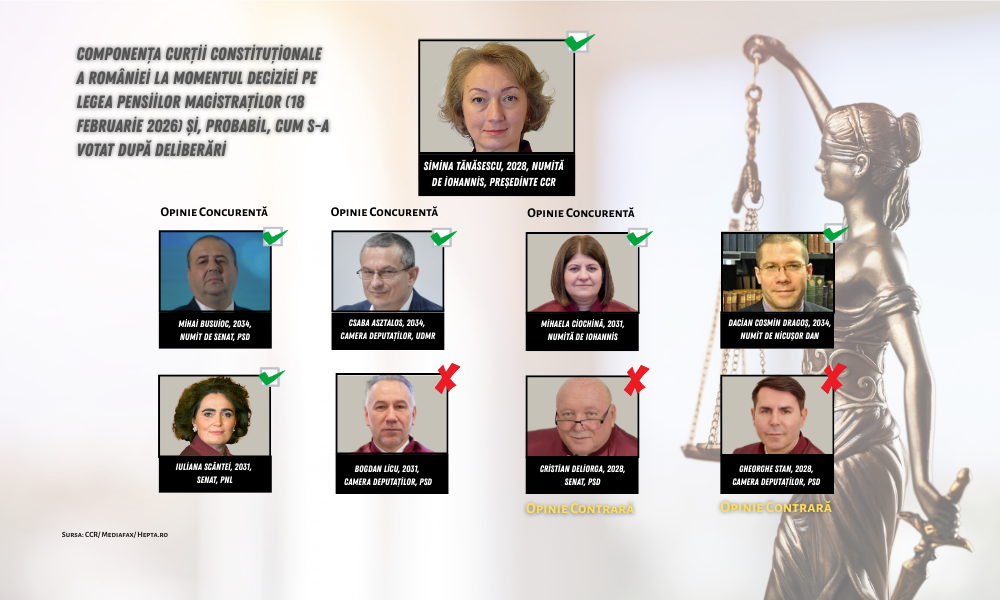
The motivation of the decision in the special pensions case of magistrates has 38 pages. It includes a concurrent opinion signed by three judges and a contrary one signed by two. One explains the decision and shows that the law could be better, and the other challenges the legislative proposal. This shows that there was an intense debate...
There are cases where the conclusion is easier to reach. There are also cases with lively debates; these are the most interesting, including for the Court judges. In the decision on magistrates' pensions, as we usually inform readers, we mention at the end, before the operative part, that the decision is made by a majority vote. This is further highlighted by the publication of a separate opinion.
The institution you lead does not publicly disclose the number of votes in one direction or another...
We do not disclose the vote for each aspect, but we announce if the decision was made unanimously or by majority. The decision-making process and deliberations take place in secret. There are numerous reasons why this is necessary.
Deliberation means the session where all nine judges are present...
Deliberation is the session where all nine judges discuss the case. The secrecy of deliberations is important both at the Constitutional Court and in ordinary courts. Each member can present arguments, in a collegial environment, regarding the respective case (in favor or against a solution). Where there are two jurists, there are three opinions, as the saying goes.
Any jurist can present arguments for and against, which will be carefully analyzed. Deliberations are held in secret, precisely for everyone to feel free to express their opinion fully. In the end, the public reaches the result. Deliberations remain secret, but the result is always public – that is the decision. Discussions, based on arguments, can change the opinions of some judges. They may maintain their initial position, but they may also accept other arguments or perspectives.
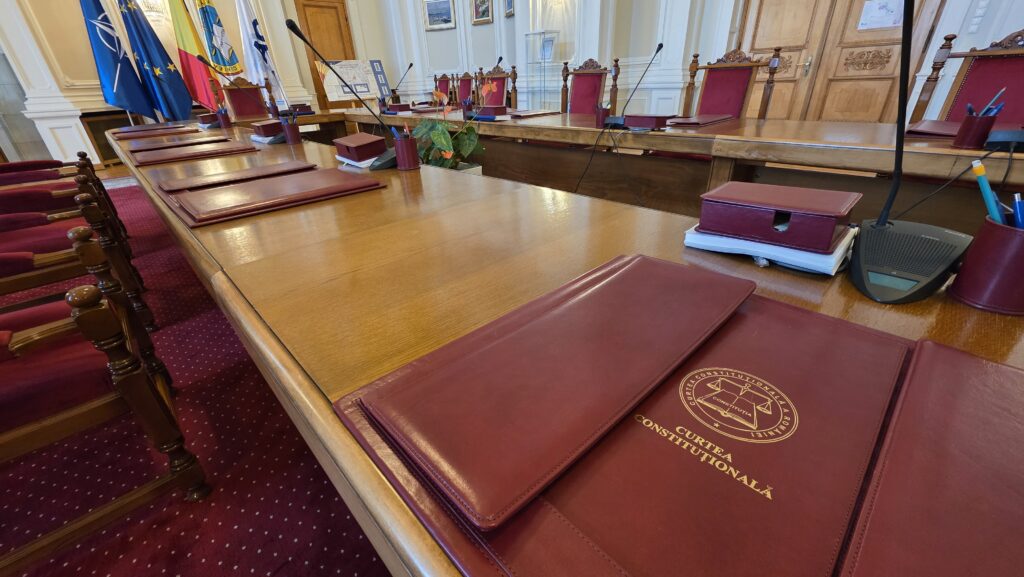
As laypeople, we may imagine that deliberation resembles more what we see in American movies, with jury deliberation.
There are two major types of decision-making processes for courts. Continental ones have deliberation in secret. Common law ones, sometimes illustrated in American movies, have their origins in English law. In the past, in England, judges publicly read the opinion and vote immediately after the public debates ended. The result was determined by vote counting. Currently, all judicial systems resort to secret deliberation.
You mentioned something very interesting that I don't want to overlook, that within these deliberations there can be an exchange of arguments that can lead to changing positions. Has this happened to you?
It's a possibility, and there are precedents.
Due to your experience as a CCR judge since 2019, have you had situations like this, deliberations where some positions have changed, entering with one position and leaving with another?
I believe so, there have been many cases, so I can't provide specific examples. It's possible that such situations have occurred. Moreover, sometimes the Court has changed its case law. Even if the decision was made by a majority, over time, one or two judges changed their position, leading to a change in the Court's case law.
I would like to ask how do you feel as a constitutional judge, the pressure of public opinion in certain cases? Have there been political pressures on deliberations to shape one decision or another?
We feel the public pressure and that from the mass media; we perceive it like any citizen, especially when it concerns our professional activity. All constitutional judges have stress resistance; it's part of the job description. I can say, with my hand on my heart, that I have never been directly pressured by any political actor or any other entity. I was a judge in the ordinary court; now I am at the Constitutional Court, but I have not encountered any attempt to influence me.
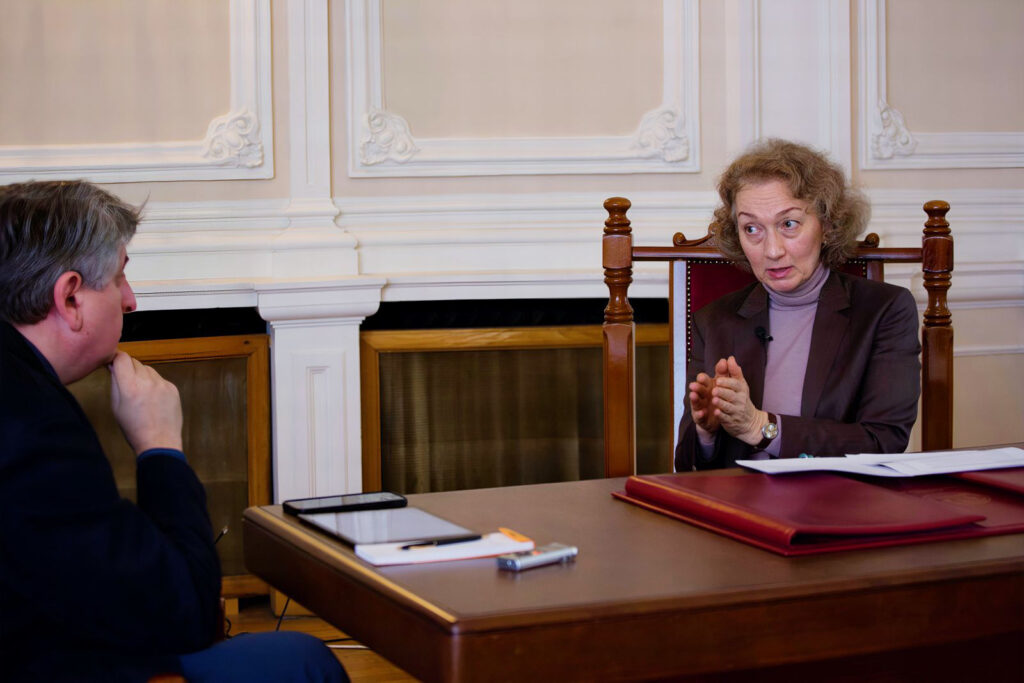
So no politician has ever called you to say: Madam, I don't know, please save the country. You must take a stand one way or another?
We always have to make a decision, as provided by Law 47/1992 (Law on the organization and functioning of the CCR). However, I have never received any calls of influence. I want to emphasize: I have never received any such personal call.
Tell us something about the workload at the CCR. How many cases are on the docket and what challenges do you face?
Currently, we have approximately 15,000 cases on the docket of the Court. Therefore, it is interesting for us, the constitutional judges, that a single case can generate a lot of interest, even though we have a total of 15,000 cases to discuss, at various procedural stages.
Mostly, are there constitutional challenges raised in cases? What percentage?
More than 80%. They are raised in cases pending before the judicial courts. We usually have very good cooperation with these courts.
Yes, but it burdens you a lot...
Our law allows the courts to filter exceptions based on very few criteria.
And is it good or bad?
I refrain from saying whether a law is good or bad. A law can be analyzed based on many criteria: it can be good, bad, appropriate, or timely. The Court can analyze it exclusively in terms of its conformity with the Constitution.
The idea is that courts could apply a denser filter...
The courts apply the filter provided by our organizational law, and we observe that they apply it correctly. However, our organizational law was amended in 1997, so long ago that perhaps many people have forgotten.
There was a period when, at the beginning of its existence, the Constitutional Court operated with its own filter for exceptions of unconstitutionality, present at its level and not at the level of the judicial courts. There was a designated judge-rapporteur who made an initial filter, and only after the exception passed this initial filter did it enter the Court's docket.
Meaning that judge determined if the exception was admissible or not?
Also, in that period, the Court had panels of three judges. All nine judges were divided into panels of three, and these panels of three judges judged the exceptions, with the possibility of an appeal to a panel of five constitutional judges. It was a somewhat more complex procedure.
But, on the one hand, it's true, that period was one in which not everyone in Romania had yet discovered the method of exercising constitutional control after the entry into force of laws, so not as many exceptions were raised as now.
On the other hand, it burdens our role quite a bit. There are also some repetitive exceptions. Out of the roughly 15,000 cases I mentioned (they may also be interconnected to reduce the number of decisions), of these, I believe approximately 4,000, if not more, are what we call repetitive cases. Many, many cases that refer to one or two provisions from a single law.
For each such case, we have to carry out what we call "internal procedural work": communications, citations, records, many things that consume a lot of our time, resources, human resources. Things that are not very visible externally but burden our activity. And perhaps here a reevaluation of our organizational law would be a good thing, to use the qualifier you mentioned earlier.
There are bills in Parliament that seek to reform the CCR, mainly the ways judges are appointed...
That's another issue.
There have been many criticisms in society regarding the way constitutional judges are appointed. It has been considered that the institution is too political, that appointments come from the Chamber of Deputies, from the Senate, from the President, being a perception that they are quite subjective and represent specific political objectives...
I believe that in Parliament, at the moment, there are several legislative initiatives targeting the Constitutional Court, but they do not address the operational issues we discussed earlier. But I would return a bit to the previous question, with just one thing. You asked me what other problems we have. One issue that I mention every time and that I don't want to miss the opportunity to mention again is that of the headquarters, the space.
It's a beautiful headquarters, look, there's a spectacular painted ceiling...
This hall is perhaps the most voluminous, spacious, and beautiful in the entire headquarters. However, the headquarters is a real issue. The Court's staff currently consists of approximately 135 people, who occupy only two floors in a building as large as the Parliament's, which has a lot of spaces, but many of them are corridors. The actual office space is very limited. And this is not something that prevents us from carrying out our activities, but it does weigh us down a bit.
For the attribution of adequate space, does it require a legislative initiative? Or a governmental decision?
Probably at the governmental level, there is a decision-making level where things would be feasible. The Court's headquarters was established in this building, again, from the beginning. And it was established from the beginning because at that time, the Court's staff was more limited, numerically more restricted. However, in the meantime, both the volume of activity has increased, and the Court's staff has grown, and the scope of the Court's activity has increased significantly. And yes, we face difficulties not only related to office spaces but also related to archive spaces.
Is the archive of the Constitutional Court digitized?
Not entirely. There are several practical, unspectacular issues that do not interest many people but represent a challenge for us. A challenge for which we have partially managed to find some solutions. We have optimized spaces; we have expanded a bit even within this building.
We have contracted storage spaces for archives that are no longer in use, historical archives, in specially designated areas for archiving documents. But it remains an agenda item, at least on the Court President's agenda, but also on the institution's agenda itself, which I keep alive, mentioning it whenever I have the opportunity.
In general, I give very bad advice. I'll give you one, but take it as a joke: Pick up the phone and call politicians...
That's a statement that belongs to you...
Representatives of the Government have complained many times that there is a certain type of scheme through which judges sue the state for compensatory payments, in the form of recognizing rights. Discrimination or difficult working conditions have been invoked many times, and in these types of cases, in general, the complainants win, meaning judges are suing each other, so there has been a very large amount of compensatory payments. We are talking about 2 billion euros that must be paid by taxpayers in Romania to judges following final decisions. We have seen, in the wake of opinions published by experts, that this issue can only be resolved by two institutions: the High Court of Cassation and Justice, which can resolve it through a decision in a trial, but also by unifying the jurisprudence of lower courts and the Constitutional Court - through a decision in a case that reaches the CCR. I would like to ask you: from the perspective of the institution you lead, is this issue a problem? Meaning that taxpayers have a debt of 2 billion euros to judges; these types of cases continue; many are on the docket, and no one knows how the whole story will end. On the other hand, the government does not implement final court decisions, saying it does not have the money…
That is the starting point for any debate, and undoubtedly, it is extremely important. It helps all of us a lot, but each judge prepares their cases beforehand. Certainly, not only in judicial activity, I believe it is much easier for anyone to assimilate, to process information when it is already somewhat prepared rather than to enter ex novo, abruptly, into a case.
So the reporting judge's report is undoubtedly absolutely necessary. But that does not mean that any of the judges are satisfied or limited only to that. However, the reporting judge, by having a prior time advantage, having the case assigned and more time to prepare it, masters it better. They can greatly support us in the analysis.
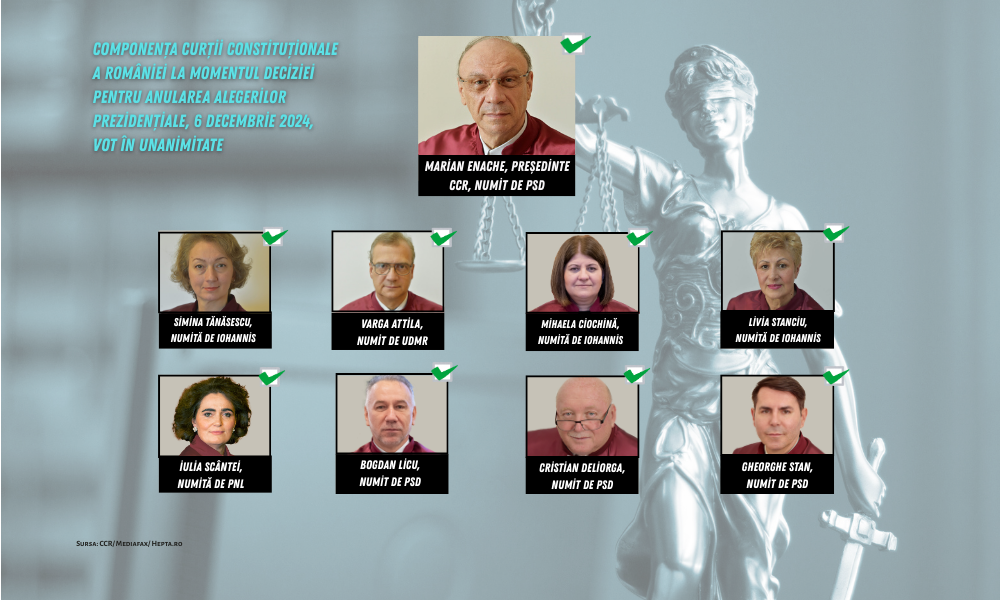
I asked this because I want to transition to the next question. You were part of the Constitutional Court panel led by Mr. Marian Enache, the former president, who made the historic decision to cancel the presidential elections in Romania in December 2024. Tell me how was it then? Unlike the decision on special pensions, it was a unanimous one. As far as I know, unanimous decisions, especially on very sensitive issues, are quite rare...
I don't want to upset you, but I have to disagree. Decisions made by majority are rarer. The vast majority of decisions are made unanimously.
However, the fact that indeed a decision like the one regarding the annulment of the elections was made unanimously should be significant. I believe that decision is self-explanatory, having been public for so long.
Who was the reporting judge in the election annulment case?
Reporting judges are one of the elements not intended for publicity. It's not a secret, but it's not necessarily something that can be made public. Moreover, in electoral litigation (and this is yet another element that can support a better Court activity), the deadlines we have in electoral litigation are quite short. It's somewhat understandable. Electoral litigation having a much higher dynamics, it's not possible to foresee very long deadlines. On the other hand, those deadlines are indeed very short.
I believe you had less than a week to make a decision...
Yes. But that decision clearly states the reasons why the elections were annulled. It was about the violation of fundamental rights of voters, electoral competitors, and the violation of rules regarding electoral campaign financing. These are three strong arguments justifying the decision made.
So there were no issues during that deliberation?
Extensive discussions exist, of course, and regarding such a decision, undoubtedly, there were discussions.
How long did the deliberation last?
I believe it's actually a well-known element. The declassification of documents took place on a Wednesday (December 4, 2024), and the Court's decision was made on a Friday (December 6, 2024).
Did you spend the entire 48 hours only in one deliberation session?
No, we did not reside at the Court's headquarters. But the deliberation was undoubtedly lively. I don't have the exact number of hours in mind right now, but it was a very focused discussion; it addressed these legal aspects on which we based our decision.
From the perspective of an expert, a law professor, did the experience stay in your memory?
Yes. Naturally.
For example, if you were to write your memoirs, how many pages would you dedicate to this episode?
I'll make a confession: I have never thought and never will think of writing my memoirs. My life itself is full enough that I don't need memoirs. But I have said this on other occasions as well and can calmly repeat it here: it was not a decision that any of us took lightly. It was not a decision we desired.
It was not a decision we had thought of beforehand; we had not thought we would face such a situation.
It is something that was bound to mark all of us, undoubtedly. But it was a decision made unanimously, embraced and argued, based on some legal arguments.
It's not just my subjective conviction that our arguments hold. Even the analysis conducted by the Venice Commission shortly after validated our arguments. The Venice Commission raised some issues related to other contextual aspects, but the validity of the legal reasoning was never once questioned.
What does the decision made by the Constitutional Court mean from the perspective of constitutional law?
There have been annulments of elections before. In Romania's case, it was presidential elections, in Austria's case, parliamentary elections, in Bulgaria's case, partial annulments of parliamentary elections. So, from the perspective of a comparative constitutional law professor, who also looks at other situations in other states, it's not an entirely new occurrence. However, it's a fact, an element that undoubtedly should be mentioned in textbooks because even from a comparative law perspective, it happens in some states, but not as a common occurrence.
In the context of the intense debates in society regarding the annulment of elections, I would like to ask you how important is the credibility of the Constitutional Court?
Credibility is essential for any public institution. Credibility probably also concerns the legitimacy of the institution, but also the degree of tolerance, acceptability of the institution by the target audience, meaning all citizens, in the case of the Constitutional Court, as well as the public authorities to whom we address our decisions.
Given that the ultimate beneficiaries of our activity are both institutions and citizens, we are equally interested in how our activity is perceived by both categories of recipients.
On the other hand, our institution, the Constitutional Court, settles disputes. As I mentioned before: not disputes between individuals, but still disputes between normative acts, which in fact means - between authorities that have adopted certain normative acts.
Therefore, inevitably, there will be legal issues, as I call them in my technical terminology, persons who will be dissatisfied with our solutions. But the legitimacy of a jurisdiction [the legitimacy of a judicial body or a Constitutional Court] primarily results from legal reasoning, from the persuasive power of the arguments you bring to support the solution you reach.
There may be solutions that are harder to accept, digest, or tolerate by society, but if they are sufficiently well, clearly, and convincingly supported by legal arguments, they will at least be tolerated, if not accepted, even by those who might not be pleased at that moment.
Because you brought the discussion here, to credibility, and linked it to the description of the decision. Not all the Constitutional Court reasonings over time have been convincing to public opinion...
I think there are at least two levels to consider. On the one hand, the fact that, indeed, like any profession, this legal profession has a specialized language, a jargon that is not always easy to penetrate, not always very intelligible, and sometimes the general public finds itself a little bewildered when faced with such legal reasoning, because the technical language used is simply not very intelligible to the general public, not because the argumentation isn't solid enough. Perhaps the argumentation is understandable to specialists, even if not to others.
On the other hand, we strive to complement that communication level to the general public somehow. We took the initiative to draft slightly more extensive press releases and we do our best to make them even more understandable.
The general public is not always very interested in the many decisions we make in which we reject constitutional challenges, and it is natural to be more interested in those decisions in which we admit the challenge and declare something unconstitutional.
And since last summer, we have started a new way of public communication through slightly more extensive press releases, a bit more suitable for ordinary language, a method that, in fact, we have received quite good feedback on, especially from the press, media representatives, who have told us that it helps them better understand the decision-making process, the content of the upcoming decision to be published, and allows them, afterwards, to translate our decision content into more general public language.
Now we are putting the reasoning into AI to understand them better...
I have a small concern regarding artificial intelligence from the perspective of intellectual property over our decisions.
But, on the other hand, the reasoning on the decision regarding the judges' pensions was very well structured. The arguments, concurring and dissenting opinions, were highlighted. In the past, CCR jurisprudence prohibited the publication of concurring and dissenting opinions...
I believe that the reasoning of decisions is another element that must be specified here. Our decisions respond to the challenges brought to us. To the extent that a challenge is well made, our response will be one that is understandable.
So, this means that the High Court of Cassation and Justice made a very good challenge, since we were able to be sufficiently explicit and clear in our response offered. Separate and concurring opinions were not hindered.
Or, well, to put it differently. In Romania, although we have a continental system, unlike many other states - mainly France, from which we drew inspiration - the drafting of separate opinions [concurring or dissenting] has been allowed since the adoption of the Civil Code in 1864, which entered into force in 1865.
As I mentioned, in many cases, the analysis made by the reporting judge is sufficient for the other Court members, so we can start our discussion and eventually align with the suggestion made by the reporting judge.
That is the starting point for any debate, and undoubtedly, it is extremely important. It helps all of us a lot, but each judge prepares their cases beforehand. Certainly, not only in judicial activity, I believe it is much easier for anyone to assimilate, to process information when it is already somewhat prepared rather than to enter ex novo, abruptly, into a case.
So the reporting judge's report is undoubtedly absolutely necessary. But that does not mean that any of the judges are satisfied or limited only to that. However, the reporting judge, by having a prior time advantage, having the case assigned and more time to prepare it, masters it better. They can greatly support us in the analysis.
I asked this because I want to transition to the next question. You were part of the Constitutional Court panel led by Mr. Marian Enache, the former president, who made the historic decision to cancel the presidential elections in Romania in December 2024. Tell me how was it then? Unlike the decision on special pensions, it was a unanimous one. As far as I know, unanimous decisions, especially on very sensitive issues, are quite rare...
I don't want to upset you, but I have to disagree. Decisions made by majority are rarer. The vast majority of decisions are made unanimously.
However, the fact that indeed a decision like the one regarding the annulment of the elections was made unanimously should be significant. I believe that decision is self-explanatory, having been public for so long.
Who was the reporting judge in the election annulment case?
Reporting judges are one of the elements not intended for publicity. It's not a secret, but it's not necessarily something that can be made public. Moreover, in electoral litigation (and this is yet another element that can support a better Court activity), the deadlines we have in electoral litigation are quite short. It's somewhat understandable. Electoral litigation having a much higher dynamics, it's not possible to foresee very long deadlines. On the other hand, those deadlines are indeed very short.
I believe you had less than a week to make a decision...
Yes. But that decision clearly states the reasons why the elections were annulled. It was about the violation of fundamental rights of voters, electoral competitors, and the violation of rules regarding electoral campaign financing. These are three strong arguments justifying the decision made.
So there were no issues during that deliberation?
Extensive discussions exist, of course, and regarding such a decision, undoubtedly, there were discussions.
How long did the deliberation last?
I believe it's actually a well-known element. The declassification of documents took place on a Wednesday (December 4, 2024), and the Court's decision was made on a Friday (December 6, 2024).
Did you spend the entire 48 hours only in one deliberation session?
No, we did not reside at the Court's headquarters. But the deliberation was undoubtedly lively. I don't have the exact number of hours in mind right now, but it was a very focused discussion; it addressed these legal aspects on which we based our decision.
From the perspective of an expert, a law professor, did the experience stay in your memory?
Yes. Naturally.
For example, if you were to write your memoirs, how many pages would you dedicate to this episode?
I'll make a confession: I have never thought and never will think of writing my memoirs. My life itself is full enough that I don't need memoirs. But I have said this on other occasions as well and can calmly repeat it here: it was not a decision that any of us took lightly. It was not a decision we desired.
It was not a decision we had thought of beforehand; we had not thought we would face such a situation.
It is something that was bound to mark all of us, undoubtedly. But it was a decision made unanimously, embraced and argued, based on some legal arguments.
It's not just my subjective conviction that our arguments hold. Even the analysis conducted by the Venice Commission shortly after validated our arguments. The Venice Commission raised some issues related to other contextual aspects, but the validity of the legal reasoning was never once questioned.
What does the decision made by the Constitutional Court mean from the perspective of constitutional law?
There have been annulments of elections before. In Romania's case, it was presidential elections, in Austria's case, parliamentary elections, in Bulgaria's case, partial annulments of parliamentary elections. So, from the perspective of a comparative constitutional law professor, who also looks at other situations in other states, it's not an entirely new occurrence. However, it's a fact, an element that undoubtedly should be mentioned in textbooks because even from a comparative law perspective, it happens in some states, but not as a common occurrence.
In the context of the intense debates in society regarding the annulment of elections, I would like to ask you how important is the credibility of the Constitutional Court?
Credibility is essential for any public institution. Credibility probably also concerns the legitimacy of the institution, but also the degree of tolerance, acceptability of the institution by the target audience, meaning all citizens, in the case of the Constitutional Court, as well as the public authorities to whom we address our decisions.
Given that the ultimate beneficiaries of our activity are both institutions and citizens, we are equally interested in how our activity is perceived by both categories of recipients.
On the other hand, our institution, the Constitutional Court, settles disputes. As I mentioned before: not disputes between individuals, but still disputes between normative acts, which in fact means - between authorities that have adopted certain normative acts.
Therefore, inevitably, there will be legal issues, as I call them in my technical terminology, persons who will be dissatisfied with our solutions. But the legitimacy of a jurisdiction [the legitimacy of a judicial body or a Constitutional Court] primarily results from legal reasoning, from the persuasive power of the arguments you bring to support the solution you reach.
There may be solutions that are harder to accept, digest, or tolerate by society, but if they are sufficiently well, clearly, and convincingly supported by legal arguments, they will at least be tolerated, if not accepted, even by those who might not be pleased at that moment.
Because you brought the discussion here, to credibility, and linked it to the description of the decision. Not all the Constitutional Court reasonings over time have been convincing to public opinion...
I think there are at least two levels to consider. On the one hand, the fact that, indeed, like any profession, this legal profession has a specialized language, a jargon that is not always easy to penetrate, not always very intelligible, and sometimes the general public finds itself a little bewildered when faced with such legal reasoning, because the technical language used is simply not very intelligible to the general public, not because the argumentation isn't solid enough. Perhaps the argumentation is understandable to specialists, even if not to others.
On the other hand, we strive to complement that communication level to the general public somehow. We took the initiative to draft slightly more extensive press releases and we do our best to make them even more understandable.
The general public is not always very interested in the many decisions we make in which we reject constitutional challenges, and it is natural to be more interested in those decisions in which we admit the challenge and declare something unconstitutional.
And since last summer, we have started a new way of public communication through slightly more extensive press releases, a bit more suitable for ordinary language, a method that, in fact, we have received quite good feedback on, especially from the press, media representatives, who have told us that it helps them better understand the decision-making process, the content of the upcoming decision to be published, and allows them, afterwards, to translate our decision content into more general public language.
Now we are putting the reasoning into AI to understand them better...
I have a small concern regarding artificial intelligence from the perspective of intellectual property over our decisions.
But, on the other hand, the reasoning on the decision regarding the judges' pensions was very well structured. The arguments, concurring and dissenting opinions, were highlighted. In the past, CCR jurisprudence prohibited the publication of concurring and dissenting opinions...
I believe that the reasoning of decisions is another element that must be specified here. Our decisions respond to the challenges brought to us. To the extent that a challenge is well made, our response will be one that is understandable.
So, this means that the High Court of Cassation and Justice made a very good challenge, since we were able to be sufficiently explicit and clear in our response offered. Separate and concurring opinions were not hindered.
Or, well, to put it differently. In Romania, although we have a continental system, unlike many other states - mainly France, from which we drew inspiration - the drafting of separate opinions [concurring or dissenting] has been allowed since the adoption of the Civil Code in 1864, which entered into force in 1865.
As I mentioned, in many cases, the analysis made by the reporting judge is sufficient for the other Court members, so we can start our discussion and eventually align with the suggestion made by the reporting judge.
There are situations during deliberations where one or another colleague feels the need for further clarification, and then we postpone the decision on the case, request additional information or relationships, and the reporting judge returns with a supplementary report and explains: here, following the information requests, we further analyzed and reached additional conclusions.
How important is the report itself for deliberations, the quality of the report?
That is the starting point for any debate, and undoubtedly, it is extremely important. It helps all of us a lot, but each judge prepares their cases beforehand. Certainly, not only in judicial activity, I believe it is much easier for anyone to assimilate, to process information when it is already somewhat prepared rather than to enter ex novo, abruptly, into a case.
So the reporting judge's report is undoubtedly absolutely necessary. But that does not mean that any of the judges are satisfied or limited only to that. However, the reporting judge, by having a prior time advantage, having the case assigned and more time to prepare it, masters it better. They can greatly support us in the analysis.
I asked this because I want to transition to the next question. You were part of the Constitutional Court panel led by Mr. Marian Enache, the former president, who made the historic decision to cancel the presidential elections in Romania in December 2024. Tell me how was it then? Unlike the decision on special pensions, it was a unanimous one. As far as I know, unanimous decisions, especially on very sensitive issues, are quite rare...
I don't want to upset you, but I have to disagree. Decisions made by majority are rarer. The vast majority of decisions are made unanimously.
However, the fact that indeed a decision like the one regarding the annulment of the elections was made unanimously should be significant. I believe that decision is self-explanatory, having been public for so long.
Who was the reporting judge in the election annulment case?
Reporting judges are one of the elements not intended for publicity. It's not a secret, but it's not necessarily something that can be made public. Moreover, in electoral litigation (and this is yet another element that can support a better Court activity), the deadlines we have in electoral litigation are quite short. It's somewhat understandable. Electoral litigation having a much higher dynamics, it's not possible to foresee very long deadlines. On the other hand, those deadlines are indeed very short.
I believe you had less than a week to make a decision...
Yes. But that decision clearly states the reasons why the elections were annulled. It was about the violation of fundamental rights of voters, electoral competitors, and the violation of rules regarding electoral campaign financing. These are three strong arguments justifying the decision made.
So there were no issues during that deliberation?
Extensive discussions exist, of course, and regarding such a decision, undoubtedly, there were discussions.
How long did the deliberation last?
I believe it's actually a well-known element. The declassification of documents took place on a Wednesday (December 4, 2024), and the Court's decision was made on a Friday (December 6, 2024).
Did you spend the entire 48 hours only in one deliberation session?
No, we did not reside at the Court's headquarters. But the deliberation was undoubtedly lively. I don't have the exact number of hours in mind right now, but it was a very focused discussion; it addressed these legal aspects on which we based our decision.
From the perspective of an expert, a law professor, did the experience stay in your memory?
Yes. Naturally.
For example, if you were to write your memoirs, how many pages would you dedicate to this episode?
I'll make a confession: I have never thought and never will think of writing my memoirs. My life itself is full enough that I don't need memoirs. But I have said this on other occasions as well and can calmly repeat it here: it was not a decision that any of us took lightly. It was not a decision we desired.
It was not a decision we had thought of beforehand; we had not thought we would face such a situation.
It is something that was bound to mark all of us, undoubtedly. But it was a decision made unanimously, embraced and argued, based on some legal arguments.
It's not just my subjective conviction that our arguments hold. Even the analysis conducted by the Venice Commission shortly after validated our arguments. The Venice Commission raised some issues related to other contextual aspects, but the validity of the legal reasoning was never once questioned.
What does the decision made by the Constitutional Court mean from the perspective of constitutional law?
There have been annulments of elections before. In Romania's case, it was presidential elections, in Austria's case, parliamentary elections, in Bulgaria's case, partial annulments of parliamentary elections. So, from the perspective of a comparative constitutional law professor, who also looks at other situations in other states, it's not an entirely new occurrence. However, it's a fact, an element that undoubtedly should be mentioned in textbooks because even from a comparative law perspective, it happens in some states, but not as a common occurrence.
In the context of the intense debates in society regarding the annulment of elections, I would like to ask you how important is the credibility of the Constitutional Court?
Credibility is essential for any public institution. Credibility probably also concerns the legitimacy of the institution, but also the degree of tolerance, acceptability of the institution by the target audience, meaning all citizens, in the case of the Constitutional Court, as well as the public authorities to whom we address our decisions.
Given that the ultimate beneficiaries of our activity are both institutions and citizens, we are equally interested in how our activity is perceived by both categories of recipients.
On the other hand, our institution, the Constitutional Court, settles disputes. As I mentioned before: not disputes between individuals, but still disputes between normative acts, which in fact means - between authorities that have adopted certain normative acts.
Therefore, inevitably, there will be legal issues, as I call them in my technical terminology, persons who will be dissatisfied with our solutions. But the legitimacy of a jurisdiction [the legitimacy of a judicial body or a Constitutional Court] primarily results from legal reasoning, from the persuasive power of the arguments you bring to support the solution you reach.
There may be solutions that are harder to accept, digest, or tolerate by society, but if they are sufficiently well, clearly, and convincingly supported by legal arguments, they will at least be tolerated, if not accepted, even by those who might not be pleased at that moment.
Because you brought the discussion here, to credibility, and linked it to the description of the decision. Not all the Constitutional Court reasonings over time have been convincing to public opinion...
I think there are at least two levels to consider. On the one hand, the fact that, indeed, like any profession, this legal profession has a specialized language, a jargon that is not always easy to penetrate, not always very intelligible, and sometimes the general public finds itself a little bewildered when faced with such legal reasoning, because the technical language used is simply not very intelligible to the general public, not because the argumentation isn't solid enough. Perhaps the argumentation is understandable to specialists, even if not to others.
On the other hand, we strive to complement that communication level to the general public somehow. We took the initiative to draft slightly more extensive press releases and we do our best to make them even more understandable.
The general public is not always very interested in the many decisions we make in which we reject constitutional challenges, and it is natural to be more interested in those decisions in which we admit the challenge and declare something unconstitutional.
And since last summer, we have started a new way of public communication through slightly more extensive press releases, a bit more suitable for ordinary language, a method that, in fact, we have received quite good feedback on, especially from the press, media representatives, who have told us that it helps them better understand the decision-making process, the content of the upcoming decision to be published, and allows them, afterwards, to translate our decision content into more general public language.
Now we are putting the reasoning into AI to understand them better...
I have a small concern regarding artificial intelligence from the perspective of intellectual property over our decisions.
But, on the other hand, the reasoning on the decision regarding the judges' pensions was very well structured. The arguments, concurring and dissenting opinions, were highlighted. In the past, CCR jurisprudence prohibited the publication of concurring and dissenting opinions...
I believe that the reasoning of decisions is another element that must be specified here. Our decisions respond to the challenges brought to us. To the extent that a challenge is well made, our response will be one that is understandable.
So, this means that the High Court of Cassation and Justice made a very good challenge, since we were able to be sufficiently explicit and clear in our response offered. Separate and concurring opinions were not hindered.
Or, well, to put it differently. In Romania, although we have a continental system, unlike many other states - mainly France, from which we drew inspiration - the drafting of separate opinions [concurring or dissenting] has been allowed since the adoption of the Civil Code in 1864, which entered into force in 1865.
Discussions happen all the time, undoubtedly, but discussions related to specific cases take place only during deliberations. Being jurists, I think it is very difficult for us to stay out of legal debates in a general sense, but these may sometimes address issues adjacent to cases, but I don't think they ever focus on specific cases. We discuss cases in the deliberation room.
As I mentioned, in many cases, the analysis made by the reporting judge is sufficient for the other Court members, so we can start our discussion and eventually align with the suggestion made by the reporting judge.
There are situations during deliberations where one or another colleague feels the need for further clarification, and then we postpone the decision on the case, request additional information or relationships, and the reporting judge returns with a supplementary report and explains: here, following the information requests, we further analyzed and reached additional conclusions.
How important is the report itself for deliberations, the quality of the report?
That is the starting point for any debate, and undoubtedly, it is extremely important. It helps all of us a lot, but each judge prepares their cases beforehand. Certainly, not only in judicial activity, I believe it is much easier for anyone to assimilate, to process information when it is already somewhat prepared rather than to enter ex novo, abruptly, into a case.
So the reporting judge's report is undoubtedly absolutely necessary. But that does not mean that any of the judges are satisfied or limited only to that. However, the reporting judge, by having a prior time advantage, having the case assigned and more time to prepare it, masters it better. They can greatly support us in the analysis.
I asked this because I want to transition to the next question. You were part of the Constitutional Court panel led by Mr. Marian Enache, the former president, who made the historic decision to cancel the presidential elections in Romania in December 2024. Tell me how was it then? Unlike the decision on special pensions, it was a unanimous one. As far as I know, unanimous decisions, especially on very sensitive issues, are quite rare...
I don't want to upset you, but I have to disagree. Decisions made by majority are rarer. The vast majority of decisions are made unanimously.
However, the fact that indeed a decision like the one regarding the annulment of the elections was made unanimously should be significant. I believe that decision is self-explanatory, having been public for so long.
Who was the reporting judge in the election annulment case?
Reporting judges are one of the elements not intended for publicity. It's not a secret, but it's not necessarily something that can be made public. Moreover, in electoral litigation (and this is yet another element that can support a better Court activity), the deadlines we have in electoral litigation are quite short. It's somewhat understandable. Electoral litigation having a much higher dynamics, it's not possible to foresee very long deadlines. On the other hand, those deadlines are indeed very short.
I believe you had less than a week to make a decision...
Yes. But that decision clearly states the reasons why the elections were annulled. It was about the violation of fundamental rights of voters, electoral competitors, and the violation of rules regarding electoral campaign financing. These are three strong arguments justifying the decision made.
So there were no issues during that deliberation?
Extensive discussions exist, of course, and regarding such a decision, undoubtedly, there were discussions.
How long did the deliberation last?
I believe it's actually a well-known element. The declassification of documents took place on a Wednesday (December 4, 2024), and the Court's decision was made on a Friday (December 6, 2024).
Did you spend the entire 48 hours only in one deliberation session?
No, we did not reside at the Court's headquarters. But the deliberation was undoubtedly lively. I don't have the exact number of hours in mind right now, but it was a very focused discussion; it addressed these legal aspects on which we based our decision.
From the perspective of an expert, a law professor, did the experience stay in your memory?
Yes. Naturally.
For example, if you were to write your memoirs, how many pages would you dedicate to this episode?
I'll make a confession: I have never thought and never will think of writing my memoirs. My life itself is full enough that I don't need memoirs. But I have said this on other occasions as well and can calmly repeat it here: it was not a decision that any of us took lightly. It was not a decision we desired.
It was not a decision we had thought of beforehand; we had not thought we would face such a situation.
It is something that was bound to mark all of us, undoubtedly. But it was a decision made unanimously, embraced and argued, based on some legal arguments.
It's not just my subjective conviction that our arguments hold. Even the analysis conducted by the Venice Commission shortly after validated our arguments. The Venice Commission raised some issues related to other contextual aspects, but the validity of the legal reasoning was never once questioned.
What does the decision made by the Constitutional Court mean from the perspective of constitutional law?
There have been annulments of elections before. In Romania's case, it was presidential elections, in Austria's case, parliamentary elections, in Bulgaria's case, partial annulments of parliamentary elections. So, from the perspective of a comparative constitutional law professor, who also looks at other situations in other states, it's not an entirely new occurrence. However, it's a fact, an element that undoubtedly should be mentioned in textbooks because even from a comparative law perspective, it happens in some states, but not as a common occurrence.
In the context of the intense debates in society regarding the annulment of elections, I would like to ask you how important is the credibility of the Constitutional Court?
Credibility is essential for any public institution. Credibility probably also concerns the legitimacy of the institution, but also the degree of tolerance, acceptability of the institution by the target audience, meaning all citizens, in the case of the Constitutional Court, as well as the public authorities to whom we address our decisions.
Given that the ultimate beneficiaries of our activity are both institutions and citizens, we are equally interested in how our activity is perceived by both categories of recipients.
On the other hand, our institution, the Constitutional Court, settles disputes. As I mentioned before: not disputes between individuals, but still disputes between normative acts, which in fact means - between authorities that have adopted certain normative acts.
Therefore, inevitably, there will be legal issues, as I call them in my technical terminology, persons who will be dissatisfied with our solutions. But the legitimacy of a jurisdiction [the legitimacy of a judicial body or a Constitutional Court] primarily results from legal reasoning, from the persuasive power of the arguments you bring to support the solution you reach.
There may be solutions that are harder to accept, digest, or tolerate by society, but if they are sufficiently well, clearly, and convincingly supported by legal arguments, they will at least be tolerated, if not accepted, even by those who might not be pleased at that moment.
Because you brought the discussion here, to credibility, and linked it to the description of the decision. Not all the Constitutional Court reasonings over time have been convincing to public opinion...
I think there are at least two levels to consider. On the one hand, the fact that, indeed, like any profession, this legal profession has a specialized language, a jargon that is not always easy to penetrate, not always very intelligible, and sometimes the general public finds itself a little bewildered when faced with such legal reasoning, because the technical language used is simply not very intelligible to the general public, not because the argumentation isn't solid enough. Perhaps the argumentation is understandable to specialists, even if not to others.
On the other hand, we strive to complement that communication level to the general public somehow. We took the initiative to draft slightly more extensive press releases and we do our best to make them even more understandable.
The general public is not always very interested in the many decisions we make in which we reject constitutional challenges, and it is natural to be more interested in those decisions in which we admit the challenge and declare something unconstitutional.
And since last summer, we have started a new way of public communication through slightly more extensive press releases, a bit more suitable for ordinary language, a method that, in fact, we have received quite good feedback on, especially from the press, media representatives, who have told us that it helps them better understand the decision-making process, the content of the upcoming decision to be published, and allows them, afterwards, to translate our decision content into more general public language.
Now we are putting the reasoning into AI to understand them better...
I have a small concern regarding artificial intelligence from the perspective of intellectual property over our decisions.
But, on the other hand, the reasoning on the decision regarding the judges' pensions was very well structured. The arguments, concurring and dissenting opinions, were highlighted. In the past, CCR jurisprudence prohibited the publication of concurring and dissenting opinions...
I believe that the reasoning of decisions is another element that must be specified here. Our decisions respond to the challenges brought to us. To the extent that a challenge is well made, our response will be one that is understandable.
So, this means that the High Court of Cassation and Justice made a very good challenge, since we were able to be sufficiently explicit and clear in our response offered. Separate and concurring opinions were not hindered.
Or, well, to put it differently. In Romania, although we have a continental system, unlike many other states - mainly France, from which we drew inspiration - the drafting of separate opinions [concurring or dissenting] has been allowed since the adoption of the Civil Code in 1864, which entered into force in 1865.
When the session begins... we all know what the reporting judge is going to present to us from a case because they present the document beforehand. So that is what we know. The reporting judge presents the report on the respective case and must make a proposal if in their evaluation the law is constitutional or unconstitutional. So we have at least one position. Or at least that is a starting point, a point of departure. There have been situations where the reporting judge proposed a solution, and during our deliberations, we all arrived at a different solution, which the reporting judge also supported.
Discussions happen all the time, undoubtedly, but discussions related to specific cases take place only during deliberations. Being jurists, I think it is very difficult for us to stay out of legal debates in a general sense, but these may sometimes address issues adjacent to cases, but I don't think they ever focus on specific cases. We discuss cases in the deliberation room.
What decisive role does the reporting judge have on a specific case? Meaning if in their report the respective judge says that the law is unconstitutional, do others tend to vote that it is unconstitutional?
As I mentioned, in many cases, the analysis made by the reporting judge is sufficient for the other Court members, so we can start our discussion and eventually align with the suggestion made by the reporting judge.
There are situations during deliberations where one or another colleague feels the need for further clarification, and then we postpone the decision on the case, request additional information or relationships, and the reporting judge returns with a supplementary report and explains: here, following the information requests, we further analyzed and reached additional conclusions.
How important is the report itself for deliberations, the quality of the report?
That is the starting point for any debate, and undoubtedly, it is extremely important. It helps all of us a lot, but each judge prepares their cases beforehand. Certainly, not only in judicial activity, I believe it is much easier for anyone to assimilate, to process information when it is already somewhat prepared rather than to enter ex novo, abruptly, into a case.
So the reporting judge's report is undoubtedly absolutely necessary. But that does not mean that any of the judges are satisfied or limited only to that. However, the reporting judge, by having a prior time advantage, having the case assigned and more time to prepare it, masters it better. They can greatly support us in the analysis.
I asked this because I want to transition to the next question. You were part of the Constitutional Court panel led by Mr. Marian Enache, the former president, who made the historic decision to cancel the presidential elections in Romania in December 2024. Tell me how was it then? Unlike the decision on special pensions, it was a unanimous one. As far as I know, unanimous decisions, especially on very sensitive issues, are quite rare...
I don't want to upset you, but I have to disagree. Decisions made by majority are rarer. The vast majority of decisions are made unanimously.
However, the fact that indeed a decision like the one regarding the annulment of the elections was made unanimously should be significant. I believe that decision is self-explanatory, having been public for so long.
Who was the reporting judge in the election annulment case?
Reporting judges are one of the elements not intended for publicity. It's not a secret, but it's not necessarily something that can be made public. Moreover, in electoral litigation (and this is yet another element that can support a better Court activity), the deadlines we have in electoral litigation are quite short. It's somewhat understandable. Electoral litigation having a much higher dynamics, it's not possible to foresee very long deadlines. On the other hand, those deadlines are indeed very short.
I believe you had less than a week to make a decision...
Yes. But that decision clearly states the reasons why the elections were annulled. It was about the violation of fundamental rights of voters, electoral competitors, and the violation of rules regarding electoral campaign financing. These are three strong arguments justifying the decision made.
So there were no issues during that deliberation?
Extensive discussions exist, of course, and regarding such a decision, undoubtedly, there were discussions.
How long did the deliberation last?
I believe it's actually a well-known element. The declassification of documents took place on a Wednesday (December 4, 2024), and the Court's decision was made on a Friday (December 6, 2024).
Did you spend the entire 48 hours only in one deliberation session?
No, we did not reside at the Court's headquarters. But the deliberation was undoubtedly lively. I don't have the exact number of hours in mind right now, but it was a very focused discussion; it addressed these legal aspects on which we based our decision.
From the perspective of an expert, a law professor, did the experience stay in your memory?
Yes. Naturally.
For example, if you were to write your memoirs, how many pages would you dedicate to this episode?
I'll make a confession: I have never thought and never will think of writing my memoirs. My life itself is full enough that I don't need memoirs. But I have said this on other occasions as well and can calmly repeat it here: it was not a decision that any of us took lightly. It was not a decision we desired.
It was not a decision we had thought of beforehand; we had not thought we would face such a situation.
It is something that was bound to mark all of us, undoubtedly. But it was a decision made unanimously, embraced and argued, based on some legal arguments.
It's not just my subjective conviction that our arguments hold. Even the analysis conducted by the Venice Commission shortly after validated our arguments. The Venice Commission raised some issues related to other contextual aspects, but the validity of the legal reasoning was never once questioned.
What does the decision made by the Constitutional Court mean from the perspective of constitutional law?
There have been annulments of elections before. In Romania's case, it was presidential elections, in Austria's case, parliamentary elections, in Bulgaria's case, partial annulments of parliamentary elections. So, from the perspective of a comparative constitutional law professor, who also looks at other situations in other states, it's not an entirely new occurrence. However, it's a fact, an element that undoubtedly should be mentioned in textbooks because even from a comparative law perspective, it happens in some states, but not as a common occurrence.
In the context of the intense debates in society regarding the annulment of elections, I would like to ask you how important is the credibility of the Constitutional Court?
Credibility is essential for any public institution. Credibility probably also concerns the legitimacy of the institution, but also the degree of tolerance, acceptability of the institution by the target audience, meaning all citizens, in the case of the Constitutional Court, as well as the public authorities to whom we address our decisions.
Given that the ultimate beneficiaries of our activity are both institutions and citizens, we are equally interested in how our activity is perceived by both categories of recipients.
On the other hand, our institution, the Constitutional Court, settles disputes. As I mentioned before: not disputes between individuals, but still disputes between normative acts, which in fact means - between authorities that have adopted certain normative acts.
Therefore, inevitably, there will be legal issues, as I call them in my technical terminology, persons who will be dissatisfied with our solutions. But the legitimacy of a jurisdiction [the legitimacy of a judicial body or a Constitutional Court] primarily results from legal reasoning, from the persuasive power of the arguments you bring to support the solution you reach.
There may be solutions that are harder to accept, digest, or tolerate by society, but if they are sufficiently well, clearly, and convincingly supported by legal arguments, they will at least be tolerated, if not accepted, even by those who might not be pleased at that moment.
Because you brought the discussion here, to credibility, and linked it to the description of the decision. Not all the Constitutional Court reasonings over time have been convincing to public opinion...
I think there are at least two levels to consider. On the one hand, the fact that, indeed, like any profession, this legal profession has a specialized language, a jargon that is not always easy to penetrate, not always very intelligible, and sometimes the general public finds itself a little bewildered when faced with such legal reasoning, because the technical language used is simply not very intelligible to the general public, not because the argumentation isn't solid enough. Perhaps the argumentation is understandable to specialists, even if not to others.
On the other hand, we strive to complement that communication level to the general public somehow. We took the initiative to draft slightly more extensive press releases and we do our best to make them even more understandable.
The general public is not always very interested in the many decisions we make in which we reject constitutional challenges, and it is natural to be more interested in those decisions in which we admit the challenge and declare something unconstitutional.
And since last summer, we have started a new way of public communication through slightly more extensive press releases, a bit more suitable for ordinary language, a method that, in fact, we have received quite good feedback on, especially from the press, media representatives, who have told us that it helps them better understand the decision-making process, the content of the upcoming decision to be published, and allows them, afterwards, to translate our decision content into more general public language.
Now we are putting the reasoning into AI to understand them better...
I have a small concern regarding artificial intelligence from the perspective of intellectual property over our decisions.
But, on the other hand, the reasoning on the decision regarding the judges' pensions was very well structured. The arguments, concurring and dissenting opinions, were highlighted. In the past, CCR jurisprudence prohibited the publication of concurring and dissenting opinions...
I believe that the reasoning of decisions is another element that must be specified here. Our decisions respond to the challenges brought to us. To the extent that a challenge is well made, our response will be one that is understandable.
So, this means that the High Court of Cassation and Justice made a very good challenge, since we were able to be sufficiently explicit and clear in our response offered. Separate and concurring opinions were not hindered.
Or, well, to put it differently. In Romania, although we have a continental system, unlike many other states - mainly France, from which we drew inspiration - the drafting of separate opinions [concurring or dissenting] has been allowed since the adoption of the Civil Code in 1864, which entered into force in 1865.
The role of the CCR President, as I mentioned, is that of a 'master of ceremonies.' The President has one vote, equal to that of all the others.
When the session begins... we all know what the reporting judge is going to present to us from a case because they present the document beforehand. So that is what we know. The reporting judge presents the report on the respective case and must make a proposal if in their evaluation the law is constitutional or unconstitutional. So we have at least one position. Or at least that is a starting point, a point of departure. There have been situations where the reporting judge proposed a solution, and during our deliberations, we all arrived at a different solution, which the reporting judge also supported.
So there are no discussions among constitutional judges in the hall over a coffee?
Discussions happen all the time, undoubtedly, but discussions related to specific cases take place only during deliberations. Being jurists, I think it is very difficult for us to stay out of legal debates in a general sense, but these may sometimes address issues adjacent to cases, but I don't think they ever focus on specific cases. We discuss cases in the deliberation room.
What decisive role does the reporting judge have on a specific case? Meaning if in their report the respective judge says that the law is unconstitutional, do others tend to vote that it is unconstitutional?
As I mentioned, in many cases, the analysis made by the reporting judge is sufficient for the other Court members, so we can start our discussion and eventually align with the suggestion made by the reporting judge.
There are situations during deliberations where one or another colleague feels the need for further clarification, and then we postpone the decision on the case, request additional information or relationships, and the reporting judge returns with a supplementary report and explains: here, following the information requests, we further analyzed and reached additional conclusions.
How important is the report itself for deliberations, the quality of the report?
That is the starting point for any debate, and undoubtedly, it is extremely important. It helps all of us a lot, but each judge prepares their cases beforehand. Certainly, not only in judicial activity, I believe it is much easier for anyone to assimilate, to process information when it is already somewhat prepared rather than to enter ex novo, abruptly, into a case.
So the reporting judge's report is undoubtedly absolutely necessary. But that does not mean that any of the judges are satisfied or limited only to that. However, the reporting judge, by having a prior time advantage, having the case assigned and more time to prepare it, masters it better. They can greatly support us in the analysis.
I asked this because I want to transition to the next question. You were part of the Constitutional Court panel led by Mr. Marian Enache, the former president, who made the historic decision to cancel the presidential elections in Romania in December 2024. Tell me how was it then? Unlike the decision on special pensions, it was a unanimous one. As far as I know, unanimous decisions, especially on very sensitive issues, are quite rare...
I don't want to upset you, but I have to disagree. Decisions made by majority are rarer. The vast majority of decisions are made unanimously.
However, the fact that indeed a decision like the one regarding the annulment of the elections was made unanimously should be significant. I believe that decision is self-explanatory, having been public for so long.
Who was the reporting judge in the election annulment case?
Reporting judges are one of the elements not intended for publicity. It's not a secret, but it's not necessarily something that can be made public. Moreover, in electoral litigation (and this is yet another element that can support a better Court activity), the deadlines we have in electoral litigation are quite short. It's somewhat understandable. Electoral litigation having a much higher dynamics, it's not possible to foresee very long deadlines. On the other hand, those deadlines are indeed very short.
I believe you had less than a week to make a decision...
Yes. But that decision clearly states the reasons why the elections were annulled. It was about the violation of fundamental rights of voters, electoral competitors, and the violation of rules regarding electoral campaign financing. These are three strong arguments justifying the decision made.
So there were no issues during that deliberation?
Extensive discussions exist, of course, and regarding such a decision, undoubtedly, there were discussions.
How long did the deliberation last?
I believe it's actually a well-known element. The declassification of documents took place on a Wednesday (December 4, 2024), and the Court's decision was made on a Friday (December 6, 2024).
Did you spend the entire 48 hours only in one deliberation session?
No, we did not reside at the Court's headquarters. But the deliberation was undoubtedly lively. I don't have the exact number of hours in mind right now, but it was a very focused discussion; it addressed these legal aspects on which we based our decision.
From the perspective of an expert, a law professor, did the experience stay in your memory?
Yes. Naturally.
For example, if you were to write your memoirs, how many pages would you dedicate to this episode?
I'll make a confession: I have never thought and never will think of writing my memoirs. My life itself is full enough that I don't need memoirs. But I have said this on other occasions as well and can calmly repeat it here: it was not a decision that any of us took lightly. It was not a decision we desired.
It was not a decision we had thought of beforehand; we had not thought we would face such a situation.
It is something that was bound to mark all of us, undoubtedly. But it was a decision made unanimously, embraced and argued, based on some legal arguments.
It's not just my subjective conviction that our arguments hold. Even the analysis conducted by the Venice Commission shortly after validated our arguments. The Venice Commission raised some issues related to other contextual aspects, but the validity of the legal reasoning was never once questioned.
What does the decision made by the Constitutional Court mean from the perspective of constitutional law?
There have been annulments of elections before. In Romania's case, it was presidential elections, in Austria's case, parliamentary elections, in Bulgaria's case, partial annulments of parliamentary elections. So, from the perspective of a comparative constitutional law professor, who also looks at other situations in other states, it's not an entirely new occurrence. However, it's a fact, an element that undoubtedly should be mentioned in textbooks because even from a comparative law perspective, it happens in some states, but not as a common occurrence.
In the context of the intense debates in society regarding the annulment of elections, I would like to ask you how important is the credibility of the Constitutional Court?
Credibility is essential for any public institution. Credibility probably also concerns the legitimacy of the institution, but also the degree of tolerance, acceptability of the institution by the target audience, meaning all citizens, in the case of the Constitutional Court, as well as the public authorities to whom we address our decisions.
Given that the ultimate beneficiaries of our activity are both institutions and citizens, we are equally interested in how our activity is perceived by both categories of recipients.
On the other hand, our institution, the Constitutional Court, settles disputes. As I mentioned before: not disputes between individuals, but still disputes between normative acts, which in fact means - between authorities that have adopted certain normative acts.
Therefore, inevitably, there will be legal issues, as I call them in my technical terminology, persons who will be dissatisfied with our solutions. But the legitimacy of a jurisdiction [the legitimacy of a judicial body or a Constitutional Court] primarily results from legal reasoning, from the persuasive power of the arguments you bring to support the solution you reach.
There may be solutions that are harder to accept, digest, or tolerate by society, but if they are sufficiently well, clearly, and convincingly supported by legal arguments, they will at least be tolerated, if not accepted, even by those who might not be pleased at that moment.
Because you brought the discussion here, to credibility, and linked it to the description of the decision. Not all the Constitutional Court reasonings over time have been convincing to public opinion...
I think there are at least two levels to consider. On the one hand, the fact that, indeed, like any profession, this legal profession has a specialized language, a jargon that is not always easy to penetrate, not always very intelligible, and sometimes the general public finds itself a little bewildered when faced with such legal reasoning, because the technical language used is simply not very intelligible to the general public, not because the argumentation isn't solid enough. Perhaps the argumentation is understandable to specialists, even if not to others.
On the other hand, we strive to complement that communication level to the general public somehow. We took the initiative to draft slightly more extensive press releases and we do our best to make them even more understandable.
The general public is not always very interested in the many decisions we make in which we reject constitutional challenges, and it is natural to be more interested in those decisions in which we admit the challenge and declare something unconstitutional.
And since last summer, we have started a new way of public communication through slightly more extensive press releases, a bit more suitable for ordinary language, a method that, in fact, we have received quite good feedback on, especially from the press, media representatives, who have told us that it helps them better understand the decision-making process, the content of the upcoming decision to be published, and allows them, afterwards, to translate our decision content into more general public language.
Now we are putting the reasoning into AI to understand them better...
I have a small concern regarding artificial intelligence from the perspective of intellectual property over our decisions.
But, on the other hand, the reasoning on the decision regarding the judges' pensions was very well structured. The arguments, concurring and dissenting opinions, were highlighted. In the past, CCR jurisprudence prohibited the publication of concurring and dissenting opinions...
I believe that the reasoning of decisions is another element that must be specified here. Our decisions respond to the challenges brought to us. To the extent that a challenge is well made, our response will be one that is understandable.
So, this means that the High Court of Cassation and Justice made a very good challenge, since we were able to be sufficiently explicit and clear in our response offered. Separate and concurring opinions were not hindered.
Or, well, to put it differently. In Romania, although we have a continental system, unlike many other states - mainly France, from which we drew inspiration - the drafting of separate opinions [concurring or dissenting] has been allowed since the adoption of the Civil Code in 1864, which entered into force in 1865.
There may be several colleagues who want to express their views at the same time. But that is a good thing. That is not a tense situation. That is a fortunate situation where a presentation made by a colleague sparks the interest of others, and then everyone wants to intervene. And that is a usual matter of moderating debates.
The discussion is held among all when each feels the need to express themselves, or it can only be between the reporting judge and 1, 2, 3, 4 colleagues who need additional information or wish to express a point of view. This somehow happens naturally; it is not related to the secrecy of deliberation; it is related to any session, in any gathering.
Can the CCR President create a certain opinion trend in a debate, in a deliberation? To be more specific, a law is being discussed in which the situation is undecided? Do you know at the beginning of the deliberation how many judges are on one side or the other?
When the session begins... we all know what the reporting judge is going to present to us from a case because they present the document beforehand. So that is what we know. The reporting judge presents the report on the respective case and must make a proposal if in their evaluation the law is constitutional or unconstitutional. So we have at least one position. Or at least that is a starting point, a point of departure. There have been situations where the reporting judge proposed a solution, and during our deliberations, we all arrived at a different solution, which the reporting judge also supported.
So there are no discussions among constitutional judges in the hall over a coffee?
Discussions happen all the time, undoubtedly, but discussions related to specific cases take place only during deliberations. Being jurists, I think it is very difficult for us to stay out of legal debates in a general sense, but these may sometimes address issues adjacent to cases, but I don't think they ever focus on specific cases. We discuss cases in the deliberation room.
What decisive role does the reporting judge have on a specific case? Meaning if in their report the respective judge says that the law is unconstitutional, do others tend to vote that it is unconstitutional?
As I mentioned, in many cases, the analysis made by the reporting judge is sufficient for the other Court members, so we can start our discussion and eventually align with the suggestion made by the reporting judge.
There are situations during deliberations where one or another colleague feels the need for further clarification, and then we postpone the decision on the case, request additional information or relationships, and the reporting judge returns with a supplementary report and explains: here, following the information requests, we further analyzed and reached additional conclusions.
How important is the report itself for deliberations, the quality of the report?
That is the starting point for any debate, and undoubtedly, it is extremely important. It helps all of us a lot, but each judge prepares their cases beforehand. Certainly, not only in judicial activity, I believe it is much easier for anyone to assimilate, to process information when it is already somewhat prepared rather than to enter ex novo, abruptly, into a case.
So the reporting judge's report is undoubtedly absolutely necessary. But that does not mean that any of the judges are satisfied or limited only to that. However, the reporting judge, by having a prior time advantage, having the case assigned and more time to prepare it, masters it better. They can greatly support us in the analysis.
I asked this because I want to transition to the next question. You were part of the Constitutional Court panel led by Mr. Marian Enache, the former president, who made the historic decision to cancel the presidential elections in Romania in December 2024. Tell me how was it then? Unlike the decision on special pensions, it was a unanimous one. As far as I know, unanimous decisions, especially on very sensitive issues, are quite rare...
I don't want to upset you, but I have to disagree. Decisions made by majority are rarer. The vast majority of decisions are made unanimously.
However, the fact that indeed a decision like the one regarding the annulment of the elections was made unanimously should be significant. I believe that decision is self-explanatory, having been public for so long.
Who was the reporting judge in the election annulment case?
Reporting judges are one of the elements not intended for publicity. It's not a secret, but it's not necessarily something that can be made public. Moreover, in electoral litigation (and this is yet another element that can support a better Court activity), the deadlines we have in electoral litigation are quite short. It's somewhat understandable. Electoral litigation having a much higher dynamics, it's not possible to foresee very long deadlines. On the other hand, those deadlines are indeed very short.
I believe you had less than a week to make a decision...
Yes. But that decision clearly states the reasons why the elections were annulled. It was about the violation of fundamental rights of voters, electoral competitors, and the violation of rules regarding electoral campaign financing. These are three strong arguments justifying the decision made.
So there were no issues during that deliberation?
Extensive discussions exist, of course, and regarding such a decision, undoubtedly, there were discussions.
How long did the deliberation last?
I believe it's actually a well-known element. The declassification of documents took place on a Wednesday (December 4, 2024), and the Court's decision was made on a Friday (December 6, 2024).
Did you spend the entire 48 hours only in one deliberation session?
No, we did not reside at the Court's headquarters. But the deliberation was undoubtedly lively. I don't have the exact number of hours in mind right now, but it was a very focused discussion; it addressed these legal aspects on which we based our decision.
From the perspective of an expert, a law professor, did the experience stay in your memory?
Yes. Naturally.
For example, if you were to write your memoirs, how many pages would you dedicate to this episode?
I'll make a confession: I have never thought and never will think of writing my memoirs. My life itself is full enough that I don't need memoirs. But I have said this on other occasions as well and can calmly repeat it here: it was not a decision that any of us took lightly. It was not a decision we desired.
It was not a decision we had thought of beforehand; we had not thought we would face such a situation.
It is something that was bound to mark all of us, undoubtedly. But it was a decision made unanimously, embraced and argued, based on some legal arguments.
It's not just my subjective conviction that our arguments hold. Even the analysis conducted by the Venice Commission shortly after validated our arguments. The Venice Commission raised some issues related to other contextual aspects, but the validity of the legal reasoning was never once questioned.
What does the decision made by the Constitutional Court mean from the perspective of constitutional law?
There have been annulments of elections before. In Romania's case, it was presidential elections, in Austria's case, parliamentary elections, in Bulgaria's case, partial annulments of parliamentary elections. So, from the perspective of a comparative constitutional law professor, who also looks at other situations in other states, it's not an entirely new occurrence. However, it's a fact, an element that undoubtedly should be mentioned in textbooks because even from a comparative law perspective, it happens in some states, but not as a common occurrence.
In the context of the intense debates in society regarding the annulment of elections, I would like to ask you how important is the credibility of the Constitutional Court?
Credibility is essential for any public institution. Credibility probably also concerns the legitimacy of the institution, but also the degree of tolerance, acceptability of the institution by the target audience, meaning all citizens, in the case of the Constitutional Court, as well as the public authorities to whom we address our decisions.
Given that the ultimate beneficiaries of our activity are both institutions and citizens, we are equally interested in how our activity is perceived by both categories of recipients.
On the other hand, our institution, the Constitutional Court, settles disputes. As I mentioned before: not disputes between individuals, but still disputes between normative acts, which in fact means - between authorities that have adopted certain normative acts.
Therefore, inevitably, there will be legal issues, as I call them in my technical terminology, persons who will be dissatisfied with our solutions. But the legitimacy of a jurisdiction [the legitimacy of a judicial body or a Constitutional Court] primarily results from legal reasoning, from the persuasive power of the arguments you bring to support the solution you reach.
There may be solutions that are harder to accept, digest, or tolerate by society, but if they are sufficiently well, clearly, and convincingly supported by legal arguments, they will at least be tolerated, if not accepted, even by those who might not be pleased at that moment.
Because you brought the discussion here, to credibility, and linked it to the description of the decision. Not all the Constitutional Court reasonings over time have been convincing to public opinion...
I think there are at least two levels to consider. On the one hand, the fact that, indeed, like any profession, this legal profession has a specialized language, a jargon that is not always easy to penetrate, not always very intelligible, and sometimes the general public finds itself a little bewildered when faced with such legal reasoning, because the technical language used is simply not very intelligible to the general public, not because the argumentation isn't solid enough. Perhaps the argumentation is understandable to specialists, even if not to others.
On the other hand, we strive to complement that communication level to the general public somehow. We took the initiative to draft slightly more extensive press releases and we do our best to make them even more understandable.
The general public is not always very interested in the many decisions we make in which we reject constitutional challenges, and it is natural to be more interested in those decisions in which we admit the challenge and declare something unconstitutional.
And since last summer, we have started a new way of public communication through slightly more extensive press releases, a bit more suitable for ordinary language, a method that, in fact, we have received quite good feedback on, especially from the press, media representatives, who have told us that it helps them better understand the decision-making process, the content of the upcoming decision to be published, and allows them, afterwards, to translate our decision content into more general public language.
Now we are putting the reasoning into AI to understand them better...
I have a small concern regarding artificial intelligence from the perspective of intellectual property over our decisions.
But, on the other hand, the reasoning on the decision regarding the judges' pensions was very well structured. The arguments, concurring and dissenting opinions, were highlighted. In the past, CCR jurisprudence prohibited the publication of concurring and dissenting opinions...
I believe that the reasoning of decisions is another element that must be specified here. Our decisions respond to the challenges brought to us. To the extent that a challenge is well made, our response will be one that is understandable.
So, this means that the High Court of Cassation and Justice made a very good challenge, since we were able to be sufficiently explicit and clear in our response offered. Separate and concurring opinions were not hindered.
Or, well, to put it differently. In Romania, although we have a continental system, unlike many other states - mainly France, from which we drew inspiration - the drafting of separate opinions [concurring or dissenting] has been allowed since the adoption of the Civil Code in 1864, which entered into force in 1865.
There may be several colleagues who want to express their views at the same time. But that is a good thing. That is not a tense situation. That is a fortunate situation where a presentation made by a colleague sparks the interest of others, and then everyone wants to intervene. And that is a usual matter of moderating debates.
The role of the CCR President, as I mentioned, is that of a 'master of ceremonies.' The President has one vote, equal to that of all the others.
The discussion is held among all when each feels the need to express themselves, or it can only be between the reporting judge and 1, 2, 3, 4 colleagues who need additional information or wish to express a point of view. This somehow happens naturally; it is not related to the secrecy of deliberation; it is related to any session, in any gathering.
Can the CCR President create a certain opinion trend in a debate, in a deliberation? To be more specific, a law is being discussed in which the situation is undecided? Do you know at the beginning of the deliberation how many judges are on one side or the other?
When the session begins... we all know what the reporting judge is going to present to us from a case because they present the document beforehand. So that is what we know. The reporting judge presents the report on the respective case and must make a proposal if in their evaluation the law is constitutional or unconstitutional. So we have at least one position. Or at least that is a starting point, a point of departure. There have been situations where the reporting judge proposed a solution, and during our deliberations, we all arrived at a different solution, which the reporting judge also supported.
So there are no discussions among constitutional judges in the hall over a coffee?
Discussions happen all the time, undoubtedly, but discussions related to specific cases take place only during deliberations. Being jurists, I think it is very difficult for us to stay out of legal debates in a general sense, but these may sometimes address issues adjacent to cases, but I don't think they ever focus on specific cases. We discuss cases in the deliberation room.
What decisive role does the reporting judge have on a specific case? Meaning if in their report the respective judge says that the law is unconstitutional, do others tend to vote that it is unconstitutional?
As I mentioned, in many cases, the analysis made by the reporting judge is sufficient for the other Court members, so we can start our discussion and eventually align with the suggestion made by the reporting judge.
There are situations during deliberations where one or another colleague feels the need for further clarification, and then we postpone the decision on the case, request additional information or relationships, and the reporting judge returns with a supplementary report and explains: here, following the information requests, we further analyzed and reached additional conclusions.
How important is the report itself for deliberations, the quality of the report?
That is the starting point for any debate, and undoubtedly, it is extremely important. It helps all of us a lot, but each judge prepares their cases beforehand. Certainly, not only in judicial activity, I believe it is much easier for anyone to assimilate, to process information when it is already somewhat prepared rather than to enter ex novo, abruptly, into a case.
So the reporting judge's report is undoubtedly absolutely necessary. But that does not mean that any of the judges are satisfied or limited only to that. However, the reporting judge, by having a prior time advantage, having the case assigned and more time to prepare it, masters it better. They can greatly support us in the analysis.
I asked this because I want to transition to the next question. You were part of the Constitutional Court panel led by Mr. Marian Enache, the former president, who made the historic decision to cancel the presidential elections in Romania in December 2024. Tell me how was it then? Unlike the decision on special pensions, it was a unanimous one. As far as I know, unanimous decisions, especially on very sensitive issues, are quite rare...
I don't want to upset you, but I have to disagree. Decisions made by majority are rarer. The vast majority of decisions are made unanimously.
However, the fact that indeed a decision like the one regarding the annulment of the elections was made unanimously should be significant. I believe that decision is self-explanatory, having been public for so long.
Who was the reporting judge in the election annulment case?
Reporting judges are one of the elements not intended for publicity. It's not a secret, but it's not necessarily something that can be made public. Moreover, in electoral litigation (and this is yet another element that can support a better Court activity), the deadlines we have in electoral litigation are quite short. It's somewhat understandable. Electoral litigation having a much higher dynamics, it's not possible to foresee very long deadlines. On the other hand, those deadlines are indeed very short.
I believe you had less than a week to make a decision...
Yes. But that decision clearly states the reasons why the elections were annulled. It was about the violation of fundamental rights of voters, electoral competitors, and the violation of rules regarding electoral campaign financing. These are three strong arguments justifying the decision made.
So there were no issues during that deliberation?
Extensive discussions exist, of course, and regarding such a decision, undoubtedly, there were discussions.
How long did the deliberation last?
I believe it's actually a well-known element. The declassification of documents took place on a Wednesday (December 4, 2024), and the Court's decision was made on a Friday (December 6, 2024).
Did you spend the entire 48 hours only in one deliberation session?
No, we did not reside at the Court's headquarters. But the deliberation was undoubtedly lively. I don't have the exact number of hours in mind right now, but it was a very focused discussion; it addressed these legal aspects on which we based our decision.
From the perspective of an expert, a law professor, did the experience stay in your memory?
Yes. Naturally.
For example, if you were to write your memoirs, how many pages would you dedicate to this episode?
I'll make a confession: I have never thought and never will think of writing my memoirs. My life itself is full enough that I don't need memoirs. But I have said this on other occasions as well and can calmly repeat it here: it was not a decision that any of us took lightly. It was not a decision we desired.
It was not a decision we had thought of beforehand; we had not thought we would face such a situation.
It is something that was bound to mark all of us, undoubtedly. But it was a decision made unanimously, embraced and argued, based on some legal arguments.
It's not just my subjective conviction that our arguments hold. Even the analysis conducted by the Venice Commission shortly after validated our arguments. The Venice Commission raised some issues related to other contextual aspects, but the validity of the legal reasoning was never once questioned.
What does the decision made by the Constitutional Court mean from the perspective of constitutional law?
There have been annulments of elections before. In Romania's case, it was presidential elections, in Austria's case, parliamentary elections, in Bulgaria's case, partial annulments of parliamentary elections. So, from the perspective of a comparative constitutional law professor, who also looks at other situations in other states, it's not an entirely new occurrence. However, it's a fact, an element that undoubtedly should be mentioned in textbooks because even from a comparative law perspective, it happens in some states, but not as a common occurrence.
In the context of the intense debates in society regarding the annulment of elections, I would like to ask you how important is the credibility of the Constitutional Court?
Credibility is essential for any public institution. Credibility probably also concerns the legitimacy of the institution, but also the degree of tolerance, acceptability of the institution by the target audience, meaning all citizens, in the case of the Constitutional Court, as well as the public authorities to whom we address our decisions.
Given that the ultimate beneficiaries of our activity are both institutions and citizens, we are equally interested in how our activity is perceived by both categories of recipients.
On the other hand, our institution, the Constitutional Court, settles disputes. As I mentioned before: not disputes between individuals, but still disputes between normative acts, which in fact means - between authorities that have adopted certain normative acts.
Therefore, inevitably, there will be legal issues, as I call them in my technical terminology, persons who will be dissatisfied with our solutions. But the legitimacy of a jurisdiction [the legitimacy of a judicial body or a Constitutional Court] primarily results from legal reasoning, from the persuasive power of the arguments you bring to support the solution you reach.
There may be solutions that are harder to accept, digest, or tolerate by society, but if they are sufficiently well, clearly, and convincingly supported by legal arguments, they will at least be tolerated, if not accepted, even by those who might not be pleased at that moment.
Because you brought the discussion here, to credibility, and linked it to the description of the decision. Not all the Constitutional Court reasonings over time have been convincing to public opinion...
I think there are at least two levels to consider. On the one hand, the fact that, indeed, like any profession, this legal profession has a specialized language, a jargon that is not always easy to penetrate, not always very intelligible, and sometimes the general public finds itself a little bewildered when faced with such legal reasoning, because the technical language used is simply not very intelligible to the general public, not because the argumentation isn't solid enough. Perhaps the argumentation is understandable to specialists, even if not to others.
On the other hand, we strive to complement that communication level to the general public somehow. We took the initiative to draft slightly more extensive press releases and we do our best to make them even more understandable.
The general public is not always very interested in the many decisions we make in which we reject constitutional challenges, and it is natural to be more interested in those decisions in which we admit the challenge and declare something unconstitutional.
And since last summer, we have started a new way of public communication through slightly more extensive press releases, a bit more suitable for ordinary language, a method that, in fact, we have received quite good feedback on, especially from the press, media representatives, who have told us that it helps them better understand the decision-making process, the content of the upcoming decision to be published, and allows them, afterwards, to translate our decision content into more general public language.
Now we are putting the reasoning into AI to understand them better...
I have a small concern regarding artificial intelligence from the perspective of intellectual property over our decisions.
But, on the other hand, the reasoning on the decision regarding the judges' pensions was very well structured. The arguments, concurring and dissenting opinions, were highlighted. In the past, CCR jurisprudence prohibited the publication of concurring and dissenting opinions...
I believe that the reasoning of decisions is another element that must be specified here. Our decisions respond to the challenges brought to us. To the extent that a challenge is well made, our response will be one that is understandable.
So, this means that the High Court of Cassation and Justice made a very good challenge, since we were able to be sufficiently explicit and clear in our response offered. Separate and concurring opinions were not hindered.
Or, well, to put it differently. In Romania, although we have a continental system, unlike many other states - mainly France, from which we drew inspiration - the drafting of separate opinions [concurring or dissenting] has been allowed since the adoption of the Civil Code in 1864, which entered into force in 1865.
Our deliberations are very consensual, you should know. Usually, in the overwhelming majority of cases, the discussion is open. Yes, there is a 'master of ceremonies,' so to speak, who gives the floor to one colleague or another, and that is the President of the Court.
There may be several colleagues who want to express their views at the same time. But that is a good thing. That is not a tense situation. That is a fortunate situation where a presentation made by a colleague sparks the interest of others, and then everyone wants to intervene. And that is a usual matter of moderating debates.
The role of the CCR President, as I mentioned, is that of a 'master of ceremonies.' The President has one vote, equal to that of all the others.
The discussion is held among all when each feels the need to express themselves, or it can only be between the reporting judge and 1, 2, 3, 4 colleagues who need additional information or wish to express a point of view. This somehow happens naturally; it is not related to the secrecy of deliberation; it is related to any session, in any gathering.
Can the CCR President create a certain opinion trend in a debate, in a deliberation? To be more specific, a law is being discussed in which the situation is undecided? Do you know at the beginning of the deliberation how many judges are on one side or the other?
When the session begins... we all know what the reporting judge is going to present to us from a case because they present the document beforehand. So that is what we know. The reporting judge presents the report on the respective case and must make a proposal if in their evaluation the law is constitutional or unconstitutional. So we have at least one position. Or at least that is a starting point, a point of departure. There have been situations where the reporting judge proposed a solution, and during our deliberations, we all arrived at a different solution, which the reporting judge also supported.
So there are no discussions among constitutional judges in the hall over a coffee?
Discussions happen all the time, undoubtedly, but discussions related to specific cases take place only during deliberations. Being jurists, I think it is very difficult for us to stay out of legal debates in a general sense, but these may sometimes address issues adjacent to cases, but I don't think they ever focus on specific cases. We discuss cases in the deliberation room.
What decisive role does the reporting judge have on a specific case? Meaning if in their report the respective judge says that the law is unconstitutional, do others tend to vote that it is unconstitutional?
As I mentioned, in many cases, the analysis made by the reporting judge is sufficient for the other Court members, so we can start our discussion and eventually align with the suggestion made by the reporting judge.
There are situations during deliberations where one or another colleague feels the need for further clarification, and then we postpone the decision on the case, request additional information or relationships, and the reporting judge returns with a supplementary report and explains: here, following the information requests, we further analyzed and reached additional conclusions.
How important is the report itself for deliberations, the quality of the report?
That is the starting point for any debate, and undoubtedly, it is extremely important. It helps all of us a lot, but each judge prepares their cases beforehand. Certainly, not only in judicial activity, I believe it is much easier for anyone to assimilate, to process information when it is already somewhat prepared rather than to enter ex novo, abruptly, into a case.
So the reporting judge's report is undoubtedly absolutely necessary. But that does not mean that any of the judges are satisfied or limited only to that. However, the reporting judge, by having a prior time advantage, having the case assigned and more time to prepare it, masters it better. They can greatly support us in the analysis.
I asked this because I want to transition to the next question. You were part of the Constitutional Court panel led by Mr. Marian Enache, the former president, who made the historic decision to cancel the presidential elections in Romania in December 2024. Tell me how was it then? Unlike the decision on special pensions, it was a unanimous one. As far as I know, unanimous decisions, especially on very sensitive issues, are quite rare...
I don't want to upset you, but I have to disagree. Decisions made by majority are rarer. The vast majority of decisions are made unanimously.
However, the fact that indeed a decision like the one regarding the annulment of the elections was made unanimously should be significant. I believe that decision is self-explanatory, having been public for so long.
Who was the reporting judge in the election annulment case?
Reporting judges are one of the elements not intended for publicity. It's not a secret, but it's not necessarily something that can be made public. Moreover, in electoral litigation (and this is yet another element that can support a better Court activity), the deadlines we have in electoral litigation are quite short. It's somewhat understandable. Electoral litigation having a much higher dynamics, it's not possible to foresee very long deadlines. On the other hand, those deadlines are indeed very short.
I believe you had less than a week to make a decision...
Yes. But that decision clearly states the reasons why the elections were annulled. It was about the violation of fundamental rights of voters, electoral competitors, and the violation of rules regarding electoral campaign financing. These are three strong arguments justifying the decision made.
So there were no issues during that deliberation?
Extensive discussions exist, of course, and regarding such a decision, undoubtedly, there were discussions.
How long did the deliberation last?
I believe it's actually a well-known element. The declassification of documents took place on a Wednesday (December 4, 2024), and the Court's decision was made on a Friday (December 6, 2024).
Did you spend the entire 48 hours only in one deliberation session?
No, we did not reside at the Court's headquarters. But the deliberation was undoubtedly lively. I don't have the exact number of hours in mind right now, but it was a very focused discussion; it addressed these legal aspects on which we based our decision.
From the perspective of an expert, a law professor, did the experience stay in your memory?
Yes. Naturally.
For example, if you were to write your memoirs, how many pages would you dedicate to this episode?
I'll make a confession: I have never thought and never will think of writing my memoirs. My life itself is full enough that I don't need memoirs. But I have said this on other occasions as well and can calmly repeat it here: it was not a decision that any of us took lightly. It was not a decision we desired.
It was not a decision we had thought of beforehand; we had not thought we would face such a situation.
It is something that was bound to mark all of us, undoubtedly. But it was a decision made unanimously, embraced and argued, based on some legal arguments.
It's not just my subjective conviction that our arguments hold. Even the analysis conducted by the Venice Commission shortly after validated our arguments. The Venice Commission raised some issues related to other contextual aspects, but the validity of the legal reasoning was never once questioned.
What does the decision made by the Constitutional Court mean from the perspective of constitutional law?
There have been annulments of elections before. In Romania's case, it was presidential elections, in Austria's case, parliamentary elections, in Bulgaria's case, partial annulments of parliamentary elections. So, from the perspective of a comparative constitutional law professor, who also looks at other situations in other states, it's not an entirely new occurrence. However, it's a fact, an element that undoubtedly should be mentioned in textbooks because even from a comparative law perspective, it happens in some states, but not as a common occurrence.
In the context of the intense debates in society regarding the annulment of elections, I would like to ask you how important is the credibility of the Constitutional Court?
Credibility is essential for any public institution. Credibility probably also concerns the legitimacy of the institution, but also the degree of tolerance, acceptability of the institution by the target audience, meaning all citizens, in the case of the Constitutional Court, as well as the public authorities to whom we address our decisions.
Given that the ultimate beneficiaries of our activity are both institutions and citizens, we are equally interested in how our activity is perceived by both categories of recipients.
On the other hand, our institution, the Constitutional Court, settles disputes. As I mentioned before: not disputes between individuals, but still disputes between normative acts, which in fact means - between authorities that have adopted certain normative acts.
Therefore, inevitably, there will be legal issues, as I call them in my technical terminology, persons who will be dissatisfied with our solutions. But the legitimacy of a jurisdiction [the legitimacy of a judicial body or a Constitutional Court] primarily results from legal reasoning, from the persuasive power of the arguments you bring to support the solution you reach.
There may be solutions that are harder to accept, digest, or tolerate by society, but if they are sufficiently well, clearly, and convincingly supported by legal arguments, they will at least be tolerated, if not accepted, even by those who might not be pleased at that moment.
Because you brought the discussion here, to credibility, and linked it to the description of the decision. Not all the Constitutional Court reasonings over time have been convincing to public opinion...
I think there are at least two levels to consider. On the one hand, the fact that, indeed, like any profession, this legal profession has a specialized language, a jargon that is not always easy to penetrate, not always very intelligible, and sometimes the general public finds itself a little bewildered when faced with such legal reasoning, because the technical language used is simply not very intelligible to the general public, not because the argumentation isn't solid enough. Perhaps the argumentation is understandable to specialists, even if not to others.
On the other hand, we strive to complement that communication level to the general public somehow. We took the initiative to draft slightly more extensive press releases and we do our best to make them even more understandable.
The general public is not always very interested in the many decisions we make in which we reject constitutional challenges, and it is natural to be more interested in those decisions in which we admit the challenge and declare something unconstitutional.
And since last summer, we have started a new way of public communication through slightly more extensive press releases, a bit more suitable for ordinary language, a method that, in fact, we have received quite good feedback on, especially from the press, media representatives, who have told us that it helps them better understand the decision-making process, the content of the upcoming decision to be published, and allows them, afterwards, to translate our decision content into more general public language.
Now we are putting the reasoning into AI to understand them better...
I have a small concern regarding artificial intelligence from the perspective of intellectual property over our decisions.
But, on the other hand, the reasoning on the decision regarding the judges' pensions was very well structured. The arguments, concurring and dissenting opinions, were highlighted. In the past, CCR jurisprudence prohibited the publication of concurring and dissenting opinions...
I believe that the reasoning of decisions is another element that must be specified here. Our decisions respond to the challenges brought to us. To the extent that a challenge is well made, our response will be one that is understandable.
So, this means that the High Court of Cassation and Justice made a very good challenge, since we were able to be sufficiently explicit and clear in our response offered. Separate and concurring opinions were not hindered.
Or, well, to put it differently. In Romania, although we have a continental system, unlike many other states - mainly France, from which we drew inspiration - the drafting of separate opinions [concurring or dissenting] has been allowed since the adoption of the Civil Code in 1864, which entered into force in 1865.
The role of the CCR President is to represent the institution in relation to other institutions, in international relations, to lead court sessions, whether they are public sessions or deliberations.
Our deliberations are very consensual, you should know. Usually, in the overwhelming majority of cases, the discussion is open. Yes, there is a 'master of ceremonies,' so to speak, who gives the floor to one colleague or another, and that is the President of the Court.
Has there been a tense situation where you had to intervene?
There may be several colleagues who want to express their views at the same time. But that is a good thing. That is not a tense situation. That is a fortunate situation where a presentation made by a colleague sparks the interest of others, and then everyone wants to intervene. And that is a usual matter of moderating debates.
The role of the CCR President, as I mentioned, is that of a 'master of ceremonies.' The President has one vote, equal to that of all the others.
The discussion is held among all when each feels the need to express themselves, or it can only be between the reporting judge and 1, 2, 3, 4 colleagues who need additional information or wish to express a point of view. This somehow happens naturally; it is not related to the secrecy of deliberation; it is related to any session, in any gathering.
Can the CCR President create a certain opinion trend in a debate, in a deliberation? To be more specific, a law is being discussed in which the situation is undecided? Do you know at the beginning of the deliberation how many judges are on one side or the other?
When the session begins... we all know what the reporting judge is going to present to us from a case because they present the document beforehand. So that is what we know. The reporting judge presents the report on the respective case and must make a proposal if in their evaluation the law is constitutional or unconstitutional. So we have at least one position. Or at least that is a starting point, a point of departure. There have been situations where the reporting judge proposed a solution, and during our deliberations, we all arrived at a different solution, which the reporting judge also supported.
So there are no discussions among constitutional judges in the hall over a coffee?
Discussions happen all the time, undoubtedly, but discussions related to specific cases take place only during deliberations. Being jurists, I think it is very difficult for us to stay out of legal debates in a general sense, but these may sometimes address issues adjacent to cases, but I don't think they ever focus on specific cases. We discuss cases in the deliberation room.
What decisive role does the reporting judge have on a specific case? Meaning if in their report the respective judge says that the law is unconstitutional, do others tend to vote that it is unconstitutional?
As I mentioned, in many cases, the analysis made by the reporting judge is sufficient for the other Court members, so we can start our discussion and eventually align with the suggestion made by the reporting judge.
There are situations during deliberations where one or another colleague feels the need for further clarification, and then we postpone the decision on the case, request additional information or relationships, and the reporting judge returns with a supplementary report and explains: here, following the information requests, we further analyzed and reached additional conclusions.
How important is the report itself for deliberations, the quality of the report?
That is the starting point for any debate, and undoubtedly, it is extremely important. It helps all of us a lot, but each judge prepares their cases beforehand. Certainly, not only in judicial activity, I believe it is much easier for anyone to assimilate, to process information when it is already somewhat prepared rather than to enter ex novo, abruptly, into a case.
So the reporting judge's report is undoubtedly absolutely necessary. But that does not mean that any of the judges are satisfied or limited only to that. However, the reporting judge, by having a prior time advantage, having the case assigned and more time to prepare it, masters it better. They can greatly support us in the analysis.
I asked this because I want to transition to the next question. You were part of the Constitutional Court panel led by Mr. Marian Enache, the former president, who made the historic decision to cancel the presidential elections in Romania in December 2024. Tell me how was it then? Unlike the decision on special pensions, it was a unanimous one. As far as I know, unanimous decisions, especially on very sensitive issues, are quite rare...
I don't want to upset you, but I have to disagree. Decisions made by majority are rarer. The vast majority of decisions are made unanimously.
However, the fact that indeed a decision like the one regarding the annulment of the elections was made unanimously should be significant. I believe that decision is self-explanatory, having been public for so long.
Who was the reporting judge in the election annulment case?
Reporting judges are one of the elements not intended for publicity. It's not a secret, but it's not necessarily something that can be made public. Moreover, in electoral litigation (and this is yet another element that can support a better Court activity), the deadlines we have in electoral litigation are quite short. It's somewhat understandable. Electoral litigation having a much higher dynamics, it's not possible to foresee very long deadlines. On the other hand, those deadlines are indeed very short.
I believe you had less than a week to make a decision...
Yes. But that decision clearly states the reasons why the elections were annulled. It was about the violation of fundamental rights of voters, electoral competitors, and the violation of rules regarding electoral campaign financing. These are three strong arguments justifying the decision made.
So there were no issues during that deliberation?
Extensive discussions exist, of course, and regarding such a decision, undoubtedly, there were discussions.
How long did the deliberation last?
I believe it's actually a well-known element. The declassification of documents took place on a Wednesday (December 4, 2024), and the Court's decision was made on a Friday (December 6, 2024).
Did you spend the entire 48 hours only in one deliberation session?
No, we did not reside at the Court's headquarters. But the deliberation was undoubtedly lively. I don't have the exact number of hours in mind right now, but it was a very focused discussion; it addressed these legal aspects on which we based our decision.
From the perspective of an expert, a law professor, did the experience stay in your memory?
Yes. Naturally.
For example, if you were to write your memoirs, how many pages would you dedicate to this episode?
I'll make a confession: I have never thought and never will think of writing my memoirs. My life itself is full enough that I don't need memoirs. But I have said this on other occasions as well and can calmly repeat it here: it was not a decision that any of us took lightly. It was not a decision we desired.
It was not a decision we had thought of beforehand; we had not thought we would face such a situation.
It is something that was bound to mark all of us, undoubtedly. But it was a decision made unanimously, embraced and argued, based on some legal arguments.
It's not just my subjective conviction that our arguments hold. Even the analysis conducted by the Venice Commission shortly after validated our arguments. The Venice Commission raised some issues related to other contextual aspects, but the validity of the legal reasoning was never once questioned.
What does the decision made by the Constitutional Court mean from the perspective of constitutional law?
There have been annulments of elections before. In Romania's case, it was presidential elections, in Austria's case, parliamentary elections, in Bulgaria's case, partial annulments of parliamentary elections. So, from the perspective of a comparative constitutional law professor, who also looks at other situations in other states, it's not an entirely new occurrence. However, it's a fact, an element that undoubtedly should be mentioned in textbooks because even from a comparative law perspective, it happens in some states, but not as a common occurrence.
In the context of the intense debates in society regarding the annulment of elections, I would like to ask you how important is the credibility of the Constitutional Court?
Credibility is essential for any public institution. Credibility probably also concerns the legitimacy of the institution, but also the degree of tolerance, acceptability of the institution by the target audience, meaning all citizens, in the case of the Constitutional Court, as well as the public authorities to whom we address our decisions.
Given that the ultimate beneficiaries of our activity are both institutions and citizens, we are equally interested in how our activity is perceived by both categories of recipients.
On the other hand, our institution, the Constitutional Court, settles disputes. As I mentioned before: not disputes between individuals, but still disputes between normative acts, which in fact means - between authorities that have adopted certain normative acts.
Therefore, inevitably, there will be legal issues, as I call them in my technical terminology, persons who will be dissatisfied with our solutions. But the legitimacy of a jurisdiction [the legitimacy of a judicial body or a Constitutional Court] primarily results from legal reasoning, from the persuasive power of the arguments you bring to support the solution you reach.
There may be solutions that are harder to accept, digest, or tolerate by society, but if they are sufficiently well, clearly, and convincingly supported by legal arguments, they will at least be tolerated, if not accepted, even by those who might not be pleased at that moment.
Because you brought the discussion here, to credibility, and linked it to the description of the decision. Not all the Constitutional Court reasonings over time have been convincing to public opinion...
I think there are at least two levels to consider. On the one hand, the fact that, indeed, like any profession, this legal profession has a specialized language, a jargon that is not always easy to penetrate, not always very intelligible, and sometimes the general public finds itself a little bewildered when faced with such legal reasoning, because the technical language used is simply not very intelligible to the general public, not because the argumentation isn't solid enough. Perhaps the argumentation is understandable to specialists, even if not to others.
On the other hand, we strive to complement that communication level to the general public somehow. We took the initiative to draft slightly more extensive press releases and we do our best to make them even more understandable.
The general public is not always very interested in the many decisions we make in which we reject constitutional challenges, and it is natural to be more interested in those decisions in which we admit the challenge and declare something unconstitutional.
And since last summer, we have started a new way of public communication through slightly more extensive press releases, a bit more suitable for ordinary language, a method that, in fact, we have received quite good feedback on, especially from the press, media representatives, who have told us that it helps them better understand the decision-making process, the content of the upcoming decision to be published, and allows them, afterwards, to translate our decision content into more general public language.
Now we are putting the reasoning into AI to understand them better...
I have a small concern regarding artificial intelligence from the perspective of intellectual property over our decisions.
But, on the other hand, the reasoning on the decision regarding the judges' pensions was very well structured. The arguments, concurring and dissenting opinions, were highlighted. In the past, CCR jurisprudence prohibited the publication of concurring and dissenting opinions...
I believe that the reasoning of decisions is another element that must be specified here. Our decisions respond to the challenges brought to us. To the extent that a challenge is well made, our response will be one that is understandable.
So, this means that the High Court of Cassation and Justice made a very good challenge, since we were able to be sufficiently explicit and clear in our response offered. Separate and concurring opinions were not hindered.
Or, well, to put it differently. In Romania, although we have a continental system, unlike many other states - mainly France, from which we drew inspiration - the drafting of separate opinions [concurring or dissenting] has been allowed since the adoption of the Civil Code in 1864, which entered into force in 1865.
We have never had angry people at the door. And I want to believe that still our decisions do not contribute to polarization. In any process, in any litigious confrontation, there are two parties involved; that is certain. But at the Constitutional Court, we do not have two individuals, but we discuss normative acts, compare laws with the Constitution, and that's it. So our competence is very limited, and I don't see why we would provoke people's anger.
The role of the CCR President is to represent the institution in relation to other institutions, in international relations, to lead court sessions, whether they are public sessions or deliberations.
For example, in a deliberation session, do you give the floor to a judge or another?
Our deliberations are very consensual, you should know. Usually, in the overwhelming majority of cases, the discussion is open. Yes, there is a 'master of ceremonies,' so to speak, who gives the floor to one colleague or another, and that is the President of the Court.
Has there been a tense situation where you had to intervene?
There may be several colleagues who want to express their views at the same time. But that is a good thing. That is not a tense situation. That is a fortunate situation where a presentation made by a colleague sparks the interest of others, and then everyone wants to intervene. And that is a usual matter of moderating debates.
The role of the CCR President, as I mentioned, is that of a 'master of ceremonies.' The President has one vote, equal to that of all the others.
The discussion is held among all when each feels the need to express themselves, or it can only be between the reporting judge and 1, 2, 3, 4 colleagues who need additional information or wish to express a point of view. This somehow happens naturally; it is not related to the secrecy of deliberation; it is related to any session, in any gathering.
Can the CCR President create a certain opinion trend in a debate, in a deliberation? To be more specific, a law is being discussed in which the situation is undecided? Do you know at the beginning of the deliberation how many judges are on one side or the other?
When the session begins... we all know what the reporting judge is going to present to us from a case because they present the document beforehand. So that is what we know. The reporting judge presents the report on the respective case and must make a proposal if in their evaluation the law is constitutional or unconstitutional. So we have at least one position. Or at least that is a starting point, a point of departure. There have been situations where the reporting judge proposed a solution, and during our deliberations, we all arrived at a different solution, which the reporting judge also supported.
So there are no discussions among constitutional judges in the hall over a coffee?
Discussions happen all the time, undoubtedly, but discussions related to specific cases take place only during deliberations. Being jurists, I think it is very difficult for us to stay out of legal debates in a general sense, but these may sometimes address issues adjacent to cases, but I don't think they ever focus on specific cases. We discuss cases in the deliberation room.
What decisive role does the reporting judge have on a specific case? Meaning if in their report the respective judge says that the law is unconstitutional, do others tend to vote that it is unconstitutional?
As I mentioned, in many cases, the analysis made by the reporting judge is sufficient for the other Court members, so we can start our discussion and eventually align with the suggestion made by the reporting judge.
There are situations during deliberations where one or another colleague feels the need for further clarification, and then we postpone the decision on the case, request additional information or relationships, and the reporting judge returns with a supplementary report and explains: here, following the information requests, we further analyzed and reached additional conclusions.
How important is the report itself for deliberations, the quality of the report?
That is the starting point for any debate, and undoubtedly, it is extremely important. It helps all of us a lot, but each judge prepares their cases beforehand. Certainly, not only in judicial activity, I believe it is much easier for anyone to assimilate, to process information when it is already somewhat prepared rather than to enter ex novo, abruptly, into a case.
So the reporting judge's report is undoubtedly absolutely necessary. But that does not mean that any of the judges are satisfied or limited only to that. However, the reporting judge, by having a prior time advantage, having the case assigned and more time to prepare it, masters it better. They can greatly support us in the analysis.
I asked this because I want to transition to the next question. You were part of the Constitutional Court panel led by Mr. Marian Enache, the former president, who made the historic decision to cancel the presidential elections in Romania in December 2024. Tell me how was it then? Unlike the decision on special pensions, it was a unanimous one. As far as I know, unanimous decisions, especially on very sensitive issues, are quite rare...
I don't want to upset you, but I have to disagree. Decisions made by majority are rarer. The vast majority of decisions are made unanimously.
However, the fact that indeed a decision like the one regarding the annulment of the elections was made unanimously should be significant. I believe that decision is self-explanatory, having been public for so long.
Who was the reporting judge in the election annulment case?
Reporting judges are one of the elements not intended for publicity. It's not a secret, but it's not necessarily something that can be made public. Moreover, in electoral litigation (and this is yet another element that can support a better Court activity), the deadlines we have in electoral litigation are quite short. It's somewhat understandable. Electoral litigation having a much higher dynamics, it's not possible to foresee very long deadlines. On the other hand, those deadlines are indeed very short.
I believe you had less than a week to make a decision...
Yes. But that decision clearly states the reasons why the elections were annulled. It was about the violation of fundamental rights of voters, electoral competitors, and the violation of rules regarding electoral campaign financing. These are three strong arguments justifying the decision made.
So there were no issues during that deliberation?
Extensive discussions exist, of course, and regarding such a decision, undoubtedly, there were discussions.
How long did the deliberation last?
I believe it's actually a well-known element. The declassification of documents took place on a Wednesday (December 4, 2024), and the Court's decision was made on a Friday (December 6, 2024).
Did you spend the entire 48 hours only in one deliberation session?
No, we did not reside at the Court's headquarters. But the deliberation was undoubtedly lively. I don't have the exact number of hours in mind right now, but it was a very focused discussion; it addressed these legal aspects on which we based our decision.
From the perspective of an expert, a law professor, did the experience stay in your memory?
Yes. Naturally.
For example, if you were to write your memoirs, how many pages would you dedicate to this episode?
I'll make a confession: I have never thought and never will think of writing my memoirs. My life itself is full enough that I don't need memoirs. But I have said this on other occasions as well and can calmly repeat it here: it was not a decision that any of us took lightly. It was not a decision we desired.
It was not a decision we had thought of beforehand; we had not thought we would face such a situation.
It is something that was bound to mark all of us, undoubtedly. But it was a decision made unanimously, embraced and argued, based on some legal arguments.
It's not just my subjective conviction that our arguments hold. Even the analysis conducted by the Venice Commission shortly after validated our arguments. The Venice Commission raised some issues related to other contextual aspects, but the validity of the legal reasoning was never once questioned.
What does the decision made by the Constitutional Court mean from the perspective of constitutional law?
There have been annulments of elections before. In Romania's case, it was presidential elections, in Austria's case, parliamentary elections, in Bulgaria's case, partial annulments of parliamentary elections. So, from the perspective of a comparative constitutional law professor, who also looks at other situations in other states, it's not an entirely new occurrence. However, it's a fact, an element that undoubtedly should be mentioned in textbooks because even from a comparative law perspective, it happens in some states, but not as a common occurrence.
In the context of the intense debates in society regarding the annulment of elections, I would like to ask you how important is the credibility of the Constitutional Court?
Credibility is essential for any public institution. Credibility probably also concerns the legitimacy of the institution, but also the degree of tolerance, acceptability of the institution by the target audience, meaning all citizens, in the case of the Constitutional Court, as well as the public authorities to whom we address our decisions.
Given that the ultimate beneficiaries of our activity are both institutions and citizens, we are equally interested in how our activity is perceived by both categories of recipients.
On the other hand, our institution, the Constitutional Court, settles disputes. As I mentioned before: not disputes between individuals, but still disputes between normative acts, which in fact means - between authorities that have adopted certain normative acts.
Therefore, inevitably, there will be legal issues, as I call them in my technical terminology, persons who will be dissatisfied with our solutions. But the legitimacy of a jurisdiction [the legitimacy of a judicial body or a Constitutional Court] primarily results from legal reasoning, from the persuasive power of the arguments you bring to support the solution you reach.
There may be solutions that are harder to accept, digest, or tolerate by society, but if they are sufficiently well, clearly, and convincingly supported by legal arguments, they will at least be tolerated, if not accepted, even by those who might not be pleased at that moment.
Because you brought the discussion here, to credibility, and linked it to the description of the decision. Not all the Constitutional Court reasonings over time have been convincing to public opinion...
I think there are at least two levels to consider. On the one hand, the fact that, indeed, like any profession, this legal profession has a specialized language, a jargon that is not always easy to penetrate, not always very intelligible, and sometimes the general public finds itself a little bewildered when faced with such legal reasoning, because the technical language used is simply not very intelligible to the general public, not because the argumentation isn't solid enough. Perhaps the argumentation is understandable to specialists, even if not to others.
On the other hand, we strive to complement that communication level to the general public somehow. We took the initiative to draft slightly more extensive press releases and we do our best to make them even more understandable.
The general public is not always very interested in the many decisions we make in which we reject constitutional challenges, and it is natural to be more interested in those decisions in which we admit the challenge and declare something unconstitutional.
And since last summer, we have started a new way of public communication through slightly more extensive press releases, a bit more suitable for ordinary language, a method that, in fact, we have received quite good feedback on, especially from the press, media representatives, who have told us that it helps them better understand the decision-making process, the content of the upcoming decision to be published, and allows them, afterwards, to translate our decision content into more general public language.
Now we are putting the reasoning into AI to understand them better...
I have a small concern regarding artificial intelligence from the perspective of intellectual property over our decisions.
But, on the other hand, the reasoning on the decision regarding the judges' pensions was very well structured. The arguments, concurring and dissenting opinions, were highlighted. In the past, CCR jurisprudence prohibited the publication of concurring and dissenting opinions...
I believe that the reasoning of decisions is another element that must be specified here. Our decisions respond to the challenges brought to us. To the extent that a challenge is well made, our response will be one that is understandable.
So, this means that the High Court of Cassation and Justice made a very good challenge, since we were able to be sufficiently explicit and clear in our response offered. Separate and concurring opinions were not hindered.
Or, well, to put it differently. In Romania, although we have a continental system, unlike many other states - mainly France, from which we drew inspiration - the drafting of separate opinions [concurring or dissenting] has been allowed since the adoption of the Civil Code in 1864, which entered into force in 1865.
The Constitutional Court can only verify laws and cannot verify acts with legal force lower than that of laws. If such matters are regulated by government decisions or ministerial orders, those do not fall under the competence of the Court. Therefore... yes, it is a quite specific matter, which, quickly, now at first glance, I don't see how it could come on our docket. I don't exclude any possibility, but at the moment, I don't have anything concrete.
We have never had angry people at the door. And I want to believe that still our decisions do not contribute to polarization. In any process, in any litigious confrontation, there are two parties involved; that is certain. But at the Constitutional Court, we do not have two individuals, but we discuss normative acts, compare laws with the Constitution, and that's it. So our competence is very limited, and I don't see why we would provoke people's anger.
But has it happened, do you know?
The role of the CCR President is to represent the institution in relation to other institutions, in international relations, to lead court sessions, whether they are public sessions or deliberations.
For example, in a deliberation session, do you give the floor to a judge or another?
Our deliberations are very consensual, you should know. Usually, in the overwhelming majority of cases, the discussion is open. Yes, there is a 'master of ceremonies,' so to speak, who gives the floor to one colleague or another, and that is the President of the Court.
Has there been a tense situation where you had to intervene?
There may be several colleagues who want to express their views at the same time. But that is a good thing. That is not a tense situation. That is a fortunate situation where a presentation made by a colleague sparks the interest of others, and then everyone wants to intervene. And that is a usual matter of moderating debates.
The role of the CCR President, as I mentioned, is that of a 'master of ceremonies.' The President has one vote, equal to that of all the others.
The discussion is held among all when each feels the need to express themselves, or it can only be between the reporting judge and 1, 2, 3, 4 colleagues who need additional information or wish to express a point of view. This somehow happens naturally; it is not related to the secrecy of deliberation; it is related to any session, in any gathering.
Can the CCR President create a certain opinion trend in a debate, in a deliberation? To be more specific, a law is being discussed in which the situation is undecided? Do you know at the beginning of the deliberation how many judges are on one side or the other?
When the session begins... we all know what the reporting judge is going to present to us from a case because they present the document beforehand. So that is what we know. The reporting judge presents the report on the respective case and must make a proposal if in their evaluation the law is constitutional or unconstitutional. So we have at least one position. Or at least that is a starting point, a point of departure. There have been situations where the reporting judge proposed a solution, and during our deliberations, we all arrived at a different solution, which the reporting judge also supported.
So there are no discussions among constitutional judges in the hall over a coffee?
Discussions happen all the time, undoubtedly, but discussions related to specific cases take place only during deliberations. Being jurists, I think it is very difficult for us to stay out of legal debates in a general sense, but these may sometimes address issues adjacent to cases, but I don't think they ever focus on specific cases. We discuss cases in the deliberation room.
What decisive role does the reporting judge have on a specific case? Meaning if in their report the respective judge says that the law is unconstitutional, do others tend to vote that it is unconstitutional?
As I mentioned, in many cases, the analysis made by the reporting judge is sufficient for the other Court members, so we can start our discussion and eventually align with the suggestion made by the reporting judge.
There are situations during deliberations where one or another colleague feels the need for further clarification, and then we postpone the decision on the case, request additional information or relationships, and the reporting judge returns with a supplementary report and explains: here, following the information requests, we further analyzed and reached additional conclusions.
How important is the report itself for deliberations, the quality of the report?
That is the starting point for any debate, and undoubtedly, it is extremely important. It helps all of us a lot, but each judge prepares their cases beforehand. Certainly, not only in judicial activity, I believe it is much easier for anyone to assimilate, to process information when it is already somewhat prepared rather than to enter ex novo, abruptly, into a case.
So the reporting judge's report is undoubtedly absolutely necessary. But that does not mean that any of the judges are satisfied or limited only to that. However, the reporting judge, by having a prior time advantage, having the case assigned and more time to prepare it, masters it better. They can greatly support us in the analysis.
I asked this because I want to transition to the next question. You were part of the Constitutional Court panel led by Mr. Marian Enache, the former president, who made the historic decision to cancel the presidential elections in Romania in December 2024. Tell me how was it then? Unlike the decision on special pensions, it was a unanimous one. As far as I know, unanimous decisions, especially on very sensitive issues, are quite rare...
I don't want to upset you, but I have to disagree. Decisions made by majority are rarer. The vast majority of decisions are made unanimously.
However, the fact that indeed a decision like the one regarding the annulment of the elections was made unanimously should be significant. I believe that decision is self-explanatory, having been public for so long.
Who was the reporting judge in the election annulment case?
Reporting judges are one of the elements not intended for publicity. It's not a secret, but it's not necessarily something that can be made public. Moreover, in electoral litigation (and this is yet another element that can support a better Court activity), the deadlines we have in electoral litigation are quite short. It's somewhat understandable. Electoral litigation having a much higher dynamics, it's not possible to foresee very long deadlines. On the other hand, those deadlines are indeed very short.
I believe you had less than a week to make a decision...
Yes. But that decision clearly states the reasons why the elections were annulled. It was about the violation of fundamental rights of voters, electoral competitors, and the violation of rules regarding electoral campaign financing. These are three strong arguments justifying the decision made.
So there were no issues during that deliberation?
Extensive discussions exist, of course, and regarding such a decision, undoubtedly, there were discussions.
How long did the deliberation last?
I believe it's actually a well-known element. The declassification of documents took place on a Wednesday (December 4, 2024), and the Court's decision was made on a Friday (December 6, 2024).
Did you spend the entire 48 hours only in one deliberation session?
No, we did not reside at the Court's headquarters. But the deliberation was undoubtedly lively. I don't have the exact number of hours in mind right now, but it was a very focused discussion; it addressed these legal aspects on which we based our decision.
From the perspective of an expert, a law professor, did the experience stay in your memory?
Yes. Naturally.
For example, if you were to write your memoirs, how many pages would you dedicate to this episode?
I'll make a confession: I have never thought and never will think of writing my memoirs. My life itself is full enough that I don't need memoirs. But I have said this on other occasions as well and can calmly repeat it here: it was not a decision that any of us took lightly. It was not a decision we desired.
It was not a decision we had thought of beforehand; we had not thought we would face such a situation.
It is something that was bound to mark all of us, undoubtedly. But it was a decision made unanimously, embraced and argued, based on some legal arguments.
It's not just my subjective conviction that our arguments hold. Even the analysis conducted by the Venice Commission shortly after validated our arguments. The Venice Commission raised some issues related to other contextual aspects, but the validity of the legal reasoning was never once questioned.
What does the decision made by the Constitutional Court mean from the perspective of constitutional law?
There have been annulments of elections before. In Romania's case, it was presidential elections, in Austria's case, parliamentary elections, in Bulgaria's case, partial annulments of parliamentary elections. So, from the perspective of a comparative constitutional law professor, who also looks at other situations in other states, it's not an entirely new occurrence. However, it's a fact, an element that undoubtedly should be mentioned in textbooks because even from a comparative law perspective, it happens in some states, but not as a common occurrence.
In the context of the intense debates in society regarding the annulment of elections, I would like to ask you how important is the credibility of the Constitutional Court?
Credibility is essential for any public institution. Credibility probably also concerns the legitimacy of the institution, but also the degree of tolerance, acceptability of the institution by the target audience, meaning all citizens, in the case of the Constitutional Court, as well as the public authorities to whom we address our decisions.
Given that the ultimate beneficiaries of our activity are both institutions and citizens, we are equally interested in how our activity is perceived by both categories of recipients.
On the other hand, our institution, the Constitutional Court, settles disputes. As I mentioned before: not disputes between individuals, but still disputes between normative acts, which in fact means - between authorities that have adopted certain normative acts.
Therefore, inevitably, there will be legal issues, as I call them in my technical terminology, persons who will be dissatisfied with our solutions. But the legitimacy of a jurisdiction [the legitimacy of a judicial body or a Constitutional Court] primarily results from legal reasoning, from the persuasive power of the arguments you bring to support the solution you reach.
There may be solutions that are harder to accept, digest, or tolerate by society, but if they are sufficiently well, clearly, and convincingly supported by legal arguments, they will at least be tolerated, if not accepted, even by those who might not be pleased at that moment.
Because you brought the discussion here, to credibility, and linked it to the description of the decision. Not all the Constitutional Court reasonings over time have been convincing to public opinion...
I think there are at least two levels to consider. On the one hand, the fact that, indeed, like any profession, this legal profession has a specialized language, a jargon that is not always easy to penetrate, not always very intelligible, and sometimes the general public finds itself a little bewildered when faced with such legal reasoning, because the technical language used is simply not very intelligible to the general public, not because the argumentation isn't solid enough. Perhaps the argumentation is understandable to specialists, even if not to others.
On the other hand, we strive to complement that communication level to the general public somehow. We took the initiative to draft slightly more extensive press releases and we do our best to make them even more understandable.
The general public is not always very interested in the many decisions we make in which we reject constitutional challenges, and it is natural to be more interested in those decisions in which we admit the challenge and declare something unconstitutional.
And since last summer, we have started a new way of public communication through slightly more extensive press releases, a bit more suitable for ordinary language, a method that, in fact, we have received quite good feedback on, especially from the press, media representatives, who have told us that it helps them better understand the decision-making process, the content of the upcoming decision to be published, and allows them, afterwards, to translate our decision content into more general public language.
Now we are putting the reasoning into AI to understand them better...
I have a small concern regarding artificial intelligence from the perspective of intellectual property over our decisions.
But, on the other hand, the reasoning on the decision regarding the judges' pensions was very well structured. The arguments, concurring and dissenting opinions, were highlighted. In the past, CCR jurisprudence prohibited the publication of concurring and dissenting opinions...
I believe that the reasoning of decisions is another element that must be specified here. Our decisions respond to the challenges brought to us. To the extent that a challenge is well made, our response will be one that is understandable.
So, this means that the High Court of Cassation and Justice made a very good challenge, since we were able to be sufficiently explicit and clear in our response offered. Separate and concurring opinions were not hindered.
Or, well, to put it differently. In Romania, although we have a continental system, unlike many other states - mainly France, from which we drew inspiration - the drafting of separate opinions [concurring or dissenting] has been allowed since the adoption of the Civil Code in 1864, which entered into force in 1865.
I don't know if we have such a case on the docket, and I don't see how... now, faced with the question at first glance, I don't see how it could come on our docket, but...
The Constitutional Court can only verify laws and cannot verify acts with legal force lower than that of laws. If such matters are regulated by government decisions or ministerial orders, those do not fall under the competence of the Court. Therefore... yes, it is a quite specific matter, which, quickly, now at first glance, I don't see how it could come on our docket. I don't exclude any possibility, but at the moment, I don't have anything concrete.

I want to talk about the role of the CCR President. I propose we return to the deliberation room, where everything is secret. And I would like, if you can, to describe what is the role of the CCR President in such an extremely tense deliberation, with angry people at the door, awaiting an important decision for the country...
We have never had angry people at the door. And I want to believe that still our decisions do not contribute to polarization. In any process, in any litigious confrontation, there are two parties involved; that is certain. But at the Constitutional Court, we do not have two individuals, but we discuss normative acts, compare laws with the Constitution, and that's it. So our competence is very limited, and I don't see why we would provoke people's anger.
But has it happened, do you know?
The role of the CCR President is to represent the institution in relation to other institutions, in international relations, to lead court sessions, whether they are public sessions or deliberations.
For example, in a deliberation session, do you give the floor to a judge or another?
Our deliberations are very consensual, you should know. Usually, in the overwhelming majority of cases, the discussion is open. Yes, there is a 'master of ceremonies,' so to speak, who gives the floor to one colleague or another, and that is the President of the Court.
Has there been a tense situation where you had to intervene?
There may be several colleagues who want to express their views at the same time. But that is a good thing. That is not a tense situation. That is a fortunate situation where a presentation made by a colleague sparks the interest of others, and then everyone wants to intervene. And that is a usual matter of moderating debates.
The role of the CCR President, as I mentioned, is that of a 'master of ceremonies.' The President has one vote, equal to that of all the others.
The discussion is held among all when each feels the need to express themselves, or it can only be between the reporting judge and 1, 2, 3, 4 colleagues who need additional information or wish to express a point of view. This somehow happens naturally; it is not related to the secrecy of deliberation; it is related to any session, in any gathering.
Can the CCR President create a certain opinion trend in a debate, in a deliberation? To be more specific, a law is being discussed in which the situation is undecided? Do you know at the beginning of the deliberation how many judges are on one side or the other?
When the session begins... we all know what the reporting judge is going to present to us from a case because they present the document beforehand. So that is what we know. The reporting judge presents the report on the respective case and must make a proposal if in their evaluation the law is constitutional or unconstitutional. So we have at least one position. Or at least that is a starting point, a point of departure. There have been situations where the reporting judge proposed a solution, and during our deliberations, we all arrived at a different solution, which the reporting judge also supported.
So there are no discussions among constitutional judges in the hall over a coffee?
Discussions happen all the time, undoubtedly, but discussions related to specific cases take place only during deliberations. Being jurists, I think it is very difficult for us to stay out of legal debates in a general sense, but these may sometimes address issues adjacent to cases, but I don't think they ever focus on specific cases. We discuss cases in the deliberation room.
What decisive role does the reporting judge have on a specific case? Meaning if in their report the respective judge says that the law is unconstitutional, do others tend to vote that it is unconstitutional?
As I mentioned, in many cases, the analysis made by the reporting judge is sufficient for the other Court members, so we can start our discussion and eventually align with the suggestion made by the reporting judge.
There are situations during deliberations where one or another colleague feels the need for further clarification, and then we postpone the decision on the case, request additional information or relationships, and the reporting judge returns with a supplementary report and explains: here, following the information requests, we further analyzed and reached additional conclusions.
How important is the report itself for deliberations, the quality of the report?
That is the starting point for any debate, and undoubtedly, it is extremely important. It helps all of us a lot, but each judge prepares their cases beforehand. Certainly, not only in judicial activity, I believe it is much easier for anyone to assimilate, to process information when it is already somewhat prepared rather than to enter ex novo, abruptly, into a case.
So the reporting judge's report is undoubtedly absolutely necessary. But that does not mean that any of the judges are satisfied or limited only to that. However, the reporting judge, by having a prior time advantage, having the case assigned and more time to prepare it, masters it better. They can greatly support us in the analysis.
I asked this because I want to transition to the next question. You were part of the Constitutional Court panel led by Mr. Marian Enache, the former president, who made the historic decision to cancel the presidential elections in Romania in December 2024. Tell me how was it then? Unlike the decision on special pensions, it was a unanimous one. As far as I know, unanimous decisions, especially on very sensitive issues, are quite rare...
I don't want to upset you, but I have to disagree. Decisions made by majority are rarer. The vast majority of decisions are made unanimously.
However, the fact that indeed a decision like the one regarding the annulment of the elections was made unanimously should be significant. I believe that decision is self-explanatory, having been public for so long.
Who was the reporting judge in the election annulment case?
Reporting judges are one of the elements not intended for publicity. It's not a secret, but it's not necessarily something that can be made public. Moreover, in electoral litigation (and this is yet another element that can support a better Court activity), the deadlines we have in electoral litigation are quite short. It's somewhat understandable. Electoral litigation having a much higher dynamics, it's not possible to foresee very long deadlines. On the other hand, those deadlines are indeed very short.
I believe you had less than a week to make a decision...
Yes. But that decision clearly states the reasons why the elections were annulled. It was about the violation of fundamental rights of voters, electoral competitors, and the violation of rules regarding electoral campaign financing. These are three strong arguments justifying the decision made.
So there were no issues during that deliberation?
Extensive discussions exist, of course, and regarding such a decision, undoubtedly, there were discussions.
How long did the deliberation last?
I believe it's actually a well-known element. The declassification of documents took place on a Wednesday (December 4, 2024), and the Court's decision was made on a Friday (December 6, 2024).
Did you spend the entire 48 hours only in one deliberation session?
No, we did not reside at the Court's headquarters. But the deliberation was undoubtedly lively. I don't have the exact number of hours in mind right now, but it was a very focused discussion; it addressed these legal aspects on which we based our decision.
From the perspective of an expert, a law professor, did the experience stay in your memory?
Yes. Naturally.
For example, if you were to write your memoirs, how many pages would you dedicate to this episode?
I'll make a confession: I have never thought and never will think of writing my memoirs. My life itself is full enough that I don't need memoirs. But I have said this on other occasions as well and can calmly repeat it here: it was not a decision that any of us took lightly. It was not a decision we desired.
It was not a decision we had thought of beforehand; we had not thought we would face such a situation.
It is something that was bound to mark all of us, undoubtedly. But it was a decision made unanimously, embraced and argued, based on some legal arguments.
It's not just my subjective conviction that our arguments hold. Even the analysis conducted by the Venice Commission shortly after validated our arguments. The Venice Commission raised some issues related to other contextual aspects, but the validity of the legal reasoning was never once questioned.
What does the decision made by the Constitutional Court mean from the perspective of constitutional law?
There have been annulments of elections before. In Romania's case, it was presidential elections, in Austria's case, parliamentary elections, in Bulgaria's case, partial annulments of parliamentary elections. So, from the perspective of a comparative constitutional law professor, who also looks at other situations in other states, it's not an entirely new occurrence. However, it's a fact, an element that undoubtedly should be mentioned in textbooks because even from a comparative law perspective, it happens in some states, but not as a common occurrence.
In the context of the intense debates in society regarding the annulment of elections, I would like to ask you how important is the credibility of the Constitutional Court?
Credibility is essential for any public institution. Credibility probably also concerns the legitimacy of the institution, but also the degree of tolerance, acceptability of the institution by the target audience, meaning all citizens, in the case of the Constitutional Court, as well as the public authorities to whom we address our decisions.
Given that the ultimate beneficiaries of our activity are both institutions and citizens, we are equally interested in how our activity is perceived by both categories of recipients.
On the other hand, our institution, the Constitutional Court, settles disputes. As I mentioned before: not disputes between individuals, but still disputes between normative acts, which in fact means - between authorities that have adopted certain normative acts.
Therefore, inevitably, there will be legal issues, as I call them in my technical terminology, persons who will be dissatisfied with our solutions. But the legitimacy of a jurisdiction [the legitimacy of a judicial body or a Constitutional Court] primarily results from legal reasoning, from the persuasive power of the arguments you bring to support the solution you reach.
There may be solutions that are harder to accept, digest, or tolerate by society, but if they are sufficiently well, clearly, and convincingly supported by legal arguments, they will at least be tolerated, if not accepted, even by those who might not be pleased at that moment.
Because you brought the discussion here, to credibility, and linked it to the description of the decision. Not all the Constitutional Court reasonings over time have been convincing to public opinion...
I think there are at least two levels to consider. On the one hand, the fact that, indeed, like any profession, this legal profession has a specialized language, a jargon that is not always easy to penetrate, not always very intelligible, and sometimes the general public finds itself a little bewildered when faced with such legal reasoning, because the technical language used is simply not very intelligible to the general public, not because the argumentation isn't solid enough. Perhaps the argumentation is understandable to specialists, even if not to others.
On the other hand, we strive to complement that communication level to the general public somehow. We took the initiative to draft slightly more extensive press releases and we do our best to make them even more understandable.
The general public is not always very interested in the many decisions we make in which we reject constitutional challenges, and it is natural to be more interested in those decisions in which we admit the challenge and declare something unconstitutional.
And since last summer, we have started a new way of public communication through slightly more extensive press releases, a bit more suitable for ordinary language, a method that, in fact, we have received quite good feedback on, especially from the press, media representatives, who have told us that it helps them better understand the decision-making process, the content of the upcoming decision to be published, and allows them, afterwards, to translate our decision content into more general public language.
Now we are putting the reasoning into AI to understand them better...
I have a small concern regarding artificial intelligence from the perspective of intellectual property over our decisions.
But, on the other hand, the reasoning on the decision regarding the judges' pensions was very well structured. The arguments, concurring and dissenting opinions, were highlighted. In the past, CCR jurisprudence prohibited the publication of concurring and dissenting opinions...
I believe that the reasoning of decisions is another element that must be specified here. Our decisions respond to the challenges brought to us. To the extent that a challenge is well made, our response will be one that is understandable.
So, this means that the High Court of Cassation and Justice made a very good challenge, since we were able to be sufficiently explicit and clear in our response offered. Separate and concurring opinions were not hindered.
Or, well, to put it differently. In Romania, although we have a continental system, unlike many other states - mainly France, from which we drew inspiration - the drafting of separate opinions [concurring or dissenting] has been allowed since the adoption of the Civil Code in 1864, which entered into force in 1865.
I don't know what reaction I could have because, on the one hand, court decisions, if final, must be enforced. On the other hand, and from your presentation, it appears to be a matter related to the judicial system. The Constitutional Court is not part of the judiciary.
I don't know if we have such a case on the docket, and I don't see how... now, faced with the question at first glance, I don't see how it could come on our docket, but...
For example, in a case where the Ministry of Finance is a party and raises a constitutional exception in this matter...
The Constitutional Court can only verify laws and cannot verify acts with legal force lower than that of laws. If such matters are regulated by government decisions or ministerial orders, those do not fall under the competence of the Court. Therefore... yes, it is a quite specific matter, which, quickly, now at first glance, I don't see how it could come on our docket. I don't exclude any possibility, but at the moment, I don't have anything concrete.
I want to talk about the role of the CCR President. I propose we return to the deliberation room, where everything is secret. And I would like, if you can, to describe what is the role of the CCR President in such an extremely tense deliberation, with angry people at the door, awaiting an important decision for the country...
We have never had angry people at the door. And I want to believe that still our decisions do not contribute to polarization. In any process, in any litigious confrontation, there are two parties involved; that is certain. But at the Constitutional Court, we do not have two individuals, but we discuss normative acts, compare laws with the Constitution, and that's it. So our competence is very limited, and I don't see why we would provoke people's anger.
But has it happened, do you know?
The role of the CCR President is to represent the institution in relation to other institutions, in international relations, to lead court sessions, whether they are public sessions or deliberations.
For example, in a deliberation session, do you give the floor to a judge or another?
Our deliberations are very consensual, you should know. Usually, in the overwhelming majority of cases, the discussion is open. Yes, there is a 'master of ceremonies,' so to speak, who gives the floor to one colleague or another, and that is the President of the Court.
Has there been a tense situation where you had to intervene?
There may be several colleagues who want to express their views at the same time. But that is a good thing. That is not a tense situation. That is a fortunate situation where a presentation made by a colleague sparks the interest of others, and then everyone wants to intervene. And that is a usual matter of moderating debates.
The role of the CCR President, as I mentioned, is that of a 'master of ceremonies.' The President has one vote, equal to that of all the others.
The discussion is held among all when each feels the need to express themselves, or it can only be between the reporting judge and 1, 2, 3, 4 colleagues who need additional information or wish to express a point of view. This somehow happens naturally; it is not related to the secrecy of deliberation; it is related to any session, in any gathering.
Can the CCR President create a certain opinion trend in a debate, in a deliberation? To be more specific, a law is being discussed in which the situation is undecided? Do you know at the beginning of the deliberation how many judges are on one side or the other?
When the session begins... we all know what the reporting judge is going to present to us from a case because they present the document beforehand. So that is what we know. The reporting judge presents the report on the respective case and must make a proposal if in their evaluation the law is constitutional or unconstitutional. So we have at least one position. Or at least that is a starting point, a point of departure. There have been situations where the reporting judge proposed a solution, and during our deliberations, we all arrived at a different solution, which the reporting judge also supported.
So there are no discussions among constitutional judges in the hall over a coffee?
Discussions happen all the time, undoubtedly, but discussions related to specific cases take place only during deliberations. Being jurists, I think it is very difficult for us to stay out of legal debates in a general sense, but these may sometimes address issues adjacent to cases, but I don't think they ever focus on specific cases. We discuss cases in the deliberation room.
What decisive role does the reporting judge have on a specific case? Meaning if in their report the respective judge says that the law is unconstitutional, do others tend to vote that it is unconstitutional?
As I mentioned, in many cases, the analysis made by the reporting judge is sufficient for the other Court members, so we can start our discussion and eventually align with the suggestion made by the reporting judge.
There are situations during deliberations where one or another colleague feels the need for further clarification, and then we postpone the decision on the case, request additional information or relationships, and the reporting judge returns with a supplementary report and explains: here, following the information requests, we further analyzed and reached additional conclusions.
How important is the report itself for deliberations, the quality of the report?
That is the starting point for any debate, and undoubtedly, it is extremely important. It helps all of us a lot, but each judge prepares their cases beforehand. Certainly, not only in judicial activity, I believe it is much easier for anyone to assimilate, to process information when it is already somewhat prepared rather than to enter ex novo, abruptly, into a case.
So the reporting judge's report is undoubtedly absolutely necessary. But that does not mean that any of the judges are satisfied or limited only to that. However, the reporting judge, by having a prior time advantage, having the case assigned and more time to prepare it, masters it better. They can greatly support us in the analysis.
I asked this because I want to transition to the next question. You were part of the Constitutional Court panel led by Mr. Marian Enache, the former president, who made the historic decision to cancel the presidential elections in Romania in December 2024. Tell me how was it then? Unlike the decision on special pensions, it was a unanimous one. As far as I know, unanimous decisions, especially on very sensitive issues, are quite rare...
I don't want to upset you, but I have to disagree. Decisions made by majority are rarer. The vast majority of decisions are made unanimously.
However, the fact that indeed a decision like the one regarding the annulment of the elections was made unanimously should be significant. I believe that decision is self-explanatory, having been public for so long.
Who was the reporting judge in the election annulment case?
Reporting judges are one of the elements not intended for publicity. It's not a secret, but it's not necessarily something that can be made public. Moreover, in electoral litigation (and this is yet another element that can support a better Court activity), the deadlines we have in electoral litigation are quite short. It's somewhat understandable. Electoral litigation having a much higher dynamics, it's not possible to foresee very long deadlines. On the other hand, those deadlines are indeed very short.
I believe you had less than a week to make a decision...
Yes. But that decision clearly states the reasons why the elections were annulled. It was about the violation of fundamental rights of voters, electoral competitors, and the violation of rules regarding electoral campaign financing. These are three strong arguments justifying the decision made.
So there were no issues during that deliberation?
Extensive discussions exist, of course, and regarding such a decision, undoubtedly, there were discussions.
How long did the deliberation last?
I believe it's actually a well-known element. The declassification of documents took place on a Wednesday (December 4, 2024), and the Court's decision was made on a Friday (December 6, 2024).
Did you spend the entire 48 hours only in one deliberation session?
No, we did not reside at the Court's headquarters. But the deliberation was undoubtedly lively. I don't have the exact number of hours in mind right now, but it was a very focused discussion; it addressed these legal aspects on which we based our decision.
From the perspective of an expert, a law professor, did the experience stay in your memory?
Yes. Naturally.
For example, if you were to write your memoirs, how many pages would you dedicate to this episode?
I'll make a confession: I have never thought and never will think of writing my memoirs. My life itself is full enough that I don't need memoirs. But I have said this on other occasions as well and can calmly repeat it here: it was not a decision that any of us took lightly. It was not a decision we desired.
It was not a decision we had thought of beforehand; we had not thought we would face such a situation.
It is something that was bound to mark all of us, undoubtedly. But it was a decision made unanimously, embraced and argued, based on some legal arguments.
It's not just my subjective conviction that our arguments hold. Even the analysis conducted by the Venice Commission shortly after validated our arguments. The Venice Commission raised some issues related to other contextual aspects, but the validity of the legal reasoning was never once questioned.
What does the decision made by the Constitutional Court mean from the perspective of constitutional law?
There have been annulments of elections before. In Romania's case, it was presidential elections, in Austria's case, parliamentary elections, in Bulgaria's case, partial annulments of parliamentary elections. So, from the perspective of a comparative constitutional law professor, who also looks at other situations in other states, it's not an entirely new occurrence. However, it's a fact, an element that undoubtedly should be mentioned in textbooks because even from a comparative law perspective, it happens in some states, but not as a common occurrence.
In the context of the intense debates in society regarding the annulment of elections, I would like to ask you how important is the credibility of the Constitutional Court?
Credibility is essential for any public institution. Credibility probably also concerns the legitimacy of the institution, but also the degree of tolerance, acceptability of the institution by the target audience, meaning all citizens, in the case of the Constitutional Court, as well as the public authorities to whom we address our decisions.
Given that the ultimate beneficiaries of our activity are both institutions and citizens, we are equally interested in how our activity is perceived by both categories of recipients.
On the other hand, our institution, the Constitutional Court, settles disputes. As I mentioned before: not disputes between individuals, but still disputes between normative acts, which in fact means - between authorities that have adopted certain normative acts.
Therefore, inevitably, there will be legal issues, as I call them in my technical terminology, persons who will be dissatisfied with our solutions. But the legitimacy of a jurisdiction [the legitimacy of a judicial body or a Constitutional Court] primarily results from legal reasoning, from the persuasive power of the arguments you bring to support the solution you reach.
There may be solutions that are harder to accept, digest, or tolerate by society, but if they are sufficiently well, clearly, and convincingly supported by legal arguments, they will at least be tolerated, if not accepted, even by those who might not be pleased at that moment.
Because you brought the discussion here, to credibility, and linked it to the description of the decision. Not all the Constitutional Court reasonings over time have been convincing to public opinion...
I think there are at least two levels to consider. On the one hand, the fact that, indeed, like any profession, this legal profession has a specialized language, a jargon that is not always easy to penetrate, not always very intelligible, and sometimes the general public finds itself a little bewildered when faced with such legal reasoning, because the technical language used is simply not very intelligible to the general public, not because the argumentation isn't solid enough. Perhaps the argumentation is understandable to specialists, even if not to others.
On the other hand, we strive to complement that communication level to the general public somehow. We took the initiative to draft slightly more extensive press releases and we do our best to make them even more understandable.
The general public is not always very interested in the many decisions we make in which we reject constitutional challenges, and it is natural to be more interested in those decisions in which we admit the challenge and declare something unconstitutional.
And since last summer, we have started a new way of public communication through slightly more extensive press releases, a bit more suitable for ordinary language, a method that, in fact, we have received quite good feedback on, especially from the press, media representatives, who have told us that it helps them better understand the decision-making process, the content of the upcoming decision to be published, and allows them, afterwards, to translate our decision content into more general public language.
Now we are putting the reasoning into AI to understand them better...
I have a small concern regarding artificial intelligence from the perspective of intellectual property over our decisions.
But, on the other hand, the reasoning on the decision regarding the judges' pensions was very well structured. The arguments, concurring and dissenting opinions, were highlighted. In the past, CCR jurisprudence prohibited the publication of concurring and dissenting opinions...
I believe that the reasoning of decisions is another element that must be specified here. Our decisions respond to the challenges brought to us. To the extent that a challenge is well made, our response will be one that is understandable.
So, this means that the High Court of Cassation and Justice made a very good challenge, since we were able to be sufficiently explicit and clear in our response offered. Separate and concurring opinions were not hindered.
Or, well, to put it differently. In Romania, although we have a continental system, unlike many other states - mainly France, from which we drew inspiration - the drafting of separate opinions [concurring or dissenting] has been allowed since the adoption of the Civil Code in 1864, which entered into force in 1865.